

Minimalist Travel: Alternatives to Bulky Tech Organizers
Table of Contents
- Why Bulky Tech Organizers Fail Minimalist Travelers
- Building a Minimalist Travel Tech Kit That Fits Your Actual Gear
- Travel Cable Wraps vs. Pouches: What Actually Saves Space
- Packing Electronics for One-Bag Travel Without the Bulk
- DIY Travel Tech Organizer Options That Cost Less and Weigh Less
- Slim Alternatives Compared: Protection, Access, and Packed Volume
- Common Mistakes When Replacing Bulky Tech Organizers
- Conclusion: Choose Less, Carry Smarter
- Frequently Asked Questions
Last Updated: October 12, 2026
Why Bulky Tech Organizers Fail Minimalist Travelers
The math is unforgiving: a padded organizer with a dozen elastic loops can eat a meaningful slice of a carry-on's usable space, and most travelers fill only a fraction of those loops. That empty structure still weighs you down. The alternatives to bulky tech organizers for minimalist travel all start from the same principle: carry structure only where you need it.
A tech organizer is a zippered case with elastic loops, sleeves, and pockets designed to hold cables, chargers, and small devices in one place. The problem is that most organizers are built for the maximum possible kit, not your actual one.
The Real Cost of Over-Organization
Every unused loop and padded panel adds volume and weight to your bag. A full-size organizer can occupy the footprint of a folded shirt, and it stays that size whether you carry three cables or thirteen. On a one-bag trip, that is space you cannot get back.
There is also an access cost. A big case holds everything, so finding one cable means opening the whole thing. Smaller, separate wraps let you pull out exactly what you need.
When to Skip an Organizer Entirely
If your kit is small, skip the organizer. A minimalist traveler carrying a phone, one charging cable, a compact power adapter, and earbuds does not need a case with twenty compartments. Loose items in a dedicated bag pocket, secured with a cable wrap, often pack smaller and lighter than any purpose-built organizer.
Organizers earn their place only when you carry many small, loose items that would otherwise tangle. Below that threshold, they are pure overhead.
Building a Minimalist Travel Tech Kit That Fits Your Actual Gear
A minimalist travel tech kit is the smallest set of electronics and cables that covers your real trip needs, organized with the least structure that still protects them. The goal is not to own less for its own sake; it is to carry only what you will actually use.
Start by listing what you genuinely use on a typical trip, not what you imagine you might. Most people overestimate. Then match your carrying method to that list rather than to a catalog.
Match Your Kit to Your Carry: A Decision Framework
Use this framework to pick your setup based on kit size. The packed-volume estimates below assume standard cables (roughly 3 ft / 1 m), a compact wall charger, and earbuds; they are typical figures most travelers observe, not lab measurements.
- Pocket kit (1-2 items): No organizer. A single cable wrap or a small zip pouch that fits in a pocket. Packed volume: roughly the size of a deck of cards. Weight: under 1 oz (about 28 g) for the wrap itself.
- Flat pouch kit (3-5 items): A slim flat pouch or zip pouch with one or two compartments. Skip elastic-loop cases. Packed volume: about the size of a paperback book. Weight: 1-2 oz (28-57 g) for the pouch.
- Modular kit (6+ items): A small modular system with separate wraps and a light pouch, so you can carry only the modules you need. Packed volume: roughly the size of a thick novel. Weight: 2-4 oz (57-113 g) for the wrap system plus pouch.
- Full workstation kit (laptop, tablet, adapters, multiple cables): A laptop sleeve plus individual wraps beats one giant case, because the sleeve protects the device and the wraps handle cables separately. Packed volume: the sleeve adds only the thickness of the laptop plus a few millimeters; wraps add almost nothing.
For comparison, a full padded organizer with elastic loops typically measures about 9 × 6 × 2 in (23 × 15 × 5 cm) and weighs 6-10 oz (170-283 g) empty. That is roughly the footprint of a folded T-shirt and the weight of a small water bottle, before you put anything inside. A slim flat pouch of similar length and width but only 0.5-1 in (1.3-2.5 cm) thick cuts packed volume by half or more.
Bulky vs. Minimal: A Direct Comparison
Most roundups recommend a dedicated pouch without showing what you give up by switching. Here is the trade-off in plain terms:
| Setup | Typical packed thickness | Empty weight | Protection | Access |
|---|---|---|---|---|
| Full padded organizer | 2 in (5 cm) | 6-10 oz (170-283 g) | High | One main opening; items can shift |
| Modular wrap system + slim pouch | 1-1.5 in (2.5-4 cm) | 2-4 oz (57-113 g) | Medium | Individual wraps; grab one cable at a time |
| Slim flat/zip pouch only | 0.5-1 in (1.3-2.5 cm) | 1-2 oz (28-57 g) | Low-medium | Open pouch, loose items |
| Cable wraps only (no pouch) | Under 0.5 in (1.3 cm) | Under 1 oz (28 g) | Low | Each cable separate |
| No organizer (bag pockets + laptop sleeve) | 0 in added | 0 oz added | Depends on bag | Whatever the bag offers |
The throughline: add structure in proportion to your kit, never ahead of it. If you carry two cables and a charger, a full organizer adds 6-10 oz and 2 in of thickness for no benefit. If you carry eight small items, a slim pouch plus wraps keeps them findable without the padded block.
When Not to Use an Organizer
There is a real case for skipping organizers entirely. If your kit fits in the pockets your bag already has, a laptop sleeve, a front organizer panel, a water-bottle pocket, you can eliminate an extra item rather than optimize it. Many one-bag travelers find that a laptop sleeve with a small accessory pocket plus two cable wraps covers everything, with zero added weight and no separate case to pack around.
The trade-off is access and protection: bag pockets are not designed for cables, so items can tangle or migrate, and there is no padding. If your bag lacks suitable pockets, or if you carry fragile items, a slim pouch is the minimum viable structure.
Travel Cable Wraps vs. Pouches: What Actually Saves Space
Travel cable wraps are the single most effective swap for a bulky organizer. A wrap is a small strap, clip, or elastic band that holds one cable coiled. Because each cable is secured individually, they pack flat and you grab only what you need.
Pouches still have a role. A slim zip pouch or flat pouch corrals small loose items like earbuds, a memory card, or a short adapter. The difference is that a pouch holds a few things loosely, while a bulky organizer imposes rigid structure on everything.
| Method | Packed Volume | Weight | Protection | Best For |
|---|---|---|---|---|
| Individual cable wraps | Lowest | Lightest | Low | 1-4 cables, minimalist kits |
| Slim flat/zip pouch | Low | Light | Low-medium | Small loose items, earbuds |
| Modular wrap system | Low-medium | Light | Medium | 5-8 items, flexible kits |
| Full padded organizer | High | Heaviest | High | Large kits, fragile gear |
If your priority is the smallest possible packed volume, wraps beat pouches beat organizers. If you carry fragile items, a slim padded pouch is the compromise.
Packing Electronics for One-Bag Travel Without the Bulk
Packing electronics for one-bag travel comes down to three rules: protect the expensive flat things, wrap the cables, and let the soft things fill gaps. Your laptop and tablet need a laptop sleeve or a padded tablet case. Everything else can be flexible.
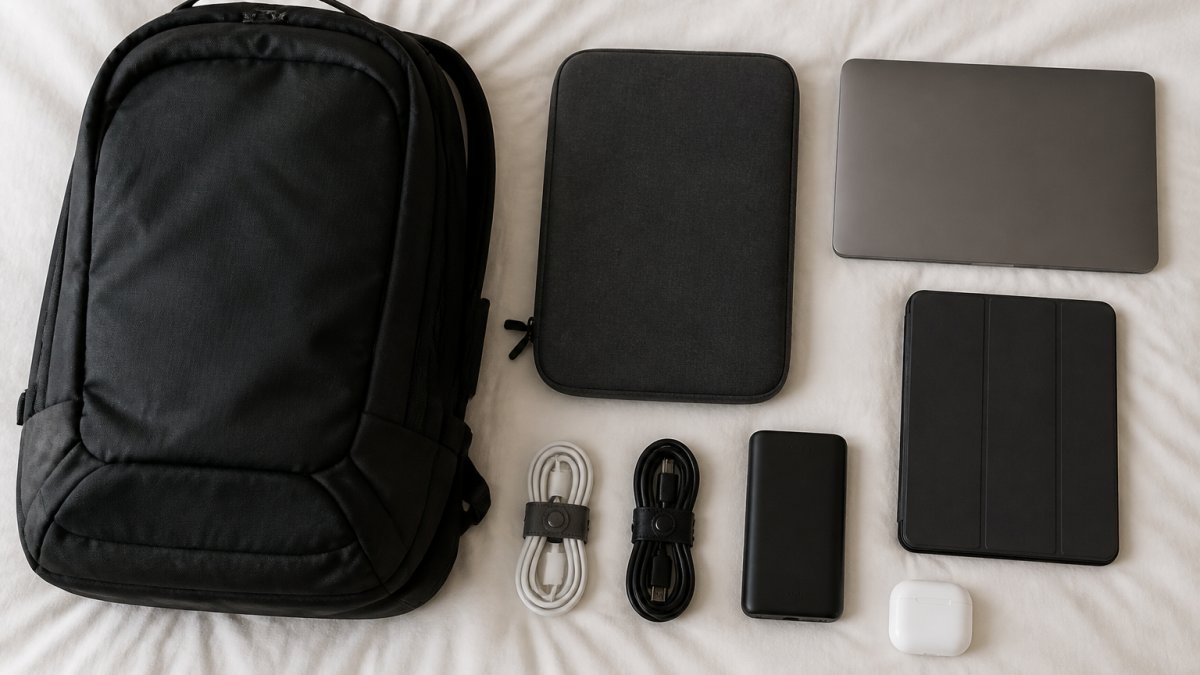
Roll cables rather than folding them; folds create stress points that shorten cable life. Secure each roll with a wrap, then tuck the bundle into a pocket or beside your folded clothes. This uses dead space instead of creating a new block of it.
According to the TSA's guidance on traveling with electronics, larger electronics may need to be removed for screening, so keep devices easy to reach rather than buried at the bottom of a packed organizer.
A Realistic Minimalist Packing List
For a short trip, a genuinely minimal electronics kit looks like this:
- Phone (already on you)
- One charging cable for the phone
- One compact charging brick or power adapter
- A power bank for long days out
- Earbuds in a small case
- Laptop or tablet in a laptop sleeve, only if the trip requires it
- One spare short cable
That is it for most people. Note what is absent: no multi-port hub unless you truly need one, no second charger "just in case," and no oversized case to hold six items.
DIY Travel Tech Organizer Options That Cost Less and Weigh Less
A DIY travel tech organizer often outperforms a bought one for minimalist travel, because you build it around your exact gear. You are not paying for loops you will never fill. The options below are widely available, inexpensive, and light enough that they rarely add more than an ounce or two to your kit.
Repurposed and Low-Cost Options
- Hair ties or elastic bands to wrap coiled cables. A pack of 50 costs a few dollars, each band weighs under 0.1 oz (3 g), and they are replaceable anywhere. They lack the durability of a dedicated cable wrap, but for a minimalist kit they are often sufficient.
- A small drawstring pouch repurposed from other gear (headphones, sunglasses, or a toiletry kit) to hold earbuds and adapters. Weight: typically 0.5-1 oz (14-28 g). Cost: zero if you already own one.
- A slim pencil pouch with one compartment for a few cables and a power bank. Many measure about 8 × 4 in (20 × 10 cm) and weigh 1-2 oz (28-57 g) empty. Cost: often under $5.
- A clear zip bag (the kind used for liquids at security) for items you want visible at screening. Weight: under 0.5 oz (14 g). Cost: pennies. It offers no padding, but it keeps small items together and visible.
- A sunglasses case for a power bank or small charger. Rigid, padded, and often already in your bag. Weight: 2-3 oz (57-85 g). Cost: zero if repurposed.
Each of these costs little, weighs almost nothing, and adapts as your kit changes. The trade-off is protection: soft DIY solutions cushion less than a padded case, so keep genuinely fragile items in a dedicated sleeve rather than a loose pouch.
What You Give Up vs. a Purpose-Built Organizer
DIY solutions trade three things for their low cost and weight:
- Durability. Elastic bands and hair ties stretch and snap; a purpose-built cable wrap with a snap or Velcro closure lasts longer. If you travel frequently, replacing bands every few trips is a minor ongoing cost.
- Structure. A pencil pouch or drawstring bag has no loops or dividers, so items can shift. You may need to dig for a specific cable. A modular wrap system keeps each cable separate.
- Protection. None of these options offer meaningful impact protection. A padded organizer or a laptop sleeve is still the right choice for a tablet, camera, or other fragile item.
A Hybrid Approach That Works for Most Travelers
The strongest minimalist setups often mix DIY and purpose-built elements: use hair ties or elastic bands for cables (cheap, light, replaceable), a repurposed drawstring pouch for earbuds and adapters, and a slim padded sleeve only for the one or two fragile items you carry. This keeps total added weight under 3 oz (85 g) and packed thickness under 1 in (2.5 cm) for a typical kit, while still protecting what needs it.
If you prefer a ready-made solution, look for flat pouches and modular wrap systems rather than full padded organizers, they match the DIY weight and volume while adding durability and a cleaner look.
Slim Alternatives Compared: Protection, Access, and Packed Volume
The right choice depends on what you value most, and the three factors pull against each other. More protection usually means more bulk; easier access usually means more separate pieces to track.
Here is how the trade-offs stack up for a typical minimalist kit:
- Cable wraps: Best access and lowest volume, minimal protection. Ideal when your cables are the main cargo.
- Flat pouch: Good access, low volume, light protection. Best all-rounder for small loose items.
- Modular wrap system: Medium on all three. Best when your kit changes size between trips.
- Laptop sleeve plus wraps: High protection for devices, low volume for cables. Best for work trips.
- Full organizer: Highest protection, highest volume and weight. Reserve it for large or fragile kits.
The honest limitation of every slim option is impact protection. If you check a bag or carry fragile gear, you will want at least one padded element, even in a minimalist setup.
Common Mistakes When Replacing Bulky Tech Organizers
The first mistake is replacing one big organizer with several small ones and ending up heavier overall. Count total volume and weight, not the number of pieces.
The second is over-wrapping. Securing every cable individually with a heavy clip adds bulk fast. Light elastic bands do the same job for less.
A third is forgetting cable management at the destination. A tidy kit still tangles if you dump everything on a hotel desk. Keep one wrap per cable so items stay separated in use, not just in transit.
Finally, do not sacrifice protection for thinness on the wrong items. Cables tolerate loose packing; a tablet does not. Match protection to fragility, item by item.
Conclusion: Choose Less, Carry Smarter
The hardest part of minimalist travel is resisting the urge to organize for every possibility. A kit built around what you actually carry, secured with simple wraps and a slim pouch, will nearly always pack smaller and lighter than a purpose-built case.
If you want compact, reliable audio gear that fits a minimalist kit, Electro Gift Shop curates portable gadgets built for exactly that. Our products pair a nostalgic look with modern function, give you crystal-clear audio quality, and are designed to be light and easy to carry for work, play, or travel.
Frequently Asked Questions
What can I use instead of a bulky tech organizer?
Flat zip pouches, elastic cable wraps, and small pencil pouches handle most minimalist travel tech kit needs without the bulk. A flat pouch holding cables and a power bank can weigh under 100 grams and pack into a laptop sleeve. For lighter trips, skip the pouch entirely and use cable wraps plus a zippered pocket in your backpack. The right choice depends on how much gear you carry and whether you need quick access or just protection.
Are travel cable wraps better than a tech pouch?
Travel cable wraps win on weight and packed volume, while a tech pouch offers better protection and one-place access. Wraps keep each charging cable coiled and tangle-free, so you can grab one without unpacking everything. A pouch adds structure and padding but takes up more space. For one-bag travel, many people combine both: wraps for cables, and a slim flat pouch for a power bank, charging brick, and earbuds.
How do minimalist travelers pack cables and chargers?
Start by cutting down to one charging brick with multiple ports, one power bank, and only the cables you actually use daily. Wrap each cable with an elastic or silicone travel cable wrap and store them in a flat pouch or backpack zippered pocket. Keep the charging brick and power bank in a separate small compartment so you can grab them at security or in a cafe without unpacking your whole bag.
Do I need a separate tech organizer for minimalist travel?
Not always. If your gear fits in a laptop sleeve pocket or a small flat pouch, a separate organizer adds weight and packed volume without much benefit. Skip it when you carry fewer than four items, when your backpack already has dedicated small pockets, or when you need fast access at security. Use one only if your bag lacks compartments or your electronics need extra padding and water resistance.
Choosing less structure takes discipline at first, but the payoff shows up every time you pack. Get started with Electro Gift Shop and build a travel kit that sounds better and carries lighter.