

JBL vs Klipsch Sound Quality: 2026 Comparison Guide
Table of Contents
- JBL vs Klipsch Sound Quality: Core Differences
- Klipsch Horn-Loaded Tweeter Sound Explained
- JBL vs Klipsch for Music vs Movies
- Soundstage, Imaging, and Room Acoustics
- How to Choose High-Fidelity Speakers
- Listening Fatigue: Which Sound Signature Lasts?
- Compact Alternatives for Daily Listening
- Conclusion
- Frequently Asked Questions
Last Updated: September 28, 2026
JBL vs Klipsch Sound Quality: Core Differences
The JBL vs Klipsch sound quality comparison comes down to one core split: Klipsch's horn-loaded tweeters deliver sharper, more forward treble, while JBL's dome tweeters aim for a flatter, more neutral tonal balance. This guide breaks down what that difference actually sounds like in a real room, not just on a spec sheet.
Both brands build speakers that measure well. The gap shows up in how each one shapes the frequency response curve, and how that shape interacts with your amplifier and your room. According to Audio Engineering Society technical resources, horn loading raises sensitivity and changes the dispersion pattern, which is why Klipsch speakers often sound "louder" at the same volume setting.
Below, we'll cover the five things that actually decide which sound you'll prefer: tonal balance, sensitivity, tweeter design, room interaction, and long-term listening fatigue. Most guides skip the last two. Those are usually the ones that matter most after the first week.
Frequency Response and Tonal Balance
Klipsch speakers typically push the upper mid-range and treble forward. That produces a bright, detailed, "live venue" character. JBL speakers usually aim for a smoother mid-range and a gentler treble roll-off, which reads as warmer and more neutral.
Tonal balance is the relative loudness of low, mid, and high frequencies across the audible range. A neutral speaker keeps those three bands close to level. A colored speaker emphasizes one band, and that coloration becomes the speaker's acoustic signature.
- Klipsch: elevated treble, punchy bass, forward vocals
- JBL: flatter response, softer treble, fuller mid-range
- What to listen for: cymbals and "s" sounds. If they sting, the treble is forward.
Neither curve is "correct." It's a preference call, and it's the single biggest factor in whether you enjoy a speaker six months from now.
Sensitivity, Efficiency, and Amplifier Headroom
Sensitivity ratings decide how much amplifier power you need. Klipsch's horn design typically produces higher sensitivity, meaning it reaches the same sound pressure level with fewer watts. JBL's dome-tweeter designs usually need more power for the same output.
Amplifier headroom is the reserve power left when music hits a sudden peak. A high-sensitivity speaker needs less headroom to stay clean. A lower-sensitivity speaker demands a stronger amp or it will compress transients and lose dynamic range.
| Factor | Klipsch (horn-loaded) | JBL (dome tweeter) |
|---|---|---|
| Typical sensitivity | Higher | Moderate |
| Amplifier demand | Low power needed | More power needed |
| Peak power handling | Easier to drive | Needs headroom |
| Best amp match | Low-watt tube or class A/B | Higher-watt solid state |
If you own a small desktop amp, a high-sensitivity speaker is the safer bet. If you already run a capable receiver, either design works.
Klipsch Horn-Loaded Tweeter Sound Explained
A horn-loaded tweeter uses a flared waveguide to amplify and direct high frequencies. The result is higher efficiency, tighter dynamics, and a more directional dispersion pattern than a conventional dome tweeter can produce.
The mechanism matters more than the marketing. A compression driver sits at the throat of the horn and pushes sound through a narrowing passage. The horn's flare controls how that energy spreads into the room. A typical Klipsch horn holds usable output within roughly a 90-degree horizontal window before treble rolls off noticeably off-axis. A JBL dome tweeter, by contrast, often spreads usable high-frequency energy across 120 degrees or more. That single number explains most of the listening differences people describe.
That directionality is the part most buyers miss. Horns focus treble into a narrower beam, so the "sweet spot" is smaller. Sit dead center and the imaging is razor sharp. Move two feet off-axis and the treble drops noticeably. In a wide seating arrangement, the person on the end of the couch hears a duller version of what the center seat hears.
JBL's dome tweeters spread high frequencies wider, which makes off-axis listening more forgiving. In a room where people sit in different seats, that wider dispersion often wins.
Why Amplifier Pairing Changes the Sound
This is the section most comparison guides skip, and it's the one that decides whether a Klipsch speaker sounds exciting or exhausting in your home.
Horn-loaded Klipsch models commonly rate in the 95-98 dB sensitivity range. JBL's dome-tweeter bookshelf and floorstanding models typically land in the 86-90 dB range. Every 3 dB of sensitivity roughly halves the amplifier power needed for the same output. A 96 dB Klipsch speaker needs about one-eighth the wattage of an 87 dB JBL to hit the same volume. That gap is enormous, and it changes which amplifier you should buy.
Here's the practical consequence:
- Low-power tube amps (3-15 W): Horn-loaded Klipsch is the natural match. A 5-watt single-ended tube amp can drive a 96 dB Klipsch to room-filling levels. The same amp on an 87 dB JBL will compress transients and sound thin.
- Mid-power class A/B receivers (50-100 W): Both brands work. Klipsch will reveal any amplifier hiss or noise floor because of its efficiency. JBL will sound clean and unstrained.
- High-power class D or solid-state (100 W+): JBL's lower sensitivity benefits most. The extra headroom keeps dynamics intact on demanding film soundtracks.
A common pattern reported by owners: pairing a bright, high-sensitivity Klipsch speaker with a bright, low-cost class D amp produces fatiguing treble within minutes. The same speaker on a warmer tube or class A/B amp sounds balanced. The speaker didn't change. The amplifier's noise floor and harmonic profile did.
Horns also expose flaws. A bright recording stays bright. That transparency is a feature for some listeners and a dealbreaker for others. The amplifier you pair with the speaker is the single biggest lever you have over whether that transparency reads as detail or as harshness.
JBL vs Klipsch for Music vs Movies
For music, JBL's flatter tonal balance suits long sessions and acoustic material. For movies, Klipsch's dynamic range and forward treble make dialogue and effects cut through a busy soundtrack.
Home theater setup changes the math. Film soundtracks bury dialogue under bass and effects. A speaker with elevated mid-range and treble keeps voices intelligible at lower volumes. Klipsch's acoustic signature fits that job well.
Music listening rewards neutrality. A flat speaker lets the recording's own character come through, and it's less likely to fatigue your ears over a two-hour album. JBL leans that direction.
- Movies first: Klipsch's punch and clarity suit action and dialogue
- Music first: JBL's neutrality suits critical listening
- Mixed use: match the speaker to your room, not the genre
Subwoofer integration matters here too. If you run a sub, the main speaker's bass extension matters less. Focus on mid-range clarity and treble instead.
Soundstage, Imaging, and Room Acoustics
Room acoustics decide more of your final sound than the brand on the box. A speaker with excellent imaging in a treated room can sound muddy in a bare one with hard floors and glass walls. This is the section most JBL vs Klipsch comparisons skip, and it's the one that determines whether either speaker actually sounds good in your home.
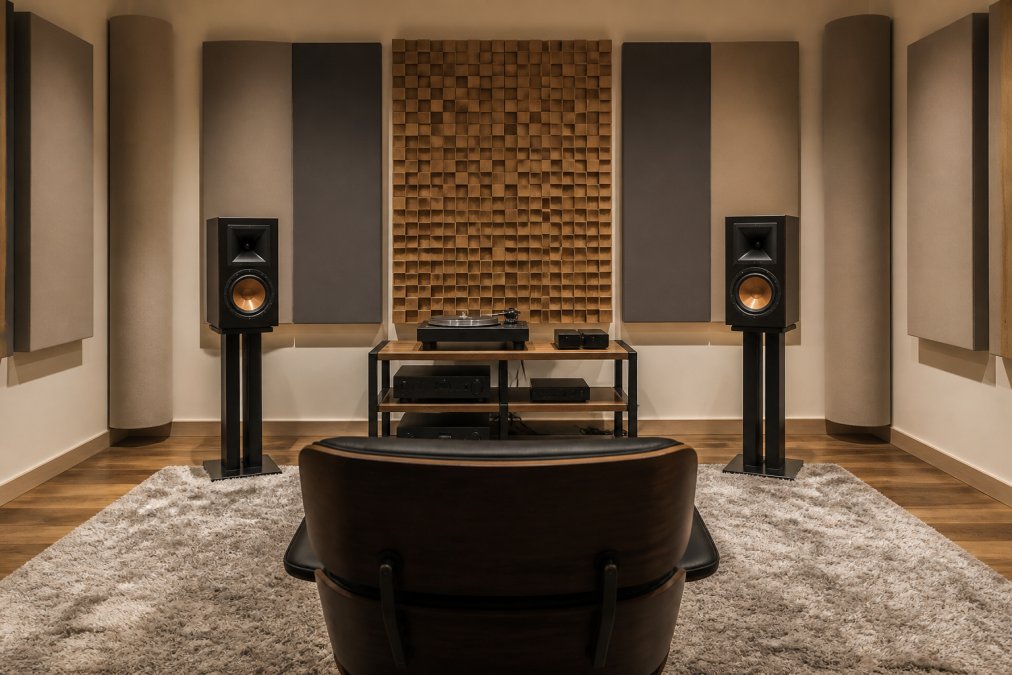
Soundstage is the perceived width and depth of the performance. Imaging is how precisely you can place individual instruments within it. Both depend on speaker placement, distance from walls, and how symmetrical your room is.
How Room Size Changes the Brand Decision
The same speaker behaves differently in a 12 square metre bedroom and a 30 square metre open-plan living room. Here's how to match the brand to the space:
Mini Retro White Noise Bluetooth Speaker →
- Small rooms (under 15 square metres): Horn-loaded Klipsch speakers can overwhelm a small room because their narrow dispersion bounces aggressively off close side walls. JBL's wider dispersion and flatter response usually integrate more smoothly in tight spaces. Bookshelf models from either brand work, but Klipsch demands more careful toe-in.
- Medium rooms (15-25 square metres): Both brands perform well. Klipsch's efficiency lets a modest amplifier fill the space. JBL's neutrality rewards a treated room with a focused listening seat.
- Large rooms (over 25 square metres): Klipsch's higher sensitivity and dynamic headroom have a real advantage here. Filling a large room at reference volume with an 87 dB JBL speaker requires substantially more amplifier power than with a 96 dB Klipsch.
Placement Rules That Actually Matter
- Pull speakers at least 30cm from the rear wall. Klipsch horns benefit from 45-60cm because their rear-firing ports and horn flare interact more with boundary surfaces.
- Keep them equidistant from your listening position. A 10cm difference shifts the center image audibly.
- Toe them in slightly for sharper imaging. Klipsch horns often need 10-15 degrees of toe-in to aim the treble beam at the listening seat. JBL domes tolerate 0-5 degrees.
- Treat the first reflection points on side walls. A single absorption panel at each side-wall reflection point does more for imaging than upgrading the speaker.
- Avoid placing either brand in a corner. Corner loading boosts bass by 3-6 dB and smears the mid-range.
Horn speakers reward precise placement because of their narrower dispersion. Dome speakers tolerate sloppier setups. Neither fixes a bad room on its own.
Pushing speakers into a corner boosts bass but smears the mid-range and collapses the soundstage. If your bass sounds boomy and vocals sound distant, move the speakers out from the wall before you buy anything new.
The Treatment Priority Order
If you can't treat the whole room, treat in this order. It's the same order audio engineers use in studios, and it applies to both brands:
- First reflection points on side walls, biggest impact on imaging.
- Behind the listening position, reduces rear-wall slap that blurs the soundstage.
- Front wall behind the speakers, controls bass buildup, especially important for Klipsch's punchier low end.
- Floor and ceiling, thick rug and a ceiling cloud if the room is tall.
A common pattern: buyers spend more on speakers than on room treatment, then blame the speaker for problems the room created. A 200-dollar absorption panel set often improves perceived sound quality more than a 500-dollar speaker upgrade.
The Unique Angle Most Guides Miss
Neither JBL nor Klipsch publishes room-size recommendations. Neither brand tells you that a 96 dB Klipsch horn in a 10 square metre room with bare walls will sound harsh no matter what amplifier you use. The brand decision is downstream of the room decision. Measure your room, treat the first reflection points, and place the speakers correctly before you decide which sound signature you prefer. The room will tell you which brand fits.
How to Choose High-Fidelity Speakers
Choosing high-fidelity speakers starts with your room size and amplifier, not the brand. Match sensitivity to your amp, match dispersion to your seating layout, and match tonal balance to your listening habits.
Here's a practical decision framework:
- Measure your room. Small rooms under 15 square metres favor bookshelf speakers. Larger rooms need floorstanders or a sub.
- Check your amplifier's wattage. Low-power amps pair better with high-sensitivity speakers.
- Count your listening seats. One seat favors horns. Multiple seats favor wider dispersion.
- Audition with your own music. Bring three tracks you know well: one vocal, one acoustic, one bass-heavy.
- Test fatigue over 30 minutes. Bright speakers reveal themselves after 20 minutes, not two.
A common mistake is buying on a five-minute demo. Treble-heavy speakers impress instantly and tire you out later. Longer sessions tell the truth.
Listening Fatigue: Which Sound Signature Lasts?
Listening fatigue is the ear strain that builds after extended play, and it's the strongest argument for a neutral tonal balance. Forward treble and boosted upper mid-range cause fatigue faster than a flat response.
Fatigue isn't about volume. It's about how hard your ears work to process an aggressive frequency curve. A bright speaker at moderate volume can tire you out faster than a neutral speaker at higher volume.
- Elevated treble and upper mid-range: faster fatigue
- Flat, neutral response: slower fatigue, longer sessions
- Bass-heavy coloration: masks detail but rarely causes strain
If you listen for hours while working, neutrality wins. If you listen in short, focused bursts, a livelier signature keeps things exciting. Be honest about which listener you are.
Compact Alternatives for Daily Listening
Full-size speakers demand space, placement, and a decent amplifier. For commuters, travelers, and desk workers, a compact speaker delivers most of the enjoyment with none of the setup friction.
This is where Electro Gift Shop fits. The Mini Retro White Noise Bluetooth Speaker packs Bluetooth 5.0, AUX input, and TF card playback into a 5.6 x 6 x 2.64 inch body, so it travels as easily as it sits on a bedside table. A 1500mAh battery gives 4-6 hours of playtime, and it recharges fully in 2-3 hours over USB.

The 360-degree surround sound and dedicated white noise mode make it useful beyond music. Built-in nature sounds, including ocean waves and crackling bonfires, help mask background noise. The RGB ambient light rotates with your music, and a screen-off function stops glare at night.
What most reviews miss is that a compact speaker like this solves the placement problem entirely. No toe-in, no stands, no room treatment. It won't match a floorstander's soundstage, and it isn't trying to. For daily listening on a desk, in a gym bag, or on a nightstand, that trade-off is the whole point.
Conclusion
Picking between these two sound signatures is really a question about your room, your amp, and how long you listen at a stretch. Get those three right and the brand decision makes itself.
Electro Gift Shop stocks portable audio gear built for exactly that daily-listening use case. The Mini Retro White Noise Bluetooth Speaker combines Bluetooth 5.0 connectivity, four built-in nature sounds, RGB ambient lighting, and a rechargeable 1500mAh battery in a body small enough to take anywhere. It blends retro looks with modern function.
Shop now with Electro Gift Shop and find a speaker that fits your space, your commute, and your listening habits.
Frequently Asked Questions
What are the primary differences between JBL and Klipsch sound signatures?
JBL speakers often deliver a neutral, balanced sound with controlled bass and smooth treble, making them versatile for many genres. Klipsch uses horn-loaded tweeters that produce higher sensitivity and a more forward, dynamic treble, which can sound exciting for movies but may cause listening fatigue during long music sessions. The choice depends on whether you prefer a relaxed, accurate tonal balance or a lively, detail-forward acoustic signature.
Is Klipsch better for home theater than JBL?
Klipsch's horn-loaded tweeters and high sensitivity make them excellent for home theater, delivering clear dialogue and impactful dynamics at lower amplifier power. JBL also offers strong home theater performance, particularly with their studio monitor heritage, but their sound is generally more neutral. For a dedicated cinema room where raw output and detail matter most, Klipsch often has an edge. For mixed music and movie use, JBL's balanced tuning may suit more listeners.
How does JBL's sound quality compare to Klipsch in subwoofers?
JBL subwoofers tend to prioritize deep low-frequency extension with relatively flat response, integrating smoothly with main speakers for music. Klipsch subwoofers often emphasize output and punch, which works well for action movies but can sometimes overshadow subtle bass textures. Room correction and proper placement matter more than brand here. If you want accurate bass for critical listening, JBL is a strong choice; for maximum impact in a home theater, Klipsch may satisfy more.
How do I choose high-fidelity speakers for my room size and amplifier?
Start by matching speaker sensitivity to your amplifier's power. High-sensitivity designs like Klipsch need fewer watts, while lower-sensitivity JBL models benefit from an amp with ample headroom. Next, consider room size: large rooms need speakers with wide dispersion and strong low-frequency extension, while small rooms can use compact monitors. Finally, audition both brands with your own music. If possible, test at home with a return policy to ensure the tonal balance suits your space and listening habits.
Acoustical Society of America resources on room acoustics
Consumer audio measurement guidance from the Audio Engineering Society