

Retro Aesthetic Bluetooth Speakers Review 2026
Table of Contents
- Why Retro Bluetooth Speakers Are Worth Taking Seriously
- Design and Aesthetic Appeal: Mid-Century Modern Done Right
- Retro Bluetooth Speaker Sound Quality Comparison
- Battery Life, Portability, and USB-C Charging
- Connectivity: Bluetooth Version, Codec Support, and Auxiliary Input
- Ease of Use: Knob Controls, Tactile Feedback, and Setup
- Spotlight: Mini Retro White Noise Bluetooth Speaker
- Price vs. Value: What You Actually Pay Extra For
- How to Choose a Retro Bluetooth Speaker for Your Setup
- Frequently Asked Questions
Last Updated: August 31, 2026
Why Retro Bluetooth Speakers Are Worth Taking Seriously
Retro aesthetic bluetooth speakers have grown from niche to mainstream as buyers reject clinical all-black-plastic design in favor of vintage-inspired audio gear. The honest answer is whether these speakers hold up beyond aesthetics depends heavily on which product you pick. Many sacrifice driver quality for looks; others get audio right but use materials that deteriorate quickly. A few manage both.
Below, we'll break down what separates good from disappointing: acoustic performance, build durability, connectivity specs, and the one product in our catalog that earns genuine recommendation.
The retro bluetooth speaker category is more technically interesting than most assume. Passive radiators, analog-style knob controls, and wooden enclosures aren't merely decorative, they affect how the speaker sounds, ages, and performs over time.

Design and Aesthetic Appeal: Mid-Century Modern Done Right
Mid-century modern audio design is experiencing genuine revival. The aesthetic draws on 1950s and 1960s hi-fi equipment: fabric grilles, rounded enclosures, exposed knob controls, and warm wood tones. Done well, this design integrates naturally into home offices and living rooms where a matte-black cylinder would look out of place.
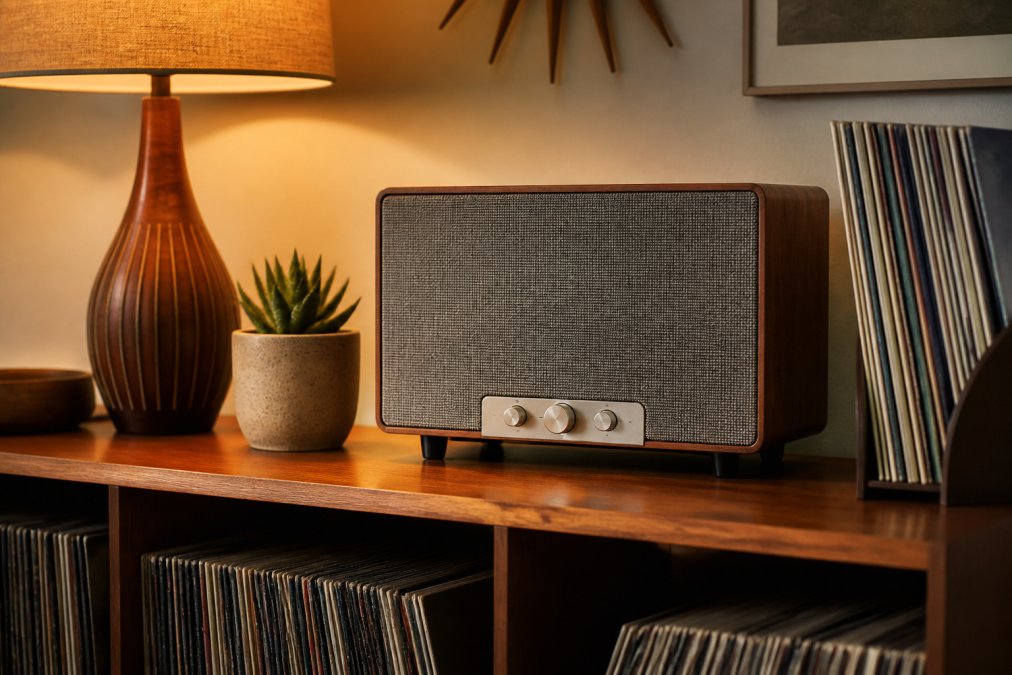
What separates genuine retro design from costume design is proportion and material honesty. The best vintage-inspired speakers carry their aesthetic through every surface: grille weave, control knob finish, enclosure shape. Speakers that bolt fabric onto generic form factors look unconvincing in person. Aesthetic integration matters more than most reviews acknowledge, a speaker that fits the room gets used daily.
Build Materials and Long-Term Durability
Common materials in retro-styled bluetooth speakers are fabric grilles, wood or wood-effect enclosures, and metal hardware. Each ages differently.
Genuine wood enclosures develop character over time; minor scuffs become part of the object. Fabric grilles attract dust, can snag, and fade with UV exposure. Metal knobs hold up well and outlast internal electronics.
Wood-effect finishes on plastic are the weak point in budget retro speakers. They look convincing initially but chip, peel, or yellow over time. For durability, look for genuine wood or MDF enclosures rather than plastic with printed finish.
Build quality varies more than pricing suggests. Check enclosure seam quality, knob resistance, and whether the grille attaches magnetically (more durable) or via clips.
Analog Aesthetic vs. Modern Finish: What Ages Better
The analog aesthetic ages better than modern minimalist finishes because it was designed to look lived-in. Brushed metal, warm wood, and woven fabric don't show micro-scratches the way gloss plastic or powder-coated surfaces do. This is genuinely practical, not just stylistic.
Modern finishes show wear quickly. Fingerprints, edge chips, and scratches are all more visible. For home office or bedroom shelf use where the speaker gets handled regularly, the analog aesthetic holds up better over two to three years.
Retro Bluetooth Speaker Sound Quality Comparison
Sound quality in this category varies significantly. Many vintage-inspired speakers prioritize warm, mid-forward sound signatures that suit vocals and acoustic instruments. That's deliberate tuning, and it works well for specific listening contexts.
For genuine sound quality comparison, examine driver configuration, frequency response range, and how the enclosure contributes to overall sound.
Acoustic Signature Analysis: Frequency Response and Soundstage
Well-designed retro bluetooth speakers typically emphasize the 200Hz-3kHz range, where vocals, guitar, and piano fundamentals live. This produces warm, full-bodied presentation suited to background music and desktop audio.
Frequency response is the range of audio frequencies a speaker reproduces. Most compact retro bluetooth speakers operate across roughly 80Hz-20kHz, with the lower end dependent on passive radiator presence.
Soundstage, the perceived width and depth of audio image, is limited in single-driver mono speakers. Stereo configurations produce noticeably wider soundstage. For desktop use at close range, a mono speaker with well-tuned passive radiator can sound surprisingly spacious.
Driver Configuration, Passive Radiators, and Total Harmonic Distortion
Driver configuration determines how a speaker handles different frequency ranges. A single full-range driver covers the entire spectrum but makes compromises at extremes. A two-way configuration with dedicated tweeter produces more accurate treble and bass.
A passive radiator is an unpowered driver that resonates in response to the active driver's movement. It extends low-frequency response without requiring a powered subwoofer or large enclosure.
Total harmonic distortion measures how much a speaker distorts the original signal. Lower is better. At moderate listening volumes, quality retro bluetooth speakers perform well. Distortion increases at maximum volume, particularly in compact enclosures.
Battery Life, Portability, and USB-C Charging
Battery life is practically important and commonly overstated in product listings. Real-world playback at moderate volume with Bluetooth active is typically shorter than claimed.
USB-C charging has become the standard for quality bluetooth speakers. It supports faster charging, is reversible, and uses the same cable as most modern phones and laptops. Products still shipping with micro-USB are a reliability concern.
Portability in retro-styled speakers involves trade-off. Wooden and metal materials that improve sound and aesthetics also add weight. Most compact retro bluetooth speakers fall in the 400-800g range, manageable for desk-to-desk movement but not ideal for gym bags.
For commuters and travelers, battery capacity matters as much as playback time. According to Battery University's research on lithium-ion cycle life, minimizing full discharge cycles significantly extends battery longevity. Keeping your speaker between 20% and 80% charge extends useful life.
Connectivity: Bluetooth Version, Codec Support, and Auxiliary Input
Bluetooth version affects range, connection stability, and pairing reliability. Bluetooth 5.0 and above offers meaningfully better range and more stable connections than earlier versions.
Codec support determines audio quality over wireless connection. SBC is universal but compresses more aggressively. AAC performs better on Apple devices. aptX and aptX HD deliver near-lossless audio on compatible Android devices. For high-fidelity listening, codec support matters. For white noise or background music, SBC is adequate.
Latency matters for video playback. Standard SBC introduces noticeable audio-video sync issues. aptX Low Latency addresses this.
An auxiliary input lets you connect non-Bluetooth sources directly. This is useful for turntables, older devices, and unreliable wireless situations.
Smart Home Ecosystem Integration and Multi-Room Audio
Smart home ecosystem integration varies considerably. Some products support Wi-Fi alongside Bluetooth, enabling multi-room audio. Others are Bluetooth-only, limiting them to single-room use within range.
Wi-Fi connectivity enables more stable multi-room audio than Bluetooth-based solutions. The trade-off is complexity: Wi-Fi speakers require network configuration and typically rely on a companion app.
For smart home integration, look for compatibility with major voice assistant platforms if that matters. According to the Wi-Fi Alliance's guidance on wireless audio standards, Wi-Fi 6 connectivity significantly reduces latency compared to earlier generations, making multi-room synchronization more reliable.
Ease of Use: Knob Controls, Tactile Feedback, and Setup
Knob controls are a defining feature of retro bluetooth speakers and genuinely better than touch-sensitive panels for most users. Physical knobs provide tactile feedback: you can adjust volume without looking, and control position gives visual reference for current setting.
Knob quality varies dramatically. Well-machined aluminum knobs with appropriate resistance feel satisfying and precise. Lightweight plastic knobs that spin too freely feel cheap and make fine adjustments difficult. If possible, handle the product before buying or read reviews addressing control feel.
Setup for Bluetooth-only retro speakers is straightforward: power on, enter pairing mode, select from your device's Bluetooth menu. Most speakers with Bluetooth 5.0 or above pair within seconds and reconnect automatically. Wi-Fi speakers require more setup but typically provide guided process through a companion app.
Spotlight: Mini Retro White Noise Bluetooth Speaker
The Mini Retro White Noise Bluetooth Speaker from Electro Gift Shop targets a specific use case most retro speakers ignore: sleep, focus, and ambient sound alongside standard music playback.
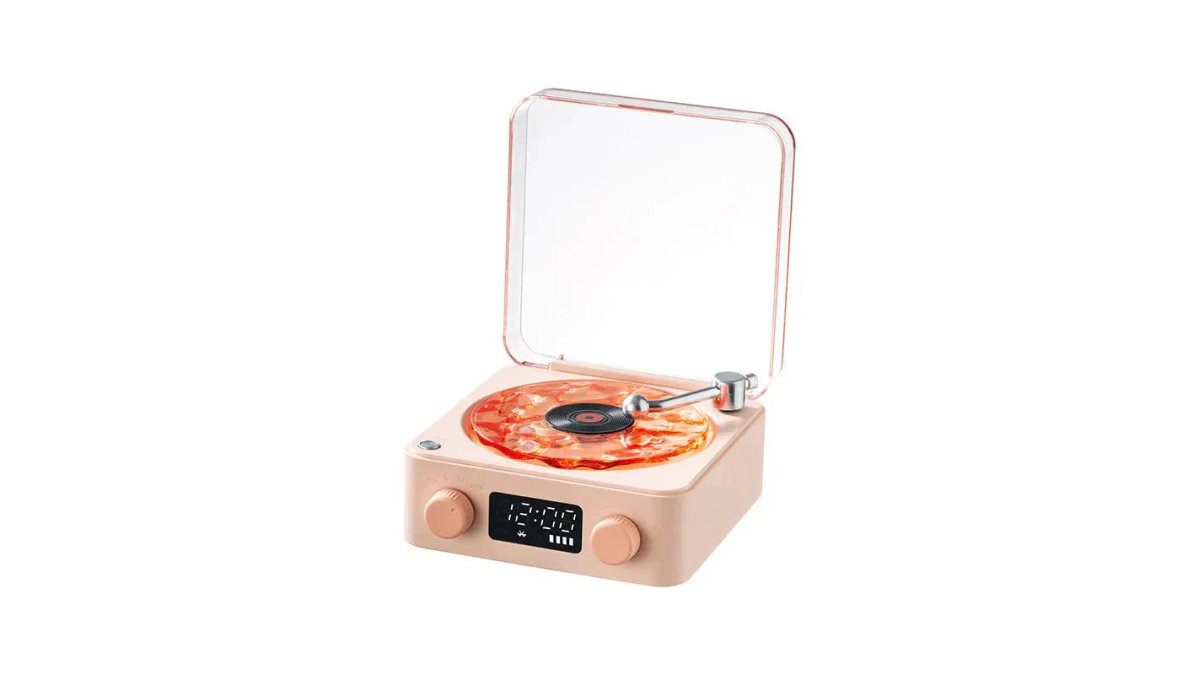
At £37.99, it sits at the accessible end of the retro speaker market. The design combines vintage-inspired form with RGB ambient lighting, which contributes to ambient atmosphere for sleep or relaxation and makes the speaker visually distinctive on a desk or nightstand.
Built-in nature sounds set this product apart from standard retro bluetooth speakers. Rather than requiring a phone or streaming app to play white noise, the speaker handles it natively. For users wanting to reduce screen time before bed or simplify sleep routine, this is a practical advantage.
Wireless streaming via Bluetooth handles standard music and podcast playback. The portable, lightweight design makes it easy to move between rooms. Customer Emily R. described it simply: "This product is worth every penny." Daniel M. noted he was "amazed by the quality and performance."
For anyone looking for a retro aesthetic bluetooth speaker that does more than play music, this is the product to start with. Shop the Mini Retro White Noise Bluetooth Speaker directly through Electro Gift Shop.
Price vs. Value: What You Actually Pay Extra For
Why retro aesthetic bluetooth speakers cost more than generic alternatives comes down to three things: materials, acoustic engineering, and design intent. Fabric grilles and wooden enclosures cost more to produce than injection-molded plastic. Well-tuned passive radiators add manufacturing complexity. Designing a product that looks genuinely good from every angle requires more development investment.
What you're not necessarily paying extra for is wireless range or Bluetooth chipset quality. Those components are largely commoditized.
| Feature | Retro-Styled Speaker | Generic Bluetooth Speaker |
|---|---|---|
| Enclosure material | Wood, MDF, or fabric | Plastic |
| Control type | Physical knobs | Touch panels or buttons |
| Acoustic tuning | Passive radiator common | Basic full-range driver |
| Aesthetic integration | High | Low |
| Repairability | Often better | Often sealed |
| USB-C charging | Increasingly standard | Mixed |
The value question depends on how you weight aesthetics against raw audio performance per pound spent. If you want the loudest speaker for the money, generic alternatives win. If you want something that sounds good, looks good on your shelf, and still works in five years, the premium for quality retro design is justified. According to the Consumer Electronics Association's guidance on audio product longevity, build material quality is one of the strongest predictors of long-term product satisfaction.
How to Choose a Retro Bluetooth Speaker for Your Setup
Choosing the right retro bluetooth speaker starts with being honest about your primary use case.
| Use Case | Priority Specs | What to Look For |
|---|---|---|
| Desktop audio / home office | Sound quality, aesthetics | Driver config, passive radiator, knob controls |
| Sleep and focus | White noise, ambient light | Built-in sound modes, RGB, battery life |
| Travel and commuting | Portability, battery | Weight, USB-C, battery capacity |
| Multi-room home audio | Connectivity | Wi-Fi support, ecosystem compatibility |
| Gift purchase | Design, ease of use | Visual appeal, simple setup, price |
The mistake most buyers make is optimizing for specs they won't use. A speaker with aptX HD codec support is wasted if your source device doesn't support aptX. Multi-room audio is irrelevant if you only use the speaker in one room.
For most buyers, the Mini Retro White Noise Bluetooth Speaker covers the most common use cases: ambient listening, sleep support, desk audio, and aesthetic integration, all at an accessible price point.
Repairability and Parts Availability
Repairability is the most overlooked factor in speaker purchasing decisions, and retro-styled speakers have genuine advantage over sealed modern designs. Many vintage-inspired speakers use screwed enclosures rather than glued construction. This means a failed driver or damaged port can often be replaced rather than requiring full product replacement.
Parts availability varies by manufacturer. Before purchasing a higher-end retro bluetooth speaker, check whether the manufacturer offers replacement parts or repair services.
Choosing a retro aesthetic bluetooth speaker that genuinely performs is harder than it looks. The market is full of products that nail the visual but cut corners on audio engineering, build quality, or durability. Electro Gift Shop's Mini Retro White Noise Bluetooth Speaker stands out because it addresses a specific gap: combining vintage-inspired design with practical multi-function features including built-in nature sounds and RGB ambient lighting, at an accessible price. Shop the Mini Retro White Noise Bluetooth Speaker and find a speaker that earns its place on your desk.
Frequently Asked Questions
Q: Do retro aesthetic speakers sacrifice sound quality for design?
A: Not necessarily. The best retro bluetooth speakers pair vintage-inspired form factors with modern driver configurations, passive radiators, and tuned frequency response curves. What you should watch for are total harmonic distortion figures and signal-to-noise ratio specs, which reveal whether audio fidelity was compromised for looks. A speaker can deliver room-filling sound and genuine high-fidelity performance while still sporting an analog aesthetic. The Mini Retro White Noise Bluetooth Speaker is a good example of this balance.
Q: What features should I look for in a vintage-style Bluetooth speaker?
A: Focus on codec support (look for AAC or aptX for lower latency and better wireless streaming quality), battery capacity relative to playback time, and whether the chassis uses durable materials that age well. Knob controls and tactile feedback matter more than touchscreen panels for an authentic analog aesthetic. USB-C charging, an auxiliary input for wired fallback, and stable Bluetooth pairing are practical must-haves. If desktop audio is your priority, check the driver configuration and whether a passive radiator is included for fuller bass.
Q: Are retro Bluetooth speakers compatible with modern smartphones?
A: Yes. Current vintage-inspired Bluetooth speakers use Bluetooth 5.0 or later, which pairs reliably with any modern Android or iOS device. Most also include an auxiliary input for devices without Bluetooth. Pairing stability is generally strong at typical room distances. The main variable is codec support: if your phone and speaker both support AAC or aptX, you get noticeably lower latency and improved audio fidelity compared to standard SBC streaming.
Q: How do I choose the best aesthetic speaker for my home decor?
A: Start with form factor: a compact desktop audio speaker suits a home office or bedside table, while a larger portable audio unit works better in living spaces. Match the build materials to your existing furniture; wood and fabric grilles complement warm, mid-century modern interiors, while metal durable chassis options suit industrial or minimalist setups. Then confirm the sound specs meet your listening habits. Treble and bass adjustment, whether physical or digital, gives you control over the acoustic signature without needing a separate equaliser.
This article was written using GrandRanker