

Bluetooth and Speakers: Best Portable Picks for 2026
Table of Contents
- Quick Comparison: Top Bluetooth Speakers for 2026
- How We Evaluated These Bluetooth Speakers
- 1. Mini Retro White Noise Bluetooth Speaker: Best for Sleep and Ambiance
- 2. Bluetooth Sleep Headband: Best for Active Lifestyles and Overnight Listening
- 3. Salange P300 Mini Portable Projector: Best for Home Theater Integration
- Bluetooth vs WiFi Speakers: Which Connection Is Right for You?
- Bluetooth Speaker Battery Life Comparison: What to Expect
- Latency and Gaming Performance: What Most Reviews Skip
- Long-Term Battery Degradation: How to Make Your Speaker Last
- Which Bluetooth Speaker Should You Pick?
- Frequently Asked Questions
Last Updated: October 1, 2026
Quick Comparison: Top Bluetooth Speakers for 2026
Shopping for bluetooth and speakers in 2026 means sorting through hundreds of near-identical listings, so we've focused on the practical details that actually matter: battery life, pairing stability, and how the sound performs with daily use. This guide from Electro Gift Shop covers three picks that solve three different problems, plus the technical context most product pages skip.
Here's the short version. If you want a bedside companion that doubles as a sleep aid, the Mini Retro White Noise Bluetooth Speaker is the one. If you need audio that stays put during workouts or overnight, the Bluetooth Sleep Headband wins. And if you want to turn a wall into a screen, the Salange P300 Mini Portable Projector handles the home theater job.

| Product | Price | Best For | Battery | Connectivity |
|---|---|---|---|---|
| Mini Retro White Noise Speaker | $37.99 | Sleep, ambiance, bedside use | 4-6 hours | Bluetooth 5.0, AUX, TF card |
| Bluetooth Sleep Headband | $8.99 | Workouts, overnight listening | 10 hours | Bluetooth 5.0 |
| Salange P300 Projector | $80.99 | Home theater, movie nights | Mains powered | Bluetooth 5.1, Wi-Fi, HDMI |
Below, we'll break down the specs, the trade-offs, and the technical questions that determine whether a speaker sounds good in your living room or falls apart on a hiking trail.
How We Evaluated These Bluetooth Speakers
We evaluated each device on several criteria: real-world battery performance, connection stability at range, audio fidelity across genres, build quality for outdoor use, and how easy the controls are. Price was considered in relation to the value offered.
A common mistake is buying on driver size alone.
1. Mini Retro White Noise Bluetooth Speaker: Best for Sleep and Ambiance
The Mini Retro White Noise Bluetooth Speaker is a compact bedside speaker that combines Bluetooth 5.0 streaming with four built-in nature sounds and RGB ambient lighting. It's the pick for anyone who wants one device to handle music, white noise, and a bit of atmosphere.
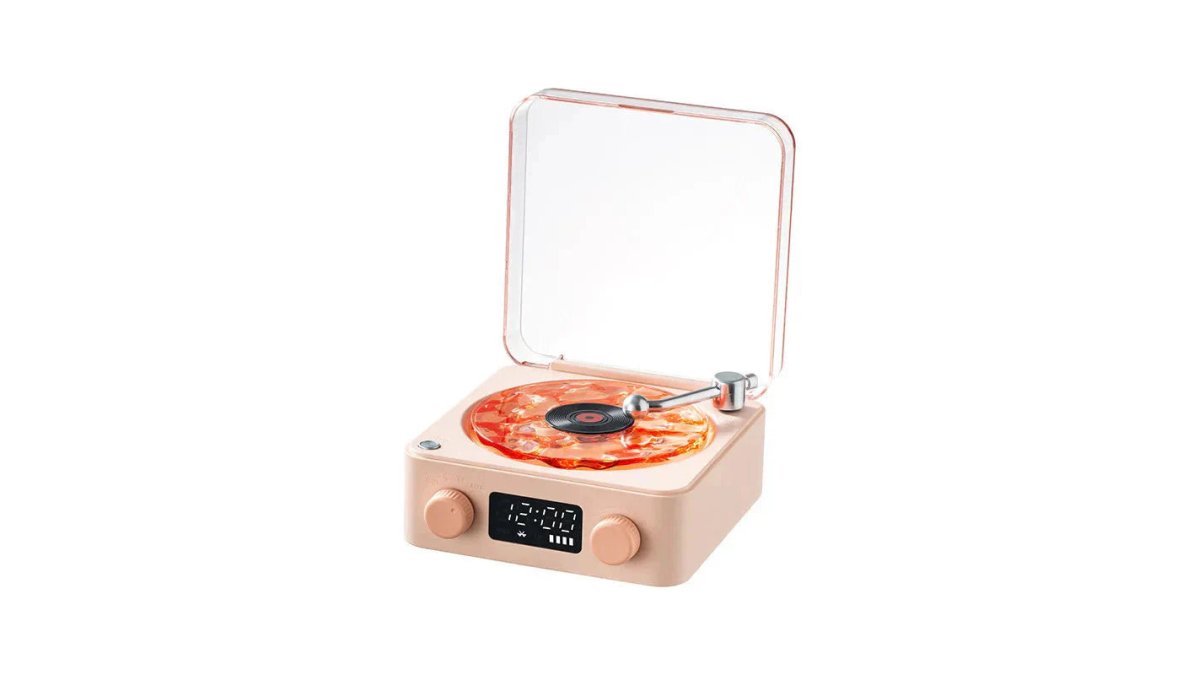
Key Specs and Performance
- Bluetooth version: 5.0, with a 10-meter connection range
- Battery: 1500mAh, giving 4-6 hours of playback
- Charging: 2-3 hours via USB
- Playback options: Bluetooth, AUX input, TF card, dedicated white noise mode
- Nature sounds: ocean waves, crackling bonfire, insects and birds, flowing stream
The four nature sounds are the standout. Instead of streaming a white noise track from your phone, you press a knob and the speaker plays it locally, which means your phone stays off the Bluetooth connection and the battery stretches further.
Pros and Cons
Pros:
- Built-in nature sounds work without a phone
- RGB lighting with a screen-off mode for sleep
- Multiple playback options including AUX and TF card
- Compact enough for a bedside table or a camping trip
Cons:
- 4-6 hours is suitable for many uses, but consider your needs for all-night playback at volume
- The output suits a bedroom environment.
2. Bluetooth Sleep Headband: Best for Active Lifestyles and Overnight Listening
The Bluetooth Sleep Headband is a fabric headband with ultra-thin HD stereo speakers sewn into the material, designed for side sleepers, gym sessions, and travel. At $8.99, it's the cheapest way to get comfortable, wire-free audio that doesn't press into your ears.

Key Specs and Performance
- Bluetooth version: 5.0 with stable pairing to phones and tablets
- Battery: up to 10 hours of continuous playtime
- Charging: USB cable included
- Controls: on-headband volume, track skip, and call handling
- Design: stretchy, breathable, sweat-wicking fabric
Side sleepers get the biggest win here. Traditional earbuds create pressure points against a pillow; the flat speakers in this headband don't. These are ultra-thin drivers tuned for podcasts, white noise, and casual listening.
Pros and Cons
Pros:
- 10-hour battery covers overnight use
- Comfortable for side sleepers and extended wear
- Doubles as a workout headband and travel eye mask
- Very low price point
Cons:
- Audio fidelity is tuned for speech and ambient sound.
3. Salange P300 Mini Portable Projector: Best for Home Theater Integration
The Salange P300 is a mini projector with native 720P resolution, support for up to 8K video decoding, Android 11, and Bluetooth 5.1. It's the option for turning a blank wall into a cinema screen, and it pairs directly with Bluetooth speakers for audio.

Key Specs and Performance
- Resolution: native 720P, decodes 1080P up to 8K
- Brightness: 200 ANSI lumens
- Processor: Quad-core ARM Cortex-A53 CPU with Mali-G31 GPU
- OS: Android 11 with dual-band Wi-Fi
- Connectivity: Bluetooth 5.1, HDMI 2.0, USB 2.0, 3.5mm audio out
- Screen size: 40 to 130 inches with auto keystone correction
The Bluetooth 5.1 connection is the detail that matters for audio. You can route sound to a dedicated speaker instead of relying on the projector's built-in output, which transforms the experience from "watchable" to genuinely cinematic.
Pros and Cons
Pros:
- Native 720P with 8K decoding support
- Android 11 runs streaming apps without extra hardware
- Bluetooth 5.1 pairs with external speakers and headphones
- Adjustable 40-130 inch screen with auto keystone
Cons:
- 200 ANSI lumens needs a darkened room
- Mains powered, so not truly portable for outdoor use
- Built-in audio is functional.
Bluetooth vs WiFi Speakers: Which Connection Is Right for You?
Bluetooth is the better choice for portable, battery-powered audio, while Wi-Fi suits fixed home setups where sound quality and multi-room control matter more than mobility. The connection type changes what the speaker can do, not just how it connects.
| Factor | Bluetooth | Wi-Fi |
|---|---|---|
| Setup | Pair and play in seconds | Requires network login |
| Range | Around 10 meters | Whole home via network |
| Audio bandwidth | Limited by codec | Higher, supports lossless |
| Battery use | Portable, rechargeable | Usually mains powered |
| Multi-room | Stereo pairing only | Full multi-room grouping |
| Best for | Travel, outdoors, commuting | Home theater, whole-home audio |
Bluetooth Speaker Battery Life Comparison: What to Expect
Battery life is the spec buyers check first and trust least, because the number on the box rarely matches the number you get. The range for portable Bluetooth speakers varies, and the gap between rated and real-world performance can differ depending on how you listen.
Mini Retro White Noise Bluetooth Speaker →
Our three picks span that range deliberately:
| Device | Rated Battery | Realistic Use Case | What Drains It Fastest |
|---|---|---|---|
| Mini Retro White Noise Speaker | 4-6 hours (1500mAh) | Bedside white noise, one evening of music | RGB lighting modes, max volume |
| Bluetooth Sleep Headband | Up to 10 hours | Full night of sleep audio, ~1 week of workouts | High volume, weak signal at range |
| Salange P300 Projector | Mains powered | Movie nights, streaming sessions | N/A, tethered to outlet |
Why Rated Battery Life Is Almost Always Optimistic
Manufacturers often measure playtime at specific conditions. Changing variables like volume, lighting, or signal strength can affect the actual playtime:
- Volume. Running a speaker at maximum volume can significantly reduce playtime versus mid-volume listening.
- Lighting and effects. The retro speaker's RGB modes pull power that would otherwise go to audio. Turning the light off can add an hour or more of playback.
- Connection quality. A weak Bluetooth link forces the radio to retransmit packets, which is measurable drain over a long session. Keeping the source device within a few meters matters more than most people realize.
- Temperature. Cold weather can temporarily reduce lithium-ion capacity.
- Standby drain. Speakers that stay paired but idle still consume power. Turning them off between sessions preserves charge.
Matching Battery Spec to Actual Use
The right battery size depends entirely on the scenario, not the biggest number:
- Bedside sleep audio (6-8 hours): You need a speaker that survives a full night. The 4-6 hour retro speaker works for a wind-down session but not all-night playback at volume; the 10-hour headband is the safer pick.
- Workouts (1-2 hours, several times a week): A 10-hour rating covers roughly a week between charges. This is where the headband's battery is genuinely overkill in a good way.
- Outdoor day trips (6-10 hours): Look for a speaker rated at 12+ hours so real-world drain still leaves margin.
- Home theater (mains power): Battery is irrelevant. The Salange P300 trades portability for brightness and processing power, which is the right trade for a fixed setup.
Charging Speed and Connector Reality
Battery capacity is only half the story, recharge time decides how often a speaker sits useless on a cable:
- 1500mAh cells like the retro speaker's typically recharge in 2-3 hours via USB. That's a reasonable overnight top-up.
- Headband-class batteries (roughly 200-300mAh in most fabric designs) charge in 1-2 hours, but the trade-off is the smaller cell that produces the 10-hour rating only at low volume.
- USB-C vs Micro-USB is worth checking before buying. USB-C is now common on many speakers and charges faster, but some models still ship with Micro-USB.
How Battery Life Degrades Over Time
A speaker rated at 10 hours when new will not deliver 10 hours in year three. Lithium-ion cells lose capacity with every full cycle, and the loss accelerates with heat and high-voltage storage. Most portable speakers experience some capacity loss over time, typically after many full charge cycles.
Latency and Gaming Performance: What Most Reviews Skip
Latency is the delay between a video frame appearing and its matching audio playing, measured in milliseconds (ms). It is the spec that decides whether a Bluetooth speaker works for gaming, video editing, or watching a movie, and it is the spec almost every retail listing buries or omits entirely. This section is the one most competitors skip, so it gets the deepest treatment here.
What Counts as "Good" Latency
While there's no universal threshold, practical ranges are often considered in audio engineering:
- Under 40ms: Imperceptible to most people. Lip-sync looks correct, and rhythm-game timing feels natural.
- 40-100ms: Noticeable on close inspection. Fine for music and podcasts; slightly off for fast-paced gaming or dialogue-heavy video.
- 100-200ms: Clearly visible lip-sync drift. Tolerable for casual viewing, frustrating for competitive play.
- Over 200ms: Unusable for anything timing-sensitive. This is where standard SBC Bluetooth audio often lands.
Why Bluetooth Adds Latency
Bluetooth audio is not a direct wire. The signal travels through a chain: your phone encodes the audio, transmits it over radio, the speaker receives and decodes it, then the amplifier drives the driver. Each step adds delay. The codec, the algorithm that compresses and decompresses the audio, is a significant variable.
| Codec | Typical Latency | Notes |
|---|---|---|
| SBC | 150-250ms | Mandatory baseline codec; worst latency |
| AAC | 120-200ms | Better on Apple devices; still high for gaming |
| aptX | 70-130ms | Qualcomm codec; requires both ends to support it |
| aptX Low Latency | 40-70ms | Designed specifically for video sync |
| aptX Adaptive | 50-80ms (variable) | Balances quality and latency dynamically |
| LDAC | 150-200ms | High-quality audio, poor for timing |
| LC3 (LE Audio) | 20-30ms | Newest standard; lowest latency of the group |
How Our Picks Handle Latency
None of the three devices in this guide is marketed as a gaming speaker, and that is worth stating plainly:
- Mini Retro White Noise Speaker (Bluetooth 5.0): Bluetooth 5.0 does not guarantee a low-latency codec. For white noise and casual music, latency is irrelevant. For video, expect visible lip-sync drift unless your phone applies its own correction.
- Bluetooth Sleep Headband (Bluetooth 5.0): Same situation. The use case, sleep audio and podcasts, has no timing dependency, so latency is a non-issue by design.
- Salange P300 Projector (Bluetooth 5.1): This is the one device where latency actually matters, because you are routing movie audio to an external speaker. Bluetooth 5.1 itself does not reduce latency, but the projector's Android 11 OS and most streaming apps include audio-delay compensation settings that let you nudge sync manually. If you pair a speaker with the projector, check the app's A/V sync menu before assuming the lag is unfixable.
Practical Workarounds for Gamers
If timing matters, Bluetooth is a convenience, not a performance tool. The realistic options:
- Use a wired connection. The 3.5mm audio-out on the Salange P300, or an AUX input on a speaker, eliminates Bluetooth latency entirely. This is the only guaranteed fix.
- Match codecs on both ends. Confirm your phone and speaker both support aptX Low Latency or LC3 before buying. Many budget speakers do not.
- Use a dedicated low-latency transmitter. Dongles that pair with a speaker using aptX LL can reduce latency, which can be acceptable for many casual gaming scenarios.
- Enable game mode on your TV or console. Many TVs apply their own audio delay compensation that masks Bluetooth lag for video content.
- Accept the trade-off for casual use. For turn-based games, board game apps, or background music, latency is invisible. It only becomes a problem in shooters, rhythm games, and live-sync video.
The Bottom Line on Latency
For the three devices in this guide, latency is a non-issue for their intended jobs, sleep, workouts, and home theater with manual sync adjustment. It becomes the deciding factor only if you are buying a speaker specifically for competitive gaming or frame-accurate video work. In that case, budget for a wired connection or a speaker that explicitly supports aptX Low Latency or LE Audio's LC3 codec, and treat standard Bluetooth as a fallback rather than a primary audio path.
Long-Term Battery Degradation: How to Make Your Speaker Last
Rechargeable batteries lose capacity over time. Repeated full discharges and constant 100% charging can accelerate wear.
- Avoid full discharges. Charge at around 20-30% rather than waiting for the speaker to die.
- Don't leave it plugged in permanently. Once charged, unplug it. Trickle charging at full capacity stresses the cells.
- Store at partial charge. If you're putting a speaker away for months, leave it around half charged rather than empty or full.
- Keep it cool. Heat is the biggest enemy of battery longevity, so don't leave a speaker on a dashboard or in direct sun.
- Match charging to the spec. Use the cable and charger type the manufacturer specifies rather than a higher-wattage brick.
Which Bluetooth Speaker Should You Pick?
Pick the Mini Retro White Noise Bluetooth Speaker if you want a bedside device that handles music, white noise, and ambiance in one compact unit. Its built-in nature sounds and RGB lighting make it the most versatile option for home use, and at $37.99 it covers sleep, relaxation, and casual listening.
Frequently Asked Questions
Which is the best Bluetooth speaker to buy?
The best Bluetooth speaker depends on your primary use case. For sleep and ambiance, the Mini Retro White Noise Bluetooth Speaker at $37.99 offers built-in nature sounds and RGB lighting. For workouts and overnight listening, the Bluetooth Sleep Headband at $8.99 provides 10 hours of playtime and sweat-wicking fabric. For home theater, the Salange P300 Mini Portable Projector at $80.99 supports Bluetooth 5.1 for connecting to external speakers. Match the speaker to your daily routine rather than chasing a single best model.
Is there a difference between Bluetooth and wireless speakers?
Yes. Bluetooth speakers connect directly to your phone or tablet over a short-range radio signal, usually within 10 meters. WiFi speakers connect to your home network and can stream from internet services, support multi-room audio, and handle higher-bandwidth audio. Bluetooth is simpler and more portable; WiFi is better for fixed home setups. Some devices, like the Salange P300 projector, support both WiFi and Bluetooth 5.1, giving you flexibility.
How do I choose a Bluetooth speaker with good battery life?
Check the milliampere-hour (mAh) rating and the manufacturer's quoted playtime. The Mini Retro White Noise Bluetooth Speaker has a 1500mAh battery rated for 4-6 hours, while the Bluetooth Sleep Headband delivers up to 10 hours. For daily commutes, 4-6 hours is usually enough. For overnight use or long travel days, aim for 10 hours or more. Also factor in charging time: the Mini Retro recharges in 2-3 hours via USB.
Are waterproof Bluetooth speakers worth the investment?
If you plan to use your speaker outdoors, near water, or during workouts, water resistance is worth paying for. Look for an IP rating, which tells you how well the device handles dust and moisture. The Bluetooth Sleep Headband uses sweat-wicking fabric, making it suitable for gym sessions. For poolside or beach use, check the product listing for a specific IP rating before buying, since not all portable speakers are designed for water exposure.
What are the disadvantages of Bluetooth speakers?
Bluetooth speakers have three main drawbacks. First, battery life is finite; the Mini Retro White Noise Bluetooth Speaker runs 4-6 hours per charge. Second, Bluetooth has higher latency than wired connections, which can cause audio lag in gaming or video. Third, signal range is limited to around 10 meters and can drop through walls. WiFi speakers avoid the range issue but cost more and are less portable.
Choosing the right audio gear comes down to matching specs to your daily routine, and that's harder than it should be when every listing looks the same. Electro Gift Shop builds its catalog around exactly this problem, offering portable, stylish devices with crystal-clear audio quality, multifunctional designs for work, play, and travel, and reliable performance you can count on. Explore the collection and find the gadget that fits how you actually listen.