

Buy High Fidelity Portable Bluetooth Speakers: 2026 Guide
Table of Contents
- What Separates High Fidelity Portable Speakers From Basic Bluetooth Models
- Bluetooth Speaker Sound Quality Comparison: What the Specs Actually Tell You
- How to Test Bluetooth Speaker Fidelity Before and After You Buy
- Is an Audiophile Portable Bluetooth Speaker Realistic? Codecs and Latency
- Battery Longevity, IP Ratings, and What Breaks First on the Road
- Acoustic Environment Testing: Why the Same Speaker Sounds Different in Every Room
- Repairability, Firmware Updates, and Sustainability in Portable Audio
- A Practical Pick: The Mini Retro White Noise Bluetooth Speaker
- Conclusion
- Frequently Asked Questions
Last Updated: September 26, 2026
What Separates High Fidelity Portable Speakers From Basic Bluetooth Models
The difference between a high fidelity portable Bluetooth speaker and a basic model comes down to three measured specs: frequency response, total harmonic distortion (THD), and signal-to-noise ratio. A basic speaker might reproduce 100 Hz to 15 kHz with audible distortion; a high fidelity portable unit covers a wider range with minimal added noise.

Those numbers matter because they predict what you'll actually hear. Frequency response tells you which notes the speaker can produce. THD measures how much the speaker distorts those notes. Signal-to-noise ratio describes how much background hiss sits under quiet passages.
This guide breaks down what each number means, how to test a speaker yourself, and which trade-offs are worth your money in 2026.
Bluetooth SIG core specification overview
Frequency Response, THD, and Signal-to-Noise Ratio Explained Simply
Frequency response is the range of pitches a speaker can reproduce, measured in hertz. Human hearing spans roughly 20 Hz to 20 kHz, but portable speakers rarely cover that full span. A spec like "60 Hz to 20 kHz" means the speaker handles most music but rolls off the deepest bass.
Total harmonic distortion measures unwanted extra tones the speaker adds to the original signal. Lower is better. Below 1% THD is generally clean at moderate volumes.
Signal-to-noise ratio compares the music signal to the background noise floor. Higher numbers mean quieter gaps between notes.
A common mistake is treating one spec as decisive. A speaker with wide frequency response but high distortion will sound worse than a narrower, cleaner unit.
Driver Configuration and Passive Radiators: Why They Matter for Bass Punch
Driver configuration describes the size and number of speaker cones inside the enclosure. A single full-range driver handles all frequencies; a two-way setup splits work between a woofer and tweeter, which usually improves mid-range clarity and treble detail.
Passive radiators are unpowered cones that move with air pressure inside the cabinet. They reinforce low frequencies without drawing extra power, which is why small portable speakers can still deliver noticeable bass punch.
Bluetooth Speaker Sound Quality Comparison: What the Specs Actually Tell You
Spec sheets only tell part of the story. Two speakers with identical frequency response figures can sound completely different because of enclosure design, driver materials, and firmware tuning. Here's how the main spec categories translate into real listening differences.
| Spec / Feature | What It Affects | What to Look For |
|---|---|---|
| Frequency response | Bass depth, treble extension | 60 Hz-20 kHz or wider |
| THD | Cleanliness at high volume | Under 1% |
| Driver configuration | Mid-range clarity, soundstage | Two-way for detail |
| Passive radiator | Bass punch | Present in compact units |
| Bluetooth codec | Wireless streaming quality | AAC, aptX, or LDAC |
| IP rating | Water and dust resistance | IPX5 or higher for travel |
| Battery capacity | Playtime per charge | Matches your longest session |
Soundstage, Mid-Range Clarity, and Treble Detail Across Price Tiers
Soundstage describes how wide and layered the music feels, as if instruments sit in different positions rather than stacked in one spot. Mid-range clarity determines whether vocals and acoustic instruments sound natural or boxy. Treble detail controls how much sparkle and air you hear on cymbals and strings.
Budget speakers tend to compress the soundstage and push the mid-range forward. Mid-tier units widen the image and smooth the treble. Higher-priced portable speakers often add stereo pairing, which lets two units create genuine left-right separation.
How to Test Bluetooth Speaker Fidelity Before and After You Buy
Testing speaker fidelity is straightforward if you use the right tracks and listen for specific cues. You don't need studio equipment, just a quiet room, a familiar playlist, and a critical ear.
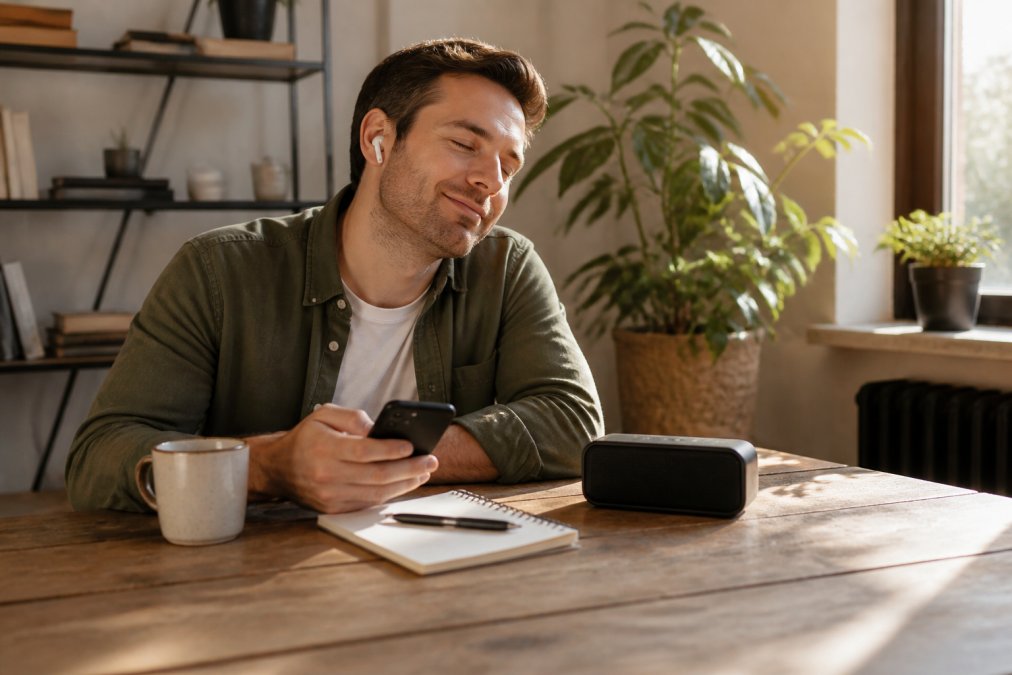
A Simple 5-Track Listening Test You Can Run in Any Room
Use this five-track test to evaluate any portable speaker in about ten minutes:
- Solo acoustic guitar, Listen for string detail and whether the body of the instrument sounds full.
- Male vocal ballad, Check mid-range clarity. Voices should sit forward without harshness.
- Upright bass jazz track, Judge bass punch and whether low notes stay distinct or blur together.
- Orchestral crescendo, Test dynamic range. Quiet passages should stay quiet before the swell.
- Electronic track with sub-bass, Push volume to 80% and listen for distortion or rattle.
Run the same five tracks on every speaker you're considering. Consistency beats variety here.
Is an Audiophile Portable Bluetooth Speaker Realistic? Codecs and Latency
An audiophile portable Bluetooth speaker is realistic within limits. Bluetooth streaming compresses audio, so a portable speaker will never match a wired hi-fi setup. But codec choice closes much of the gap.
Latency, the delay between source and sound, matters for video and gaming. Most modern speakers keep latency low enough for casual viewing, though competitive gaming still favors wired connections. Codec choice affects latency too: SBC typically introduces more delay than AAC or aptX Low Latency, which is why some speakers feel out of sync on Android but fine on iPhone.
SBC, AAC, aptX, and LDAC: Which Codec Your Phone Actually Supports
SBC is the baseline codec every Bluetooth device supports. It is functional but loses detail, and its maximum practical bitrate sits around 328 kbps. That is roughly one-quarter the data rate of a CD, which is why SBC can make even a good speaker sound flat.
AAC performs better on Apple devices and many Android phones, offering improved audio fidelity at similar bitrates.
aptX and aptX HD appear mostly on Android phones and select laptops, delivering higher-quality wireless streaming. Standard aptX targets around 352 kbps, while aptX HD pushes closer to 576 kbps. Qualcomm licenses these codecs, so support varies by chipset and phone maker.
LDAC supports the highest bitrate of the common codecs, with a theoretical ceiling near 990 kbps, but only Sony phones and some Android flagships support it.
Check your phone's spec sheet before assuming it supports a premium codec. A speaker that offers LDAC won't help if your phone only sends SBC. The same logic applies in reverse: a phone that supports aptX HD gains nothing from a speaker that only decodes SBC.
How to Verify Codec Negotiation Before You Buy
Most phones do not show which codec is active during playback. On Android, you can often check under Developer Options > Bluetooth Audio Codec, though the menu may not reflect real-time negotiation on every device.
A practical test: play a familiar track with fine treble detail, such as acoustic guitar or brushed cymbals, and listen for smearing or dullness. If the same track sounds noticeably cleaner over a wired AUX connection, the Bluetooth codec is likely the bottleneck, not the speaker driver.
Latency in Practice: What Matters for Video and Gaming
Latency is measured in milliseconds and describes the gap between the video frame and the sound you hear. Under roughly 100 ms, most viewers do not notice lip-sync issues. Above 200 ms, dialogue starts to feel detached from mouths on screen.
SBC tends to add more latency than AAC or aptX Low Latency. If you plan to use a portable speaker for movies on a tablet or laptop, look for a model that advertises low-latency mode or supports aptX Low Latency. For music-only listening, latency is irrelevant because there is no video reference.
Battery Longevity, IP Ratings, and What Breaks First on the Road
Battery longevity and IP ratings determine whether a portable speaker survives daily life. Most portable units run 4 to 20 hours per charge depending on volume and features. Higher volume drains batteries faster, and RGB lighting cuts playtime noticeably.
IP ratings tell you what the speaker resists. IPX5 handles splashes and light rain. IP67 survives full submersion and dust. For gym bags and beach trips, IPX5 is the practical minimum. The first digit in an IP rating refers to solids (dust), and the second refers to liquids (water). An IPX5 rating has no dust protection rating at all, which matters if you plan to use the speaker on a sandy beach or dusty trail.
How Lithium Batteries Actually Degrade Over Time
Storage matters too. Lithium batteries stored at 100% charge for long periods age faster than batteries stored at around 50%. If you only use a portable speaker a few times a year, storing it half-charged in a cool, dry place will extend its usable life more than any other habit.
Practical Habits That Extend Battery Health
Speakers that allow firmware updates sometimes receive battery-management improvements that slow this decline. If a manufacturer publishes firmware notes mentioning charging behavior or battery health, that is a signal they are actively managing the issue rather than ignoring it.
Repairability and Battery Replacement
Many speakers are sealed units with glued batteries, meaning a failed cell ends the product's life. Look for speakers with replaceable batteries or accessible screws. Brands that publish teardown guides and sell spare parts signal long-term support. A speaker with a user-replaceable battery can realistically last six or more years, while a sealed unit with a degraded cell often becomes e-waste after two or three.
Acoustic Environment Testing: Why the Same Speaker Sounds Different in Every Room
Room acoustics change how any speaker sounds. Hard surfaces reflect sound, soft surfaces absorb it. A speaker that sounds bass-heavy in a carpeted bedroom can sound thin in a tiled kitchen.
Test the same speaker in at least two rooms before deciding. Place it on a stable surface rather than fabric, which muffles bass. Corner placement boosts low frequencies; center placement gives a more balanced sound signature.
Outdoor use flips everything. Without walls to reinforce low end, portable speakers sound noticeably thinner outside. Bass punch that impressed you indoors may disappear at a park.
Repairability, Firmware Updates, and Sustainability in Portable Audio
Repairability and firmware support are important factors in portable audio.
A Practical Pick: The Mini Retro White Noise Bluetooth Speaker
For buyers who want a compact, design-forward option that still delivers on the fundamentals, the Mini Retro White Noise Bluetooth Speaker covers a lot of ground at $37.99.
It measures 5.6 x 6 x 2.64 inches, small enough for a bedside table and light enough for a gym bag. Bluetooth 5.0 handles wireless streaming, with AUX input and TF card support as backups when you want zero latency. The 360-degree surround sound configuration pushes audio in every direction rather than firing forward only.
Four built-in nature sounds (ocean waves, crackling bonfires, chirping insects and birds, and flowing streams) make it useful beyond music. A 1500mAh battery delivers 4-6 hours of playtime, with a full recharge in 2-3 hours via USB.
The RGB ambient breathing light rotates with your music, and a screen-off function prevents glare at night. Volume and mode selection run through physical knobs, which sidesteps the app-pairing headaches common on budget speakers.
Customer feedback backs this up. Sarah L. called it "so handy and works flawlessly," and Daniel M. said he was "amazed by the quality and performance."
Conclusion
Choosing among portable speakers gets easier once you know which specs matter and which are marketing noise. Focus on frequency response, THD, codec compatibility, and IP rating, then test in the room where you'll actually listen.
Frequently Asked Questions
What features define a high fidelity portable Bluetooth speaker?
A high fidelity portable speaker usually lists a wide frequency response (roughly 50Hz to 20kHz), low total harmonic distortion, and a signal-to-noise ratio above 90dB. Driver configuration matters too: dedicated tweeters and woofers, or passive radiators, produce clearer mid-range and stronger bass punch than a single full-range driver. Bluetooth 5.0 or newer, USB-C charging, and an IP67 rating for waterproof and dustproof protection round out the essentials. Codec support like AAC or aptX also affects how much detail survives the wireless stream.
Do high-fidelity Bluetooth speakers require special codecs for better sound?
Yes, codec support changes what you actually hear. SBC is the baseline and compresses the most. AAC sounds better on iPhones, while aptX and LDAC carry more data on Android devices that support them. If your phone and speaker share a higher-quality codec, you get better dynamic range and treble detail. Check both device spec sheets before buying. A speaker with LDAC is wasted on a phone that only sends SBC, and vice versa.
Is it possible to get true audiophile sound from a portable Bluetooth speaker?
Focus on frequency response, low distortion, and codec support. A well-tuned compact speaker with passive radiators can deliver a convincing soundstage and clean mid-range clarity. Set expectations around physics: small cabinets limit deep bass, so prioritize balance over thump.
How do I test Bluetooth speaker fidelity before buying online?
Ask for a return window and test at home with familiar tracks. Play a bass-heavy song, a vocal track, and something with cymbals to check treble detail. Listen at low volume for hiss and at high volume for distortion. Move the speaker to different rooms to hear how walls and furniture change the sound. If the retailer offers a 30-day return, you can run a full acoustic environment test without risk. Read the return policy before checkout.
Finding a speaker that sounds genuinely good and looks the part shouldn't require a research project. Electro Gift Shop curates portable audio gear that blends nostalgic design with modern functionality, from the Mini Retro White Noise Bluetooth Speaker's 360-degree surround sound and four nature sounds to its RGB ambient lighting and 1500mAh rechargeable battery. Get started with Electro Gift Shop and bring crystal-clear audio to your desk, your travels, and your bedside.