

Durable Gadgets for Gym and Travel: 2026 Picks
Table of Contents
- Durable Gadgets for Gym and Travel: What Actually Survives
- How We Evaluated These Durable Gadgets
- Quick Comparison: Weight, Packed Size, and Battery
- 1. Bluetooth Sleep Headband: The Lightest Audio Option for the Gym
- 2. Smart Fingerprint Padlock: Security That Outlasts the Trip
- 3. Mini SLR-Shaped 1080P Pocket DV Camera: Capture the Workout
- Portable Gym Equipment for Travelers: What Fits in a Carry-On
- Best Workout Equipment to Pack in a Suitcase: Size and Weight Rules
- Durable Resistance Bands for Travel: What to Look For
- Portable Power Bank for Travel and Gym: Charging Without the Bulk
- Frequently Asked Questions
Last Updated: October 6, 2026
Durable Gadgets for Gym and Travel: What Actually Survives
Most gear fails at the hinge, the battery, or the buckle, not the headline feature. That single fact reshapes how we think about durable gadgets for gym and travel: the spec sheet matters less than the parts that take the abuse. At Electro Gift Shop, we sell compact tech to people who move constantly, so we judge every item by one question: what breaks first, and how soon?
Here is the short answer before the detail. The three picks below survived our screening because each one solves a specific failure mode rather than adding features. The Bluetooth Sleep Headband ($8.99) survives sweat and repeated washing. The Smart Fingerprint Padlock ($13.00) survives weather and dead batteries. The Mini SLR-Shaped 1080P Pocket DV Camera ($29.99) survives being carried in a pocket every day.

Below, we break down how we tested, what each item weighs and measures, and which one fits your trip.
How We Evaluated These Durable Gadgets
We scored each item against four criteria that map to real failure points: build quality at the stress points, battery behavior over time, packed size against a carry-on allowance, and whether the controls work without an instruction manual.
The evaluation weighted portability heavily. A gadget that lives in a drawer at home is not travel gear, no matter how well it is built. We also checked whether each item could be repaired, charged, or cleaned away from home, because a device that needs a proprietary dock is a device that strands you.
One more filter: we excluded anything that requires an app to perform its core function. Apps get abandoned, accounts get locked, and updates break things. Hardware should work on its own terms.
Quick Comparison: Weight, Packed Size, and Battery
The table below summarizes what matters when you are packing light. Weights and dimensions come from the manufacturer listings; treat them as the baseline for your own luggage math.
| Gadget | Price | Weight | Packed Size | Power Source | Best For |
|---|---|---|---|---|---|
| Bluetooth Sleep Headband | $8.99 | Fabric, packs flat | Folds to palm size | USB rechargeable, 10-hour battery | Gym sessions and overnight travel |
| Smart Fingerprint Padlock | $13.00 | Compact lock body | Fits any side pocket | USB rechargeable, up to 6 months per charge | Lockers, luggage, and bags |
| Mini SLR-Shaped Pocket DV Camera | $29.99 | Pocket-sized | Keychain scale | 180mAh built-in battery, USB charging | Capturing workouts and trips |
The pattern is clear: all three charge over standard USB, which means one cable covers your entire kit. That is not a small detail. A single charging standard removes an entire category of packing anxiety, and it is the first thing we look for in any travel electronics.

1. Bluetooth Sleep Headband: The Lightest Audio Option for the Gym
The Bluetooth Sleep Headband is the best audio pick for anyone who finds earbuds uncomfortable during a workout. It uses ultra-thin HD stereo speakers set into soft, breathable, sweat-wicking fabric, so nothing sits inside your ear canal and nothing falls out mid-set.
Why it holds up: the headband has no hinges, no folding arms, and no exposed cable to snag. The failure points that kill conventional headphones simply are not present. Bluetooth 5.0 handles pairing with your phone, tablet, or laptop, and the on-band controls let you adjust volume, skip tracks, and take calls without reaching for a screen.
Battery life runs up to 10 hours of continuous playtime, recharged through the included USB cable. For a gym session or a long flight, that is more than enough headroom.
The honest limitation: this is a comfort-first design, not an audiophile one. If you want deep bass isolation, in-ear monitors will beat it. If you want something you can wear for three hours without noticing, this wins.
2. Smart Fingerprint Padlock: Security That Outlasts the Trip
The Smart Fingerprint Padlock is the one item on this list we would call genuinely travel-critical. It unlocks in about 0.5 seconds with a high-resolution fingerprint sensor and stores up to 10 prints, which covers you, a partner, and a couple of gym friends.
The durability case is straightforward. The lock body carries an IP65 rating, meaning it is water-resistant and dustproof, so rain, sweat, and locker-room humidity are not a problem. The lithium battery runs up to 6 months per charge over USB, and Bluetooth connectivity lets you manage prints, review unlocking records, and share temporary access through the app.
Where it falls short: it is a convenience lock, not a vault. For a gym locker, a suitcase zipper, a bike, or a storage unit, it is exactly right. For anything you would insure separately, use something heavier.
3. Mini SLR-Shaped 1080P Pocket DV Camera: Capture the Workout
The Mini SLR-Shaped 1080P Pocket DV Camera is the pick for anyone who wants footage of a session without carrying a phone around the gym floor. It shoots 1080P Full HD video and photos, and the SLR-style body fits in a pocket or on a keychain.

Three features make it practical rather than gimmicky. First, the 0.96-inch display screen lets you review footage on the spot, so you are not guessing whether the shot worked. Second, loop recording with an 8-128G SD or TF card automatically overwrites the oldest clips when storage fills, so you never run out of space mid-trip. Third, one-click recording plus 8 built-in filters means you can start shooting and adjust the look without a menu dive.
The 180mAh built-in battery handles standby time well for hiking, cycling, and travel use. The USB interface handles charging and file transfer with the same cable as everything else in your bag.
The trade-off is resolution and low-light performance. This is a pocket camera, not a production rig. For documenting a climb, a ride, or a set of lifts, it does the job.
Portable Gym Equipment for Travelers: What Fits in a Carry-On
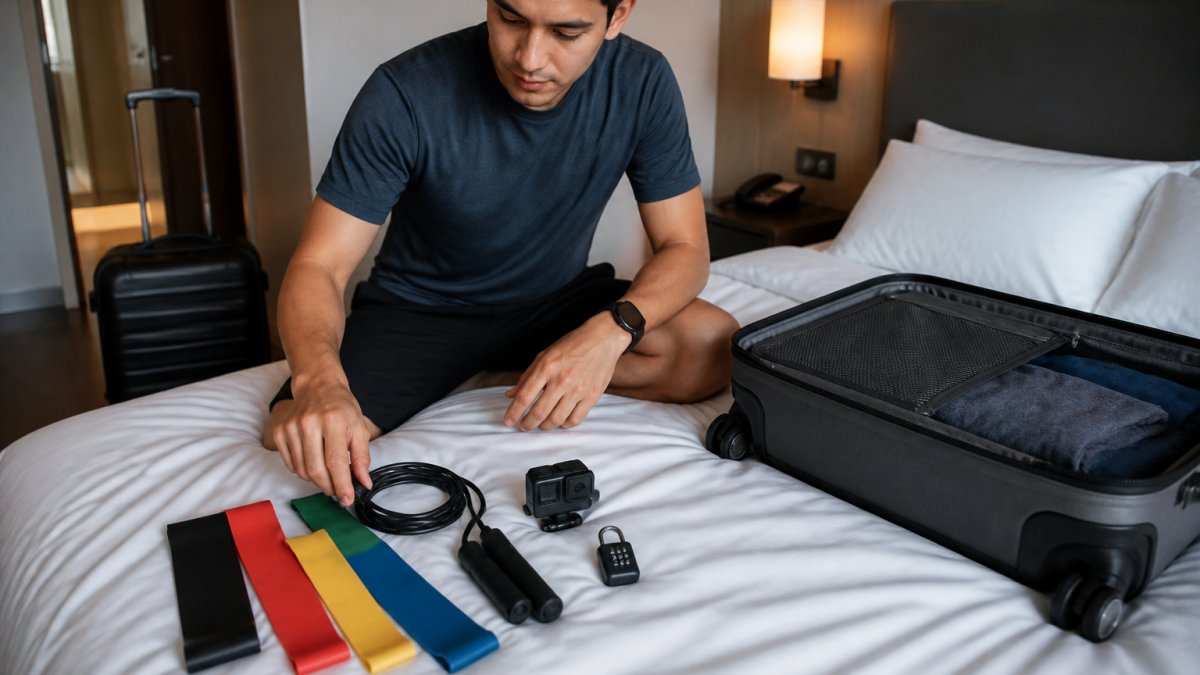
Portable gym equipment for travelers comes down to three categories: resistance, cardio, and bodyweight support. Everything else is optional.
Mini Slr-Shaped 1080P Pocket DV Camera – Portable Body Cam, Action Camera →
- Resistance bands and hip bands: flat, light, and nearly indestructible when the fabric is layered rather than latex-only.
- Jump rope: the smallest cardio option by volume, though a speed rope with a thin cable packs smaller than a beaded one.
- Travel or packable workout mat: the bulkiest item on this list, and the one most often left at home.
- Suspension trainer or training straps: excellent for strength training, but they need an anchor point, which many hotel rooms lack.
- Push-up handles and ab rollers: compact strength-training equipment that adds variety to bodyweight sessions.
The rule we give customers: if an item does not fit in a shoe, it needs to justify its space. A jump rope does. A second pair of lifting straps usually does not.
Best Workout Equipment to Pack in a Suitcase: Size and Weight Rules
Most packing guides tell you to roll your bands and fill dead space. That advice is fine, but it does not answer the question that actually decides whether your kit makes the trip: does it fit the bag you are carrying, and does it survive the way that bag gets handled?
Start with the real constraint. A standard domestic carry-on is roughly 22 x 14 x 9 inches (55 x 35 x 23 cm), and most airlines cap it around 7-10 kg. A personal item is smaller still, often around 18 x 14 x 8 inches. Your fitness kit competes for that space against clothes, a laptop, and toiletries, so the number that matters is not total weight, it is packed volume and how that volume deforms under pressure.
Here is how the common categories actually measure up when compressed:
- Fabric resistance bands (set of 3-5): roll to roughly the size of a soda can, 150-300 g. Compressible, so they disappear into shoe cavities or a laptop sleeve.
- Jump rope (speed, thin cable): coils to about the size of a fist, 100-200 g. A beaded rope is bulkier and heavier, and the beads crack if crushed.
- Travel mat (1-2 mm): folds or rolls to roughly the size of a rolled magazine, 700 g-1.2 kg. This is the item that most often gets left behind, because it does not compress.
- Suspension trainer: packs to about the size of a grapefruit, 500-900 g, but needs an anchor. Door anchors work in most hotel rooms; beam straps do not.
- Push-up handles or ab roller: the roller is the bulky one, a single wheel is roughly the size of a coffee mug and does not compress.
Three rules that hold up in practice:
- Compress, do not fold. Bands and thin mats survive rolling better than folding. Repeated creasing at the same line is where fabric bands and coated mats fail first.
- Fill structural dead space. Shoe interiors, the laptop sleeve, and the gap behind a packing cube are free real estate. Bands and a jump rope belong there, not in the main compartment.
- Cap the kit at roughly 1.5 kg and one shoe's worth of volume. Past that, the kit starts costing you clothing, and travelers abandon it on short trips.
Trip length changes the math more than any other variable. For a two-night work trip, a jump rope, a set of bands, and a headband cover resistance, cardio, and audio in under 500 g. For a two-week holiday, a thin mat and a suspension trainer start to earn their space because you will use them ten or more times. Match the kit to the trip rather than owning one fixed setup, and if you fly carry-on only, weigh the packed kit on a kitchen scale before you leave. Guessing is how people end up repacking at the gate.
One durability note that packing guides skip: how you pack determines how long gear lasts. Bands crushed against hard corners develop weak spots. A mat folded along the same line every trip delaminates there. A jump rope coiled tightly around a sharp object kinks the cable. Pack for the return trip, not just the outbound one.
Durable Resistance Bands for Travel: What to Look For
Resistance bands fail in a predictable place: the point where the band meets the handle, loop, or anchor. Bare latex snaps there without warning because the material thins as it stretches and the stress concentrates at the seam. Fabric and layered bands fail more slowly, they fray, then tear, which gives you a warning the latex does not.
That difference is the whole durability story. Here is what to check before you trust a band on a trip:
- Construction: layered fabric or a fabric-and-latex blend outlasts bare latex by a wide margin. The fabric carries the load; the latex provides the stretch.
- Stitching: double stitching at every stress point, especially where the band meets the handle or loop. Single stitching is the first thing to go.
- Width consistency: a band that narrows in the middle will tear there. Run your fingers along the length, the width should be uniform.
- Ends and anchors: metal clips and D-rings should be smooth, not sharp. A burr on a clip will saw through a band over weeks of use.
- Care instructions: most fabric bands should be hand-washed in cool water and air-dried, not machine-washed or dried.
Storage matters more than most people think. UV exposure and hot car interiors degrade the elastic over time, which is the most common reason a band fails on a trip rather than at home. Keep bands out of direct sun, out of a hot trunk, and out of the bottom of a bag where they get crushed against hard corners.
On the road, three habits extend band life:
- Anchor to smooth surfaces. A rough concrete pillar or a sharp door edge will abrade the band. Wrap a towel or shirt around the anchor point if you are unsure.
- Avoid overstretching. Bands are rated for a working range. Pulling a light band to three times its length to substitute for a heavy one is how bands break.
- Inspect before each session. Run the band through your hands and look for thinning, fraying, or a change in color at the seam. Replace it before it fails, not after.
A common pattern among frequent travelers is to carry two bands of different resistances rather than one heavy band. Two lighter bands cover more exercises, pack flatter, and fail more gracefully, if one goes, you still have a workout. For a travel kit, that redundancy is worth more than a single heavy band that saves a few grams.
Portable Power Bank for Travel and Gym: Charging Without the Bulk
A portable power bank for travel and gym use should match your devices, not exceed them. Every gadget in this guide charges over standard USB, so a single modest power bank covers the whole kit.
Two numbers decide whether a bank is worth carrying. Capacity, measured in milliamp-hours, determines how many charges you get. Output, measured in amps, determines how fast. For a headband, a padlock, and a pocket camera, you do not need a large bank, and a heavy one will stay in the hotel room.
For air travel, keep power banks in your carry-on rather than checked baggage, and confirm the current rules with your airline before you fly.
Frequently Asked Questions
What is the best workout equipment to bring when traveling?
The best workout equipment to bring when traveling is gear that packs flat, weighs little, and does not need a power outlet. Resistance bands, a jump rope, and a compact mat cover strength and cardio in under a kilogram. Add a Bluetooth sleep headband for audio and a fingerprint padlock for locker security. Choose items that fit inside your carry-on rather than needing their own bag, and check the packed size before you buy.
What compact fitness equipment is durable enough for frequent travel?
Look for gear with sealed or water-resistant construction and rechargeable batteries instead of disposable ones. The Smart Fingerprint Padlock carries an IP65 rating, which means it resists water and dust, and its lithium battery runs up to six months per charge. For audio, the Bluetooth Sleep Headband uses sweat-wicking fabric and a 10-hour battery, so it handles repeated workouts and washes better than rigid plastic headphones.
How do I choose travel workout gear that will last?
Check three things before buying: the material, the battery type, and the warranty. Sealed housings and rechargeable lithium batteries survive travel better than open ports and disposable cells. Weigh the item against its packed size, since a heavy gadget you leave behind is wasted money. The Mini SLR-Shaped 1080P Pocket DV Camera, for example, runs on a 180mAh built-in battery and supports loop recording, so it keeps working without constant card swaps.
Are resistance bands or adjustable jump ropes better for travel workouts?
Resistance bands win on packed size and versatility, since they fold flat and cover strength training for every muscle group. Jump ropes take slightly more room but deliver cardio in a shorter session and need almost no space to use. Many travelers pack both. If you only have room for one, choose bands for strength and use bodyweight exercises like push-ups and squats for cardio instead.
How can I keep working out while traveling?
Build a routine that needs no gym and no equipment beyond what fits in your bag. Pack resistance bands, a jump rope, and the Bluetooth Sleep Headband for audio, then follow a 20-minute bodyweight circuit in your hotel room. Charge everything the night before with a portable power bank so a dead battery never stops a session. Keep the same schedule you use at home, since consistency matters more than intensity on the road.