

Modern Tech with Nostalgic Design Aesthetic: 2026 Guide
Table of Contents
- Why We Crave Nostalgia in Modern Tech
- What Defines a Nostalgic Design Aesthetic in Electronics
- Retro-Inspired Gadgets That Deliver Modern Functionality
- How to Style Your Workspace with Retro Tech
- Technical Limitations as Design Features: When Less Is the Point
- Sustainability, Repairability, and the Long Life of Legacy Hardware
- The Uncanny Valley of Retro Tech: When Nostalgia Feels Forced
- Modern Tech with Nostalgic Design Aesthetic: What to Look For
- Conclusion
- Frequently Asked Questions
Last Updated: September 24, 2026
Why We Crave Nostalgia in Modern Tech
Nostalgia sells. That much is clear from the resurgence of tactile knobs, cream-colored plastics, and wood-grain finishes in 2026 product catalogs. But the pull toward modern tech with nostalgic design aesthetic runs deeper than marketing. It is a psychological response to digital fatigue.
When every surface is a touchscreen and every interaction is a swipe, the brain craves something physical. A dial you can turn. A switch that clicks. A speaker that looks like it belongs on a 1970s bookshelf but streams Bluetooth 5.0 without complaint.
At Electro Gift Shop, we see this demand every day. Design-conscious buyers aged 25-35 are not just looking for gadgets. They want objects that feel like they have a history, even if they were manufactured last month.
The term for this is nostalgia marketing: the deliberate use of familiar visual cues from past decades to trigger comfort and trust in modern products. And it works because memory is the most powerful design tool available.
What Defines a Nostalgic Design Aesthetic in Electronics
A nostalgic design aesthetic is a visual and tactile language that borrows specific cues from past decades, such as rounded corners, muted color palettes, physical controls, and analog displays, and applies them to current technology. It is not the same as vintage. Vintage means old. Nostalgic means new technology wearing old clothes.
The distinction matters. A refurbished 1980s cassette player is vintage. A Bluetooth speaker with a rotary volume knob and cream housing is nostalgic design. One requires you to accept limitations. The other gives you modern performance with period styling.

Three elements separate successful retro-inspired gadgets from costume jewelry:
- Functional honesty: Controls do what they appear to do. A knob controls volume, not a hidden menu.
- Material sincerity: Real wood, brushed aluminum, or matte plastic instead of glossy fake finishes.
- Restrained color: Warm neutrals, muted oranges, sage greens, and off-whites rather than neon RGB.
Get all three right and the product feels inevitable. Miss one and it feels like a novelty gift.
Analog Aesthetics and Tactile Feedback in a Digital World
Tactile feedback is the physical response a device gives when you touch it: the resistance of a dial, the click of a button, the weight of a well-made housing. In a market dominated by glass slabs, this feedback has become a luxury feature.
Mechanical switches in keyboards, rotary encoders in speakers, and haptic response in cameras all serve the same purpose. They confirm your action in a way a touchscreen cannot. Your fingers know the device received the command before your eyes confirm it.
The irony is that this analog feel requires very digital engineering. A rotary knob on a modern speaker is often a digital encoder sending signals to a processor. The click you feel is designed. The resistance is calibrated. Nothing about it is accidental.
Color Palettes, Typography, and Materiality That Signal Retro
Color does more work than shape when signaling an era. The 1970s read as mustard, burnt orange, and avocado. The 1980s read as beige, brown, and cream. The 1990s read as translucent plastic and cobalt blue.
Typography follows the same logic. Rounded geometric sans-serifs evoke mid-century industrial design. Condensed block lettering suggests 1980s consumer electronics. Monospaced type hints at early computing.
Materiality ties it together. Texture matters as much as color. Matte finishes feel older than gloss. Visible screws suggest repairability. Wood grain suggests warmth. These choices create a visual narrative that tells the buyer this object has weight and history, even when it left a factory weeks ago.
Retro-Inspired Gadgets That Deliver Modern Functionality
The category has matured. Retro-inspired gadgets in 2026 are not compromises. They are often better than their generic counterparts because the design constraints force clarity. But the interesting question is not whether retro gadgets work, it is how they reconcile a 1970s silhouette with a 2020s spec sheet. The answer sits in three recurring patterns.
Pattern 1: The control surface stays analog, the signal path goes digital. A rotary volume knob on a modern speaker is usually a digital encoder, not a potentiometer. It sends pulses to a microcontroller that adjusts a digital amplifier. The click you feel is a detent spring. The resistance is calibrated. Nothing about it is accidental, but the user experience is indistinguishable from a 1978 receiver.
Pattern 2: The display shrinks instead of growing. Where mainstream gadgets race toward edge-to-edge OLED, retro-inspired devices often keep a 0.96-inch or 1.5-inch panel, or drop the screen entirely. This is a deliberate trade: fewer pixels means fewer notifications, fewer menus, and a device that does not compete for attention.
Pattern 3: The housing carries the era, the internals carry the year. Cream ABS plastic, brushed aluminum faceplates, and visible screws signal an era. Bluetooth 5.0, USB-C, and lithium-polymer cells signal the present. The two layers rarely intersect visually, and that separation is what keeps the design from feeling like a costume.
Two examples from the Electro Gift Shop catalog show how these patterns play out in practice.
The Mini Retro White Noise Bluetooth Speaker looks like a bedside radio from decades past, but it packs Bluetooth 5.0, a 1500mAh battery, and four built-in nature sounds for sleep. The knobs control volume and mode. The RGB ambient light rotates with your music. It measures 5.6 x 6 x 2.64 inches, so it fits on a nightstand without dominating it. The retro cue is the radio silhouette and the physical knobs; the modern spec is the wireless playback, AUX input, TF card support, and dedicated white noise mode.
The Mini SLR-Shaped 1080P Pocket DV Camera resembles a tiny film camera, complete with a 0.96-inch display and a body that fits on a keychain. Inside, it shoots 1080P HD video, supports loop recording with an 8-128G SD card, and offers eight creative filters. One-click recording means no menu diving. The retro cue is the SLR body shape and the small display; the modern spec is the HD sensor and loop recording.

| Feature | Mini Retro Speaker | Mini SLR Pocket Camera |
|---|---|---|
| Retro cue | Rotary knobs, radio silhouette | SLR body shape, small display |
| Modern spec | Bluetooth 5.0, 1500mAh battery | 1080P HD, loop recording |
| Control pattern | Analog knobs, digital encoder | Physical shutter, digital sensor |
| Best for | Bedside, desk, travel | Cycling, travel, everyday capture |
| Price | $37.99 | $29.99 |
Both products answer the same customer question: does the retro look come at the cost of performance? In these cases, no, because the retro layer and the modern layer are kept deliberately separate. The moment a designer tries to make the internals feel retro (a slow processor, a low-resolution sensor, a deliberately clunky menu), the product stops being nostalgic design and starts being a novelty.
How to Style Your Workspace with Retro Tech
Most styling advice for retro tech stops at "buy a wood desk and a warm lamp." That is not a styling system, it is a mood board. The harder problem is that retro-inspired gadgets come from different decades, and mixing a 1970s mustard speaker with a 1990s translucent-blue keyboard and a 1950s rounded typeface produces visual noise, not nostalgia.
The fix is to pick an era anchor and treat everything else as a supporting actor. Here is a working method.
Step 1: Choose one decade as the anchor. The anchor sets the palette, the material vocabulary, and the typography. The 1970s anchor reads as mustard, burnt orange, avocado, and walnut veneer. The 1980s anchor reads as beige, brown, cream, and matte ABS plastic. The 1990s anchor reads as translucent plastic, cobalt blue, and silver. Pick one. Do not pick two.
Step 2: Let one object carry the anchor. A single retro speaker, radio, or camera on a shelf does more work than five small retro accessories scattered across a desk. Place it at eye level or slightly below so the controls stay reachable, retro design is tactile, and a knob you cannot reach is decoration, not design. Integrating these tactile centerpieces into a broader room layout often requires balancing mid-century utility with the bold, neon-soaked charm found in vintage decor ideas.
Mini Retro White Noise Bluetooth Speaker →
Step 3: Match the supporting objects to the anchor's era, not to your personal taste. If the anchor is a 1970s-style speaker in cream and walnut, a chrome-and-glass desk lamp from the 1980s will fight it. A matte-black or brass lamp will not. The rule is material and finish consistency, not literal decade matching.
Step 4: Control the light temperature. Warm white (2700K-3000K) bulbs complement cream, wood, and muted palettes. Cool white (4000K+) LEDs make cream plastic look yellowed and wood look orange. If your workspace has overhead cool-white lighting, add a warm desk lamp as a counterweight.
Step 5: Hide the modern infrastructure. Nothing breaks a retro aesthetic faster than a tangle of black USB-C cables. Route them behind furniture, use fabric-wrapped cords in a matching neutral, or consolidate charging into a single hidden dock. The retro layer should be the only thing visible.
Step 6: Leave negative space. Minimalism and retro design are not opposites. The cleanest retro desks borrow from both: two or three well-chosen objects, plenty of empty surface, and a consistent color story across everything visible. Five retro objects on one desk reads as clutter; two reads as intent.
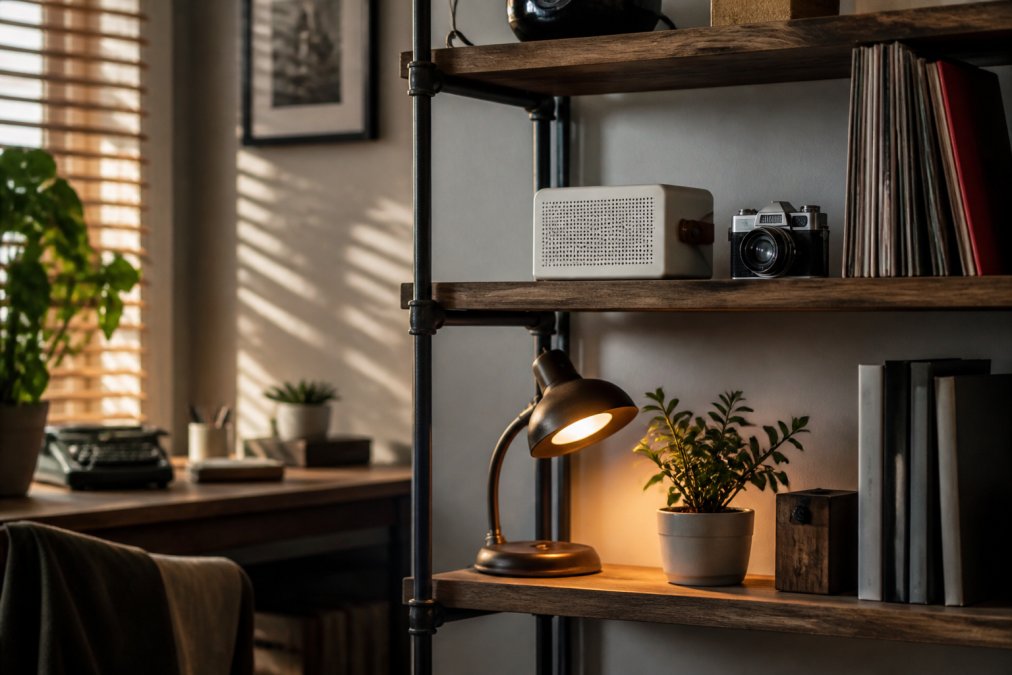
One more consideration that most styling guides skip: scale. Retro gadgets are often smaller than the objects they imitate. A mini SLR-shaped camera the size of a keychain does not read as a camera on a large desk, it reads as a trinket. Group small retro objects together on a tray or shelf edge so they read as a collection rather than as scattered clutter. Large retro objects (a full-size speaker, a radio) can stand alone.
Technical Limitations as Design Features: When Less Is the Point
Here is the counterintuitive part. Some of the most successful retro gadgets deliberately limit what they can do. That is not a flaw. It is the design.
A pocket camera with 180mAh of battery and a 0.96-inch screen will not replace your phone. It is not meant to. It exists so you can capture a moment without opening an app, scrolling notifications, or losing the shot to a software update prompt.
A speaker with physical knobs cannot bury settings in submenus. The interface is the product. Every control is visible, labeled, and immediate. That constraint produces a better experience for the specific job it does.
This is where most trend pieces miss the point. They treat limited functionality as nostalgia for its own sake. In practice, the limitation is the feature. It removes decisions. It removes friction. It gives you a tool that does one thing well instead of twelve things adequately.
Sustainability, Repairability, and the Long Life of Legacy Hardware
Durability is the quiet argument for nostalgic design. Products with physical controls, standard screws, and replaceable parts tend to outlast sealed devices with glued batteries.
The European Commission's right to repair rules have pushed repairability into mainstream product design conversations, and retro-styled electronics often align with that direction by default. A knob can be replaced. A switch can be swapped. A battery that is not glued in place can be serviced.
There is also a cultural dimension. Legacy hardware earns emotional attachment. People keep a well-made radio for twenty years. They replace a disposable speaker every eighteen months. The longer a device stays in use, the lower its environmental cost per year of service.
For buyers, this changes the math. Paying more upfront for a device you will keep is often cheaper than replacing a budget option three times.
The Uncanny Valley of Retro Tech: When Nostalgia Feels Forced
Not every retro product works. Some land in an uncanny valley where the pastiche feels hollow.
The warning signs are consistent. Fake wood grain printed on plastic. A dial that does nothing when turned. A "vintage" font slapped on a generic product with no other design changes. These read as costumes rather than designs.
The test is simple. Ask what the retro element actually does. If the answer is "it looks nice," that is fine for a decorative object but weak for a gadget. If the answer is "it makes the device easier to use," the design has earned its place.
Forced nostalgia also fails when it ignores context. A retro camera with no display screen in 2026 frustrates more than it charms. A retro speaker with no Bluetooth frustrates everyone. The rule is consistent: keep the modern capability, borrow the old form.
Modern Tech with Nostalgic Design Aesthetic: What to Look For
Choosing well comes down to a short checklist. Use it before you buy anything in this category.
- Does the retro element serve a function? Knobs, switches, and displays should control something real.
- Are the materials honest? Real wood, metal, or quality plastic, not printed imitation.
- Is the modern spec current? Bluetooth 5.0 or newer, USB-C charging, adequate battery life.
- Is it repairable? Accessible screws, replaceable battery, standard parts where possible.
- Does the color palette hold together? Warm neutrals and muted tones age better than loud accents.
- Is the size right for the space? Measure before you buy, especially for desk and shelf pieces.
- Is the return policy clear? Buying audio gear online without hearing it first is a real concern, so check the terms before ordering.
That last point matters more than most buyers expect. Sound quality is subjective, and a speaker that looks perfect on your shelf may not suit your room. A clear return policy removes the risk.
Conclusion
The appeal of nostalgic design is not nostalgia itself. It is what the old forms give you: control you can feel, objects you can repair, and interfaces that do not demand your attention. Modern tech with nostalgic design aesthetic works when the styling serves the function, not when it replaces it.
Electro Gift Shop builds around that idea. The Mini Retro White Noise Bluetooth Speaker pairs a vintage radio silhouette with Bluetooth 5.0, four nature sounds, and RGB ambient lighting for $37.99. The Mini SLR-Shaped 1080P Pocket DV Camera packs 1080P video, loop recording, and eight filters into a body small enough for a keychain at $29.99. Both are portable, lightweight, and designed for daily use.
Shop Now at Electro Gift Shop and find gear that sounds as good as it looks.
Frequently Asked Questions
Why is retro design becoming popular in modern technology?
Retro design gives people a sense of control and warmth that flat touchscreens often lack. Physical knobs, mechanical switches, and warm lighting create tactile feedback and a visual narrative that feels familiar. Design-conscious buyers aged 25-35, in particular, are drawn to gadgets that blend vintage-inspired looks with modern functionality, turning everyday devices into objects they actually enjoy displaying.
What are the best examples of modern gadgets with a vintage look?
Good examples include the Mini Retro White Noise Bluetooth Speaker at $37.99, which pairs a vintage-inspired body with Bluetooth 5.0, four nature sounds, RGB ambient lighting, and a 1500mAh battery that runs 4-6 hours. Another is the Mini SLR-Shaped 1080P Pocket DV Camera at $29.99, which offers 1080P HD capture, loop recording, a 0.96-inch display, and eight filters in a body that recalls classic SLR cameras.
Is retro-styled tech just a trend or here to stay?
It is more than a passing trend because it addresses a real need: digital fatigue. As interfaces become more abstract, tactile feedback and analog aesthetics offer a counterweight. Brands that treat nostalgia as a design language rather than a gimmick, combining retro-modern looks with genuine performance, are building products that stay relevant beyond a single season.
How do I know a retro gadget will actually perform well, not just look good?
Check the specifications before buying. Look for details like Bluetooth version, battery capacity, playback time, and input options. For example, a speaker with Bluetooth 5.0, AUX input, TF card support, and a 1500mAh battery is built for daily use. Customer reviews such as Sarah L.'s 'works flawlessly' or Daniel M.'s 'amazed by the quality' help confirm real-world performance.