

Retro Style Speakers With Modern Sound: 2026 Guide
Table of Contents
- What Defines Retro Style Speakers With Modern Sound
- Modern vs Vintage Speaker Sound Quality: What Actually Changes
- Bluetooth Connectivity vs Wired Fidelity in Retro Style Speakers
- Best Vintage Bluetooth Speakers: Active vs Passive and Portability
- How to Choose a Retro Speaker That Performs as Good as It Looks
- Featured Pick: Mini Retro White Noise Bluetooth Speaker
- Are Retro Style Speakers Worth It for Serious Listeners?
- Frequently Asked Questions
Last Updated: September 2, 2026
What Defines Retro Style Speakers With Modern Sound
Retro style speakers with modern sound represent one of the most interesting intersections in consumer electronics: the kind of product that earns a place on your shelf aesthetically and earns its keep sonically. The best examples marry a mid-century modern design language with driver technology and connectivity that would embarrass some speakers twice their price.
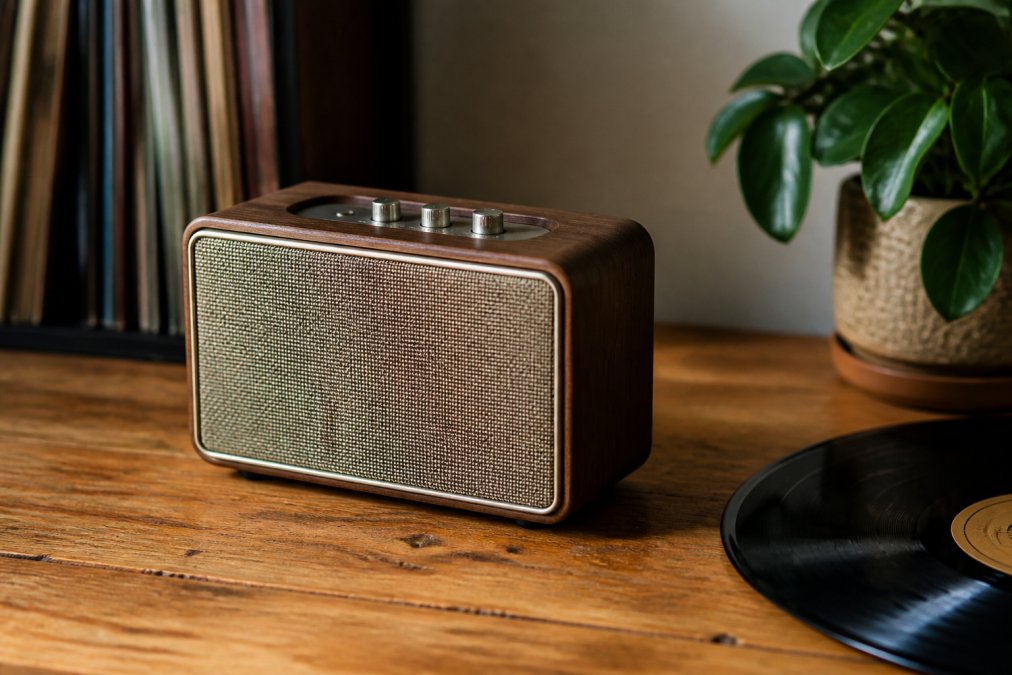
The category has exploded in the past few years, and not all of it is worth your money. Many buyers get drawn in by the analog aesthetic and end up with a speaker that looks like 1965 but sounds like a transistor radio. Understanding what actually defines a well-executed retro speaker is the first step toward buying one you won't regret.
The Analog Aesthetic: Wood Veneers, Fabric Grilles, and Mid-Century Modern Design
Retro style speakers are defined by a specific visual vocabulary: wood veneer or wood-effect cabinets, woven fabric grilles in earthy or muted tones, rounded corners, minimal visible hardware, and often a warm-toned display or dial. Mid-century modern design influence is unmistakable in most examples, borrowing from the Scandinavian and American furniture movements of the 1950s and 1960s.
What makes this aesthetic work in 2026 is restraint. The best examples don't pile on nostalgic references; they pick two or three design cues and execute them cleanly. A walnut veneer paired with a charcoal fabric grille and brass-tipped controls reads as intentional. Slapping retro fonts on a plastic box does not.
The practical implication for buyers: look at the grille attachment method and the quality of the veneer edges. On well-built speakers, the fabric grille sits flush and the wood grain is consistent. On cheap imitations, the grille rattles and the veneer peels at the corners within months.
Modern Components Inside a Nostalgic Cabinet
The nostalgic design is the entry ticket. The modern components are what justify the purchase.
A well-specified retro speaker will house a Class D amplifier, which runs cooler and more efficiently than older Class A/B designs without sacrificing audio performance. The drivers themselves should use modern materials: woven glass fibre, treated paper, or aluminium cones rather than the brittle foam-surround originals of the mid-century era. Modern crossover networks use precision-wound inductors and polypropylene capacitors that hold their values over time, unlike the vintage components they replace.
The result is a speaker that looks like it belongs in a 1960s living room but measures like a 2026 product. That combination is genuinely difficult to pull off, which is why the gap between good and mediocre retro speakers is so wide.
Modern vs Vintage Speaker Sound Quality: What Actually Changes
The real difference between a vintage speaker and a modern retro-styled one comes down to consistency, reliability, and low-end extension. Vintage speakers have character; modern ones have control. The best retro style speakers try to capture the former without sacrificing the latter.
Driver Technology, Frequency Response, and Acoustic Engineering
Modern driver technology has advanced considerably since the mid-century golden age of hi-fi. Contemporary drivers achieve tighter frequency response curves with less harmonic distortion across the audible range. A vintage driver might measure with a pleasantly warm character, but that warmth often reflects a rolled-off high-frequency response and elevated second-harmonic distortion, not a deliberate tuning choice.
Modern retro speakers use drivers engineered to a target frequency response, typically aiming for a relatively flat curve with a gentle low-frequency lift for perceived warmth. This gives the listener the impression of a vintage sound signature without the actual limitations of 60-year-old components. According to Audio Engineering Society resources on loudspeaker design, controlled harmonic distortion profiles and flat in-room frequency response are the two most significant predictors of perceived audio quality in compact loudspeakers.
The practical difference for listeners: a modern retro speaker will handle complex, dynamically compressed modern music (streaming audio, podcasts, electronic music) more cleanly than a genuine vintage unit. The vintage speaker may sound more "alive" on a well-recorded jazz record; the modern retro speaker will be more versatile across your entire library.
Cabinet Resonance, Crossover Networks, and Harmonic Distortion
Cabinet resonance is the part of speaker design most buyers never think about. It matters enormously.
A poorly braced cabinet acts as an unintended second driver, adding its own frequency content to the signal. Many cheap retro speakers use thin MDF or hollow plastic cabinets that resonate in the 200-400Hz range, adding a boxy coloration that muddies vocals and acoustic instruments. Quality retro speakers use thicker cabinet walls, internal bracing, and sometimes acoustic damping material to suppress this effect.
Crossover network quality is similarly invisible to the buyer but audible in the result. A well-designed passive crossover hands off cleanly between the woofer and tweeter, maintaining consistent stereo imaging and soundstage width. A cheap crossover creates a dip or peak at the crossover frequency, often around 2-5kHz where the human ear is most sensitive.
Bluetooth Connectivity vs Wired Fidelity in Retro Style Speakers
Most buyers today want Bluetooth. The question is how much audio quality they're trading for the convenience. The honest answer is: less than you think, if the speaker implements it properly.
Latency, Codec Support, and Signal-to-Noise Ratio for Wireless Retro
Bluetooth audio quality is largely determined by codec support. The standard SBC codec, which all Bluetooth speakers support, compresses audio significantly and introduces latency that makes it unsuitable for video sync. Higher-quality codecs like aptX, aptX HD, and AAC preserve more of the original signal and reduce latency to acceptable levels for most listening scenarios.
For retro style speakers used primarily for music and ambient audio, aptX or AAC support is the meaningful threshold. The signal-to-noise ratio of the wireless chain matters too: a speaker with a strong internal amplifier can maintain clean audio even at modest Bluetooth signal levels, while a weaker design will introduce audible noise as the signal degrades.
As Bluetooth SIG's technical documentation on audio codec performance outlines, codec selection has a measurable impact on perceptible audio fidelity at typical listening distances. For most home listening scenarios, the difference between a wired and wireless connection is negligible with a well-implemented codec.
Latency is primarily a concern for home theatre use. For music-only listening, even standard Bluetooth latency is imperceptible.
Smart Home Integration and Connectivity Options
The connectivity options on modern retro speakers have expanded well beyond Bluetooth. Many now support Wi-Fi streaming, which offers higher bandwidth and lower latency than Bluetooth and enables multi-room audio grouping. Some integrate with voice assistant ecosystems, allowing control through smart home platforms without breaking the aesthetic.
The tension here is real: smart home integration requires persistent network connectivity and software updates, which introduces long-term reliability considerations that a simple Bluetooth speaker avoids. A speaker that depends on a manufacturer's cloud service is a speaker that could stop working if that service is discontinued.

For buyers who want smart home integration, look for speakers that support open standards like AirPlay 2 or Chromecast Audio in addition to proprietary ecosystems. These protocols are more likely to remain supported long-term than manufacturer-specific apps.
Best Vintage Bluetooth Speakers: Active vs Passive and Portability
Choosing between active and passive retro speakers is one of the most consequential decisions in this category, and it's one that many buyers make without fully understanding the trade-offs.
Active speakers have a built-in amplifier. They connect directly to a source via Bluetooth or a line-in cable. They're self-contained, easier to set up, and dominate the portable and desktop segments of the retro speaker market.
Passive speakers require a separate amplifier. They offer more flexibility for audiophile-grade home audio systems, allow amplifier upgrades over time, and are the format most associated with serious high-fidelity listening. Most of the best vintage bluetooth speakers designed for home use are passive bookshelf speakers paired with a vintage-styled integrated amplifier.
| Format | Best For | Setup Complexity | Portability | Sound Ceiling |
|---|---|---|---|---|
| Active Bluetooth | Desktop, portable, casual listening | Low | High | Mid-range |
| Active Wi-Fi | Home audio, multi-room | Medium | Low | Mid-high |
| Passive + Amp | Audiophile home systems | High | None | High |
| Portable Battery | Travel, outdoor, gym | Very low | Very high | Entry-mid |
Bookshelf Speakers vs Portable Audio: Soundstage and Stereo Imaging
Bookshelf speakers and portable speakers are solving different problems. The decision isn't really about which sounds better in absolute terms; it's about which sounds better in your actual listening environment.
A pair of bookshelf speakers placed correctly in a room will produce a soundstage and stereo imaging that no portable speaker can match. The physical separation between drivers creates genuine stereo width; the larger cabinet volume allows for meaningful bass extension. For serious home listening, bookshelf speakers are the right choice.
Portable speakers, by contrast, are a single-enclosure compromise. They use psychoacoustic processing to simulate stereo width from a mono or closely-spaced stereo array. The result is impressive for the form factor but doesn't replicate the experience of two separate speakers. What portable speakers offer is something bookshelf speakers can't: the ability to move the listening experience from your desk to your kitchen to your garden without setup.
According to Consumer Electronics Association guidance on portable audio standards, the portable audio segment has seen consistent growth as buyers increasingly want audio quality that travels with them rather than staying fixed in one room.
How to Choose a Retro Speaker That Performs as Good as It Looks
Most guides on how to choose a retro speaker focus on aesthetics. This one starts with performance and works backwards, because a speaker you eventually stop listening to is a speaker that fails regardless of how good it looks on your shelf.
Build Quality, Repairability, and Component Sourcing
Build quality in retro speakers has a direct relationship with longevity. The most durable examples use solid wood or high-density MDF cabinets, metal grille frames, and binding posts or connectors rated for thousands of insertion cycles. The weakest points in most speakers are the driver surrounds, the crossover capacitors, and the amplifier board (in active designs).
Repairability is an angle almost no buyer considers before purchase, and it's one that separates genuinely good retro speakers from fashion accessories. A speaker with a user-serviceable amplifier board, standard driver sizes, and accessible crossover components can last decades with occasional maintenance. A sealed, glued unit with proprietary components is effectively disposable.
Before buying, check whether replacement drivers are available from the manufacturer or third-party suppliers. Standard driver sizes (3.5-inch, 4-inch, 5.25-inch, 6.5-inch) are much easier to source than proprietary sizes. This is especially relevant for retro speakers positioned as long-term home audio investments.
Acoustic Room Correction and Amplifier Integration
Acoustic room correction is the gap topic that most retro speaker buyers don't know they need to think about. Every room imposes its own frequency response on any speaker placed in it. Reflective surfaces boost certain frequencies; absorptive surfaces attenuate others. A speaker that measures flat in an anechoic chamber will rarely measure flat in your living room.
High-end active speakers increasingly include DSP-based room correction that adjusts the speaker's output to compensate for room acoustics. This feature, once reserved for high-end home theatre processors, is now appearing in mid-range active retro speakers. It makes a genuine, audible difference in rooms with hard floors and reflective walls.
For passive retro speakers, room correction requires an external DSP processor or an amplifier with built-in EQ. Many modern integrated amplifiers designed for the retro aesthetic include parametric EQ or Dirac Live room correction, which can be a worthwhile investment if you're placing speakers in a challenging acoustic environment.
The practical checklist for choosing well:
- Does the speaker publish frequency response measurements?
- Is the cabinet material specified (solid wood, MDF, density rating)?
- Are replacement drivers available from the manufacturer?
- Does the active version support a high-quality codec (aptX or AAC minimum)?
- Is there a wired input as a fallback for Bluetooth?
- Does the manufacturer provide firmware updates for active models?
- Is the amplifier board user-accessible for servicing?
Featured Pick: Mini Retro White Noise Bluetooth Speaker
The Electro Gift Shop Mini Retro White Noise Bluetooth Speaker sits at the intersection of the two things this category does best: it looks genuinely good and it does more than you'd expect for its size.
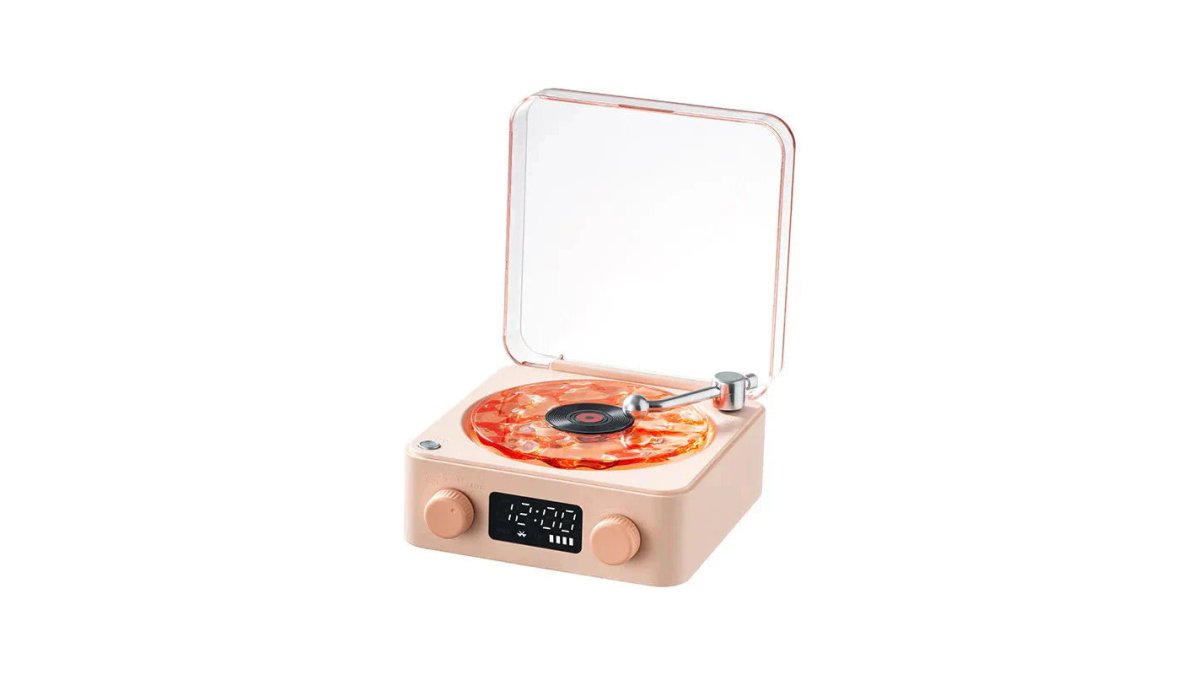
At £37.99, this speaker targets buyers who want a versatile desktop or bedside companion rather than a dedicated audiophile listening station. The design language is compact retro: the kind of piece that sits naturally next to a vinyl record or a stack of paperbacks without demanding attention.
What separates it from basic Bluetooth speakers in this price range is the built-in nature sounds and white noise functionality. For sleep, focus, or ambient background audio, having these modes built into the speaker itself removes the dependency on a streaming app or a separate white noise machine. The RGB ambient lighting adds a visual dimension that most speakers in this class don't offer, making it genuinely multifunctional as a bedside or desk accessory.
Bluetooth connectivity handles standard music streaming cleanly. The portable, lightweight design means it travels well for commuters and frequent movers who want consistent audio quality at their desk, in a hotel room, or in a home office setup. Customers like Daniel M. have noted they're "amazed by the quality and performance," which aligns with what this speaker is designed to deliver: reliable, everyday audio quality wrapped in a package that earns its place on your desk aesthetically.
The honest limitation: this is a compact single-unit speaker, not a bookshelf stereo pair. Soundstage and stereo imaging are inherently constrained by the form factor. For serious critical listening, you'd want a dedicated stereo setup. For everything else, desk use, sleep audio, travel, ambient background music, this speaker covers the brief well.
Are Retro Style Speakers Worth It for Serious Listeners?
The question serious listeners ask is whether retro style speakers represent a genuine audio choice or an aesthetic compromise.
The answer has changed in the past few years. Early retro-styled speakers were largely fashion products with mediocre drivers and thin cabinets. The current generation, particularly in the bookshelf and active desktop segments, includes products with measured performance that holds up against non-retro competitors at the same price point. The aesthetic is no longer a reliable indicator of audio quality in either direction.
For serious listeners, the relevant questions are these: Does the speaker publish measurements? Does the manufacturer have an engineering background or a design background? Are the drivers sourced from reputable suppliers?
A retro speaker that answers all three questions well is worth serious consideration. The listening experience it delivers, particularly in a well-treated room with correct placement, can be genuinely high-fidelity. The dynamic range and acoustic suspension design of the better bookshelf examples compare favourably with conventional-looking speakers at similar price points.
The caveat is that the retro category still attracts a higher proportion of style-first products than the conventional speaker market. Doing the research before buying matters more here than in categories where brand reputation and measurements are more consistently available. As Which? consumer electronics buying guides consistently notes, build quality and driver specification are the two most reliable predictors of long-term satisfaction in speaker purchases, regardless of aesthetic category.
For casual and semi-serious listeners, the retro aesthetic is simply a bonus. For dedicated audiophiles, the best retro speakers are now worth audition on sonic grounds alone.
Retro style speakers have moved well past the novelty phase. The best examples in 2026 offer genuine audio performance alongside the mid-century modern design language that makes them worth displaying. Electro Gift Shop's Mini Retro White Noise Bluetooth Speaker brings that philosophy to a compact, multifunctional form factor, combining Bluetooth streaming, built-in nature sounds, and RGB ambient lighting in a portable design built for daily use. Shop Now and bring home a speaker that sounds as good as it looks.
Frequently Asked Questions
Q: Do retro-style Bluetooth speakers sacrifice sound quality?
A: Not necessarily. Many retro style speakers with modern sound use updated driver technology, digital signal processing, and high-quality crossover networks inside their vintage-inspired cabinets. The key is checking specs like frequency response range, signal-to-noise ratio, and driver configuration rather than judging by looks alone. A well-engineered retro speaker can deliver audio performance that rivals purely modern designs, especially at the bookshelf and portable speaker tiers.
Q: What features should I look for in a vintage-style speaker?
A: Focus on driver quality, Bluetooth codec support (aptX or AAC for lower latency), build materials like solid wood veneer versus plastic laminate, and connectivity options beyond wireless. Also check whether the speaker is active or passive, since active speakers have built-in amplification and are easier to set up. Repairability matters too: speakers with replaceable drivers and accessible components last longer and hold their value better than sealed units.
Q: Are retro-style speakers worth the investment for audiophiles?
A: For audiophiles, retro style speakers are worth buying when the acoustic engineering backs up the aesthetic. Look for verified frequency response data, low harmonic distortion figures, and a well-designed crossover network. Vintage-inspired speakers that use modern components inside mid-century modern cabinets can produce a warm, wide soundstage that suits extended listening sessions. The aesthetic appeal is a bonus, not the reason to buy.
Q: How do modern components improve the sound of vintage-design speakers?
A: Modern components replace the weakest parts of classic speaker design. Updated drivers handle a wider dynamic range with less distortion. Digital crossover networks split frequencies more precisely than older passive components. Bluetooth chipsets with aptX or AAC codecs reduce latency and preserve audio fidelity during wireless streaming. Together, these upgrades let a retro style speaker deliver high-fidelity stereo sound while keeping the nostalgic design that makes it visually distinctive.
This article was written using GrandRanker