

What Are Retro Aesthetics? A 2026 Guide
Table of Contents
- Defining Retro Aesthetics
- The Role of Nostalgia in Retro Design
- 80s and 90s Design Trends That Define Modern Retro
- Retrofuturism vs. Traditional Retro Aesthetics
- The Psychology Behind the Retro Resurgence
- Retro Tech Design in Modern Gadgets
- How to Style Retro Gadgets in Your Space
- The Ethics of Nostalgia in Design
- Frequently Asked Questions
Last Updated: October 2, 2026
Defining Retro Aesthetics
Retro aesthetics is the deliberate use of design elements, visual styles, and cultural references from past decades, primarily the 1950s through 1990s, applied to contemporary products, spaces, and digital media. It's not about recreating the past exactly; it's about capturing the feeling of nostalgia while maintaining modern functionality and relevance.
What makes retro aesthetics distinct is its intentionality. A vintage item that's simply old is not retro. A retro product is something new designed to evoke an earlier era through color choices, typography, material finishes, and visual cues. Think of a Bluetooth speaker shaped like a 1970s transistor radio, or a camera styled after film SLRs from the 1980s. The device performs like 2026 technology, but it looks like it belongs in a different time.

The retro movement spans multiple design disciplines. Graphic designers use retro aesthetics in branding and packaging. Product manufacturers apply it to gadgets and home goods. Web designers incorporate retro elements into digital interfaces. At Electro Gift Shop, we offer products that blend nostalgic design with modern performance, speakers with vintage silhouettes that deliver crystal-clear audio, and cameras with retro bodies that shoot in full HD.
Retro aesthetics differ from minimalism and maximalism in their emotional purpose. Minimalism strips away detail to focus on function. Maximalism embraces abundance and visual complexity. Retro aesthetics, by contrast, celebrate specific historical moments and the design languages that defined them. A retro product tells a story about where it came from, even if it was manufactured last month.
The Role of Nostalgia in Retro Design
Nostalgia drives the retro aesthetic movement more than any other factor. It's not mere sentimentality, it's a psychological response to uncertainty and rapid change. When the world feels overwhelming, familiar visual cues from simpler times provide comfort and stability.
The psychology behind nostalgia is straightforward: our brains associate past design styles with positive memories, even if we didn't directly experience that era. Someone born in 2010 can feel nostalgic for 1980s aesthetics through films, music, and cultural references they've absorbed. That emotional connection translates into purchasing decisions. A retro-styled gadget doesn't just function well; it makes the user feel something.
This is why retro aesthetics have resurged so dramatically in recent years. As digital life accelerates, constant notifications, algorithm-driven feeds, endless choice, people crave the tangible, the deliberate, the designed-with-intention. A retro speaker with physical knobs and a warm color palette offers a counterpoint to the sleek, touchscreen-dominated aesthetic that dominated the 2010s.
Nostalgia also operates differently across generations. Millennials gravitate toward 1990s aesthetics, the era of their childhood. Gen Z often embraces 1980s and early 1990s styles, drawn to them through secondhand discovery and cultural nostalgia they didn't live through. This creates a rich market where retro products appeal across age groups, each finding different eras compelling.
80s and 90s Design Trends That Define Modern Retro
The 1980s and 1990s dominate contemporary retro aesthetics more than any other decades. These eras produced design languages so distinctive that they're instantly recognizable and endlessly reinterpretable.
The 1980s gave us neon colors, geometric shapes, and bold typography. Think hot pink, electric blue, and chrome finishes. The design philosophy was maximalist, more is more. Patterns clashed intentionally. Textures were tactile: brushed metal, plastic with visible grain, faux leather. This era celebrated the new and the technological. Design reflected optimism about the future, even as it looks deliberately artificial today.
The 1990s introduced a softer, more chaotic approach. Grunge aesthetics brought muted earth tones, distressed textures, and an anti-design sensibility. Simultaneously, the early internet inspired a playful, experimental digital aesthetic: misaligned text, pixelated graphics, bright but oddly saturated colors. The 1990s felt like a collision between analog decline and digital emergence, and that tension is precisely what makes 1990s retro so compelling now.
Modern retro gadgets often draw from both eras. A contemporary speaker might combine 1980s-inspired geometric form with 1990s color choices. A camera design might use 1980s industrial materials with 1990s playful typography. The Mini Retro White Noise Bluetooth Speaker from Electro Gift Shop exemplifies this blend: its compact, geometric shape echoes 1980s design philosophy, while its RGB ambient lighting and water-ripple rotation effect are features that blend contemporary and nostalgic elements.
Color Palettes and Typography
Color choice is the fastest way to signal a specific retro era. 1980s retro demands saturated, high-contrast colors: hot pink against electric blue, neon yellow on black. These colors feel energetic and slightly uncomfortable, intentionally so. They reject the muted, neutral palette that dominated much of the 2000s and 2010s.
1990s retro embraces a different palette: dusty rose, sage green, warm gray, soft peach. These colors feel nostalgic without being aggressive. They work well in home décor and consumer products because they're sophisticated while still evoking a specific era. Many contemporary retro products layer both palettes, a 1990s color scheme applied to 1980s geometric forms.
Typography reinforces the retro message. 1980s design favored sans-serif fonts with geometric precision: clean lines, uniform stroke weight, technological feeling. 1990s typography became more experimental: rounded sans-serifs, distressed fonts, playful irregularity. Modern retro design often uses slightly imperfect typography, letters that are almost aligned but not quite, creating visual tension that feels authentic to the era.
Visual Cues and Textures
Texture separates authentic retro design from generic "vintage-looking" products. Real 1980s and 1990s products had distinct tactile qualities. Brushed aluminum, ribbed plastic, faux leather, screen printing visible at the edges, these imperfections are what make retro products feel genuine.
Modern retro gadgets often replicate these textures through material choices or finish treatments. A speaker might have a matte plastic body with subtle grain, mimicking 1980s consumer electronics. A camera might feature brushed metal accents and slightly misaligned printing, evoking the handmade quality of 1990s design. These details matter because they signal intentionality. A product that looks retro through color alone feels cheap; a product that incorporates authentic material textures feels designed.
Visual cues, the small details that anchor a product to a specific era, are equally important. Rounded corners instead of sharp edges. Visible screws or rivets. Embossed logos. Analog dials instead of digital displays. These elements create a visual language that consumers instantly recognize and trust.
Retrofuturism vs. Traditional Retro Aesthetics
Retrofuturism is a distinct subset of retro design that deserves separate attention. While traditional retro aesthetics celebrate what actually existed in past decades, retrofuturism imagines what people in the past thought the future would look like.
Traditional retro is historically grounded. It replicates the actual design languages, color palettes, and materials of the 1980s, 1990s, or earlier eras. A retro speaker looks like speakers from a specific time period looked.
Retrofuturism is speculative. It draws from sci-fi films, futuristic product designs, and utopian visions from past decades. Think sleek chrome, bold geometric shapes, a sense of optimism about technology. Retrofuturism often incorporates elements that never actually existed in consumer products, design language borrowed from concept cars, space-age aesthetics, or retro-futuristic illustrations.
Many contemporary products blend both approaches. The Mini SLR-Shaped 1080P Pocket DV Camera from Electro Gift Shop uses traditional retro aesthetics, its form factor mimics actual SLR cameras from the 1980s and 1990s, while its compact size and digital functionality offer a blend of retro and modern. It looks like a camera from the past but performs like a device from the future.

The distinction matters for designers and consumers. Traditional retro appeals to people seeking authenticity and historical connection. Retrofuturism appeals to people who want the idea of the future as imagined in the past, a blend of optimism, technological wonder, and design boldness that feels distinct from both historical accuracy and contemporary minimalism.
The Psychology Behind the Retro Resurgence
Why has retro aesthetics become so dominant in 2026? The answer lies in several converging psychological and cultural factors.
First, digital saturation creates appetite for analog. Screens dominate modern life. Everything is touchscreen, algorithm-driven, optimized. Retro products, with physical knobs, tactile buttons, visible mechanical elements, offer a psychological break. They feel intentional and deliberate in a world that feels automated and invisible.
Second, nostalgia serves as psychological stability. Rapid technological change, economic uncertainty, and information overload create anxiety. Familiar design languages from the past, eras that feel simpler in retrospect, provide comfort. A retro gadget isn't just a product; it's a small act of resistance against overwhelming change.
Third, retro aesthetics signal taste and cultural awareness. Choosing a retro-styled product communicates that the owner understands design history, appreciates intentionality, and rejects mass-market uniformity. It's a form of cultural capital, a way of saying "I know where this design language comes from."
Mini Retro White Noise Bluetooth Speaker →
Fourth, retro design democratizes sophistication. A vintage or truly antique item signals wealth and access. A contemporary retro product, designed and manufactured now, offers the aesthetic benefits of vintage without the cost or rarity. Anyone can own a beautifully designed retro speaker or camera. This accessibility has driven the retro movement into mainstream consumer markets.
Retro Tech Design in Modern Gadgets
The intersection of retro aesthetics and modern technology is where the movement becomes most tangible. Contemporary tech companies face a design challenge: how do you make a 2026 device feel like it belongs in a different era while maintaining modern performance?
The solution involves strategic choices across multiple dimensions. Form factor is primary. A speaker designed to resemble a 1970s transistor radio immediately signals retro intention. A camera shaped like a film SLR from the 1980s creates instant recognition. These form factors aren't arbitrary, they're chosen because they're distinctive and emotionally resonant.
Material selection reinforces the retro message. Matte plastic finishes, brushed metal accents, and visible seams create texture and tactile interest. Modern manufacturing allows precise replication of vintage material qualities without the durability issues of actual vintage products. A contemporary retro speaker can have the look and feel of a 1980s device while featuring modern components, wireless connectivity, and reliable performance.
Color and finish treatments complete the aesthetic. A retro gadget typically uses a restrained color palette, two or three colors maximum, rather than the full spectrum available in digital design. This constraint mirrors manufacturing limitations of past decades and creates visual coherence. Matte finishes dominate; glossy surfaces feel too contemporary and undermine the retro effect.
Interface design presents the greatest challenge. How do you incorporate modern connectivity (Bluetooth, WiFi, USB-C charging) into a form that references pre-digital eras? The most successful retro products make this visible. Exposed ports, visible charging connections, and analog-style controls become design features rather than engineering necessities. This transparency, showing the "seams" between retro aesthetic and modern function, actually strengthens the retro effect. It says: "This is a contemporary product that chooses to look retro."
How to Style Retro Gadgets in Your Space
Retro gadgets work best when they're integrated intentionally into a designed space. A single retro speaker on a modern minimalist shelf looks out of place. The same speaker, surrounded by complementary design elements, becomes a focal point.
Start with a foundation. Decide whether you're building a cohesive retro aesthetic or using retro gadgets as accent pieces. A cohesive retro room incorporates furniture, lighting, textiles, and décor from a specific era or in a unified retro style. Accent pieces mean retro gadgets sit within a primarily contemporary or eclectic space, drawing attention through contrast.
For a cohesive retro aesthetic, choose your era first. 1980s retro calls for bold colors, geometric furniture, chrome or brushed metal finishes, and statement lighting. 1970s retro incorporates warm earth tones, natural materials, and organic shapes. 1990s retro uses muted colors, mixed materials, and an intentionally casual arrangement. Once you've chosen your era, select gadgets that align. A 1980s-styled speaker fits naturally into a room with 1980s furniture and décor. A 1990s-styled camera works with 1990s design language.
For accent pieces, let the gadget's color and form guide placement. A brightly colored retro speaker becomes a statement piece, place it where it draws the eye, on a shelf or desk where it's visible and accessible. A more neutral retro gadget can integrate more subtly, functioning as both tool and design element.
Lighting matters significantly. Retro gadgets often feature warm color temperatures or RGB lighting. Natural light and warm artificial light complement retro aesthetics. Harsh overhead lighting or cool-temperature LEDs can undermine the effect. Consider adding a vintage-style lamp or warm-toned lighting fixture near your retro gadgets.
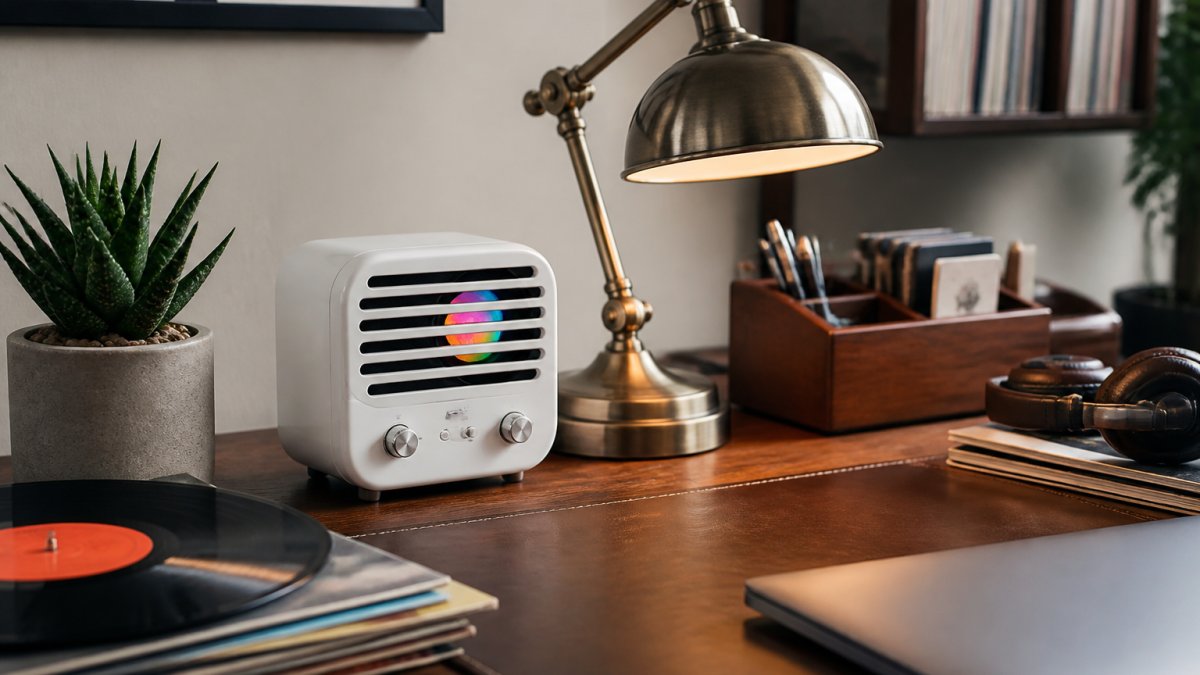
Grouping retro items creates visual impact. A single retro gadget can feel isolated. Two or three retro pieces, a speaker, a camera, a decorative object, arranged together create a curated aesthetic. This works especially well on shelves, desks, or side tables where multiple items naturally cluster.
Consider scale and proportion. A very small retro speaker on a large empty shelf looks diminished. The same speaker on a smaller shelf or desk, surrounded by other objects, feels intentional and balanced. Think about negative space, leaving room around retro gadgets so they're showcased rather than crowded.
Finally, use retro gadgets functionally. The best styling emerges from actual use. A speaker that sits on your desk and plays music throughout the day becomes integrated into your space naturally. A camera you carry and use regularly becomes part of your daily visual identity. Retro gadgets that are purely decorative and never used feel inauthentic.
The Ethics of Nostalgia in Design
As retro aesthetics have become mainstream, questions about authenticity and ethical design have emerged. Is it ethical to market new products as retro when they're manufactured using contemporary methods and sold at contemporary prices? Does retro design exploit nostalgia, particularly among people who didn't experience the eras being referenced?
These are legitimate concerns worth examining. Retro design can feel exploitative when it's purely superficial, when a product's retro appearance masks poor quality or when the design language is used manipulatively to charge premium prices for mediocre performance.
Authentic retro design, by contrast, respects the eras it references. It incorporates genuine design principles from those periods, uses appropriate materials and manufacturing techniques where feasible, and delivers actual performance that matches the aesthetic promise. A retro speaker that looks like a 1970s device but sounds tinny and distorted is dishonest design. A retro speaker that looks like a 1970s device and delivers excellent audio quality honors both the aesthetic and the function.
The ethical framework for retro design centers on transparency and authenticity. Consumers should understand that they're buying a contemporary product designed to evoke an earlier era, not an actual vintage item or a reproduction of one. Manufacturers should be clear about materials, construction, and performance specifications. The retro aesthetic should enhance the product's function, not disguise deficiencies.
There's also an ethical dimension to cultural appropriation in retro design. When retro aesthetics reference specific cultural or subcultural movements, punk, hip-hop, rave culture, designers should approach with respect and knowledge. Stripping cultural context from retro design elements to create a generic "retro" look can feel hollow or disrespectful to the communities that created those styles.
The most ethical approach to retro design acknowledges what it is: contemporary design that draws inspiration from the past. It doesn't pretend to be vintage. It doesn't claim to be "authentic" in ways that misrepresent manufacturing or origins. Instead, it celebrates the design languages of past eras while using modern technology, manufacturing precision, and performance standards. This honest approach, retro in appearance, contemporary in capability, is where the movement finds its strongest footing.
Retro aesthetics have moved beyond trend into something more fundamental: a design language that responds to contemporary needs for tactile engagement, historical connection, and intentional craftsmanship. Whether you're drawn to the bold maximalism of 1980s design, the experimental chaos of 1990s aesthetics, or the retrofuturistic optimism of mid-century futurism, retro design offers a way to personalize your space and your tools.
The key is choosing retro products that deliver on both fronts, authentic design language combined with genuine performance. At Electro Gift Shop, we've built our product selection around this principle: gadgets that look like they belong in a different era while performing at contemporary standards. The Mini Retro White Noise Bluetooth Speaker combines 1980s-inspired geometric design with modern Bluetooth connectivity and 4-6 hours of battery life. The Mini SLR-Shaped 1080P Pocket DV Camera delivers 1080P video capture in a form factor that references classic film cameras. Both honor retro aesthetics while delivering the reliability and functionality today's users expect. Start exploring retro-designed gadgets that match your aesthetic and your actual needs.
Frequently Asked Questions
Are 80s and 90s considered retro?
Yes, the 80s and 90s are now firmly classified as retro. What once felt contemporary has become a cultural touchstone, with those decades' design language defining modern retro aesthetics. Bright color palettes, bold typography, analog textures like grain and scanlines, and the visual language of early digital technology are core elements of retro style today. This shift reflects how quickly cultural memory moves, what was everyday 30-40 years ago now feels nostalgic and distinctive.
How does retro tech design differ from vintage?
Retro tech design is a modern interpretation inspired by past eras, blending nostalgic aesthetics with current technology and functionality. Vintage refers to authentic original products from those decades. Retro tech design intentionally recreates that visual language, misaligned typography, chromatic aberration, analog warmth, while delivering modern performance. The Mini Retro White Noise Bluetooth Speaker exemplifies this: it has the throwback look of 1970s-80s audio equipment but includes Bluetooth 5.0, USB charging, and contemporary features vintage speakers never had.
Why is retro tech making a comeback?
Retro tech appeals to multiple audiences: nostalgia for those who lived through those eras, aesthetic appreciation for younger generations discovering that design language, and a cultural reaction against minimalism. Retro design offers maximalism, texture, and personality, visual cues that stand out in a digital age dominated by flat, featureless interfaces. Additionally, retro tech satisfies a desire for tangible, tactile products with character, providing relief from the sterile sameness of contemporary consumer electronics.
Can retro aesthetics work across different industries?
Absolutely. Retro aesthetics transcend product categories. Fashion, home décor, graphic design, hospitality, and automotive industries all draw on retro visual language. The underlying principles, specific color saturation, typography choices, texture, and cultural references, are adaptable. A retro-styled portable camera or Bluetooth speaker uses the same design philosophy as retro fashion or interior design: honoring past visual identity while serving modern needs. This cross-industry application proves retro aesthetics is a design movement, not a niche trend.