

Compact Speakers With Deep Bass: 2026 Buying Guide
Table of Contents
- Compact Speakers With Deep Bass: What Actually Matters
- How to Find the Best Small Speaker With Bass
- Choosing a Portable Bluetooth Speaker for Bass
- Compact Bluetooth Speakers: Dimensions, Weight, and Real Portability
- Loud Bass Bluetooth Speakers: Volume, Distortion, and Room Size
- Deep Bass vs Boosted Bass: How to Tell the Difference
- Battery Life, Charging, and Long-Term Ownership
- Common Mistakes When Buying Compact Speakers With Deep Bass
- Conclusion: Matching Bass Performance to How You Listen
- Frequently Asked Questions
Last Updated: October 13, 2026
Compact Speakers With Deep Bass: What Actually Matters
Compact speakers with deep bass are small-format audio devices, typically under 20 cm wide, designed to reproduce low frequencies convincingly despite their size. The trick is physics: a small cabinet can only move so much air, so engineers rely on passive radiators, sealed chambers, and digital processing to fake the weight and punch of a bigger box. This guide from Electro Gift Shop breaks down what genuinely separates a compact speaker that thumps from one that just rattles.
Here's the uncomfortable truth most buying guides skip: "deep bass" in a compact speaker is almost always a trade-off, not a free upgrade. You are choosing between bass extension, maximum volume, battery life, and physical size. You cannot max out all four. The speakers that claim otherwise are usually boosting a narrow band of frequencies, not reproducing real low-frequency response.
Below, we'll show you how to read a spec sheet honestly, what to listen for at low volume, and which mistakes cost people money. We'll also cover why a compact speaker that sounds great at 60% volume can fall apart at 90%, and how to match a speaker to the room you actually use it in.
How to Find the Best Small Speaker With Bass
The best small speaker with bass is one that stays controlled at the volume you actually listen at, not the one with the biggest claimed wattage. Wattage numbers on compact speakers are marketing, not measurement. A 20W driver in a well-sealed cabinet can outperform a 40W driver in a rattling plastic shell.
Start with three questions:
- What is the cabinet made of? Rigid materials (metal, dense plastic, wood) resist vibration. Thin plastic flexes and muddies bass.
- Is there a passive radiator? A passive radiator is an unpowered cone that moves with air pressure inside the cabinet, extending low-frequency response without a second powered driver.
- What volume do you listen at? Most compact speakers are tuned for 50-70% volume. Above that, distortion climbs fast.
A common mistake is buying on peak wattage alone. Peak figures describe a momentary spike, not sustained output. Look for RMS or rated power if the manufacturer publishes it, and treat any speaker that lists only "peak" as a question mark.
Bluetooth SIG audio specifications and codec documentation
Driver Size, Cabinet Volume, and Passive Radiators
Driver size tells you the potential, not the result. A larger driver moves more air, but only if the cabinet gives it room to travel. Cram a 5 cm driver into a sealed shell with no breathing space and you get punchy mid-bass with almost no low-frequency extension.
Cabinet volume is the constraint nobody advertises. Two speakers can share identical drivers and sound completely different because one has internal bracing and the other does not. Passive radiators are the workaround: they let a small cabinet behave like a larger one at low frequencies, at the cost of some efficiency.
What the Spec Sheet Won't Tell You
Frequency response ranges are the most abused spec in compact audio. A speaker claiming "20Hz-20kHz" at a compact size is almost certainly quoting a range at a volume where the bass is inaudible. What matters is the range at a usable output level, and almost no manufacturer publishes that.
Here's what to check instead: does the listing state a tolerance, such as "±3dB"? A range without a tolerance is meaningless. Also look for total harmonic distortion figures. High distortion at low frequencies is what makes cheap bass sound flabby rather than tight.
Choosing a Portable Bluetooth Speaker for Bass
A portable Bluetooth speaker for bass needs three things working together: a rigid cabinet, a tuned passive radiator, and enough amplifier headroom to avoid clipping at your listening volume. Miss any one of those and the bass either disappears or turns to mush.

Bluetooth version matters less than people think for sound quality. Bluetooth 5.0 and later handle range and connection stability well. What actually affects your listening experience is the codec, the latency, and how the speaker handles multi-unit pairing.
Codec, Latency, and Multi-Speaker Connectivity
Codec support determines how much audio data reaches the speaker. The baseline is SBC, which is universal but compresses aggressively. AAC is common on Apple devices and generally preserves more detail than SBC. aptX and LDAC push further, but on a compact speaker with a small driver, the audible difference between SBC and a higher-quality codec is smaller than on full-size headphones. The codec matters most when the source material has dense low-frequency content, the kind of bass line that SBC tends to smear.
Latency is the delay between the video on your screen and the sound from the speaker. For music, latency is invisible. For video, anything above roughly 100 milliseconds becomes noticeable as lip-sync drift. If you plan to use a compact speaker for films or gaming, check whether the speaker supports a low-latency mode. Some speakers advertise this as a "game mode" or "video mode" that drops latency to around 60-80 milliseconds, which is generally below the threshold where most viewers notice.
Multi-speaker connectivity lets you pair two units for true stereo separation. This matters more than bass boost for perceived sound quality, because stereo imaging makes a small speaker feel larger than it is. Two compact speakers placed a meter apart will almost always outperform a single larger speaker on soundstage, even if the single unit has deeper bass extension. If you plan to pair units, check whether the speakers support stereo pairing (left/right channel split) or only party mode (both play the same channel). Stereo pairing is the one that improves imaging; party mode just increases volume.
Bluetooth SIG audio specifications and codec documentation
Compact Bluetooth Speakers: Dimensions, Weight, and Real Portability
Compact Bluetooth speakers are defined by measurable size and weight, not by marketing language. If a listing does not publish dimensions and weight, treat "portable" as unverified. A speaker you cannot comfortably carry in one hand or slip into a bag is a desk speaker with a handle.
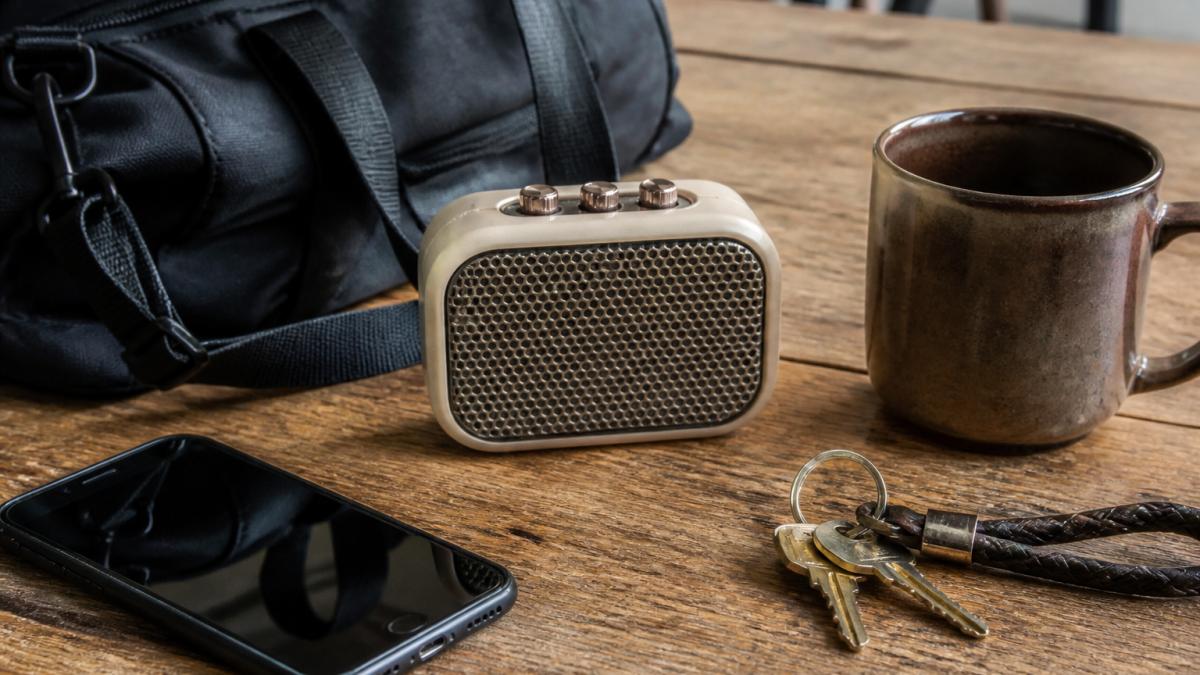
For reference, our Mini Retro White Noise Bluetooth Speaker measures 5.6 x 6 x 2.64 inches and weighs little enough to sit on a bedside table or travel in a bag. That footprint is the practical benchmark: anything much larger starts competing for desk space rather than fitting into it.
Portability has a cost. Smaller cabinets mean less internal volume, which limits how low the speaker can go. A speaker designed for a backpack will almost always lose to a desk-bound unit on bass extension. Decide which matters more before you shop.
| Use Case | Size Priority | Bass Expectation | What to Check |
|---|---|---|---|
| Bedside or desk | Small footprint | Moderate, tuned for low volume | Cabinet rigidity, low-volume clarity |
| Commute and gym | Fits in a bag | Punchy mid-bass | Weight, durability, water resistance |
| Outdoor gatherings | Larger compact | Higher output | Max volume before distortion |
| Travel | Lightest option | Limited extension | Battery life, charging speed |
Loud Bass Bluetooth Speakers: Volume, Distortion, and Room Size
Loud bass Bluetooth speakers are limited by physics before they are limited by wattage. A compact cabinet can only displace so much air, so volume and bass extension pull against each other. Turn the dial past the speaker's tuned range and the bass stops getting louder and starts getting messier.
The mechanism is straightforward: as the driver cone travels further to produce more low-frequency output, it moves outside its linear range. The result is compression, the bass stops scaling with volume, and distortion, which manifests as a thickening or blurring of low notes. Most compact speakers hit this wall somewhere between 70% and 90% of their maximum volume, depending on cabinet rigidity and amplifier headroom.
Mini Retro White Noise Bluetooth Speaker →
Room size changes everything. A small speaker in a small room sounds fuller because the walls reinforce low frequencies. This is called room gain, and it typically adds 3-6 dB of perceived bass below 100 Hz in a typical bedroom or office. The same speaker in a large open space loses that reinforcement and sounds thin. This is why a speaker that impressed you in a shop can disappoint at home, the shop's listening room may have different dimensions and boundary placement than your living space.
A Repeatable Test You Can Run Before Buying
If you can test a speaker in person, use the same three-track routine every time. This makes comparisons meaningful rather than impressionistic.
- Track one: a familiar bass-heavy song. Listen for whether the bass line stays distinct or turns into a single thud. A well-tuned speaker lets you hear pitch and decay; a poorly tuned one collapses everything into one note.
- Track two: a vocal-forward recording. Listen for whether vocals stay clear or get recessed behind the bass. Bass that bleeds into the midrange is a sign of boosted upper-bass rather than true low-frequency extension.
- Track three: a dynamic orchestral or acoustic piece. Listen for whether quiet passages remain audible when the volume is low. This is the low-volume bass test that most buyers skip.
Run each track at three volumes:
- Low volume (around 30-40%): Can you still hear the bass line, or does it vanish? A well-designed compact speaker keeps bass audible at low volume; a cheap one relies on volume to mask poor tuning.
- Mid volume (around 60-70%): Is the bass tight and controlled, or boomy? This is where most compact speakers are tuned to sound their best.
- High volume (around 85-100%): Does the sound stay clean, or does it distort and compress? Listen for whether the bass stops getting louder and starts getting thicker.
Matching Output to Room Size
A compact speaker rated for a small room will struggle in a large open-plan space, regardless of its wattage. As a rough guide, a single compact speaker can fill a bedroom or office up to about 15 square meters. Beyond that, you either need a larger speaker or a second unit for stereo pairing. Outdoors, there is no room gain at all, so expect to lose the low-frequency reinforcement you get indoors. If outdoor bass matters to you, prioritize speakers with a passive radiator and a rigid cabinet over those with the highest wattage claims.
Deep Bass vs Boosted Bass: How to Tell the Difference
Deep bass reproduces low frequencies accurately. Boosted bass exaggerates a narrow band, usually somewhere in the upper bass region, to create the impression of weight. The first survives a critical listen. The second impresses for thirty seconds and then fatigues your ears.
You can usually tell the difference within one track. Boosted bass makes kick drums sound thick and one-note. Deep bass lets you hear the pitch and decay of the same kick. Boosted bass also tends to bleed into vocals, making them sound recessed.
If a speaker has an equalizer or bass boost setting, try the same track with it on and off. On a well-tuned speaker, the difference should be subtle. On a poorly tuned one, bass boost is doing the work the cabinet should be doing.
Audio Engineering Society papers on low-frequency reproduction
Battery Life, Charging, and Long-Term Ownership
Battery life claims are usually measured at moderate volume with bass-heavy content avoided. Real-world runtime drops when you push volume up, because moving air takes power. If a speaker claims 10 hours, plan for less if you listen loud.
Charging speed matters more than people expect. A speaker that takes six hours to charge and runs for four is a speaker that spends more time on the cable than off it. Look for USB charging and check the rated charge time alongside the playback time.
Our Mini Retro White Noise Bluetooth Speaker runs on a 1500mAh battery with 4-6 hours of playtime and recharges in 2-3 hours via USB. That ratio, roughly two hours of charging for four to six hours of playback, is a reasonable benchmark for a compact unit.
Long-term ownership comes down to three things: battery replacement, build quality, and whether the controls are physical or app-dependent. Physical knobs and buttons outlast touch panels and rarely break. If a speaker relies entirely on an app, its useful life is tied to that app staying supported.
Common Mistakes When Buying Compact Speakers With Deep Bass
The most common mistake is buying bass boost instead of bass extension. Boost impresses in a shop and disappoints at home. Extension costs more to engineer, which is why fewer compact speakers deliver it.
Other mistakes we see repeatedly:
- Ignoring the listening environment. A speaker tuned for a small room sounds thin outdoors.
- Trusting peak wattage. Peak power describes a spike, not sustained output.
- Skipping the dimensions. "Portable" without a size and weight is a claim, not a spec.
- Overlooking connectivity. No AUX input or memory card slot means you are dependent on Bluetooth alone.
- Assuming water resistance. Splash resistance and full waterproofing are different ratings.
The fix is simple: decide your primary use case first, then filter speakers by the specs that matter for it. Bass extension for a desk, durability for a gym bag, output for a garden. Trying to optimize for all three at once is how people end up with a speaker that does none of them well.
Conclusion: Matching Bass Performance to How You Listen
The best compact speaker with deep bass is the one tuned for your actual listening habits, not the one with the loudest spec sheet. Decide whether you need low-volume clarity, outdoor output, or portability first. Everything else follows from that.
At Electro Gift Shop, we build compact audio gear around exactly that idea: portable design, crystal-clear audio, and reliable performance for work, play, or travel. Our Mini Retro White Noise Bluetooth Speaker combines a compact 5.6 x 6 x 2.64 inch frame with Bluetooth 5.0, AUX and TF card playback, and a 1500mAh battery that recharges in 2-3 hours.
If you want a compact speaker that sounds balanced at the volume you actually use, browse the Electro Gift Shop collection and find the one that fits how you listen.
Frequently Asked Questions
Can compact speakers produce deep bass?
Yes, but with limits. A compact speaker moves less air than a full-size cabinet, so true low-frequency response usually stops around 60-80 Hz rather than the 40 Hz a subwoofer reaches. Designers compensate with passive radiators, sealed chambers, and DSP tuning. The result can feel punchy and full in a small room, but it will not reproduce the physical rumble of a dedicated subwoofer. Set expectations around perceived bass impact rather than measured extension.
What should I look for in a small Bluetooth speaker with strong bass?
Check four things: driver size (usually 40-52 mm in compact models), the presence of a passive radiator, stated low-frequency response, and distortion at high volume. Also confirm Bluetooth version, codec support, and battery capacity. A 1500mAh battery, for example, typically gives 4-6 hours of playtime. Physical dimensions matter too, since a speaker measuring around 5.6 x 6 x 2.64 inches fits on a bedside table but won't fill a large room.
Does a speaker need a subwoofer to produce deep bass?
Not always, but it helps for the lowest frequencies. A subwoofer handles roughly 20-80 Hz, which compact speakers cannot reach at usable volume. However, many compact speakers with deep bass use passive radiators and sealed enclosures to deliver convincing bass response down to around 60 Hz. For desk use, indoor listening, or outdoor listening in a small space, that is often enough. For parties or large rooms, a separate subwoofer still wins.
Is loud bass bad for speakers?
Sustained playback at maximum volume with heavy bass boost can damage a compact driver over time. The risk is distortion: when a driver is pushed past its excursion limit, the cone movement becomes uncontrolled and can fatigue the suspension. Most compact speakers include a limiter that reduces output near the threshold, which protects the driver but also flattens dynamics. Using an equalizer to cut rather than boost bass, and keeping volume below maximum, extends speaker life.