

High Performance Audio for Small Rooms: 2026 Guide
Table of Contents
- Understanding High Performance Audio for Small Rooms
- The Physics of Small Room Acoustics
- Choosing the Right Speaker Type for Compact Spaces
- Compact Desktop Speakers for Near-Field Listening
- Small Room Acoustic Treatment Strategies
- Optimizing Your Near-Field Listening Setup
- Subwoofer Integration in Compact Spaces
- Digital Signal Processing and Room Correction
- Soundbar vs. Discrete Component Systems
- Budget-Friendly Audio Solutions for Small Rooms
- High-End Stereo Configurations for Compact Environments
- Speaker Placement and Positioning Tips
- Common Mistakes When Setting Up Audio in Small Rooms
- Frequently Asked Questions
Last Updated: September 3, 2026
Understanding High Performance Audio for Small Rooms
High performance audio for small rooms isn't about cramming expensive components into a closet. It's about solving the physics problems that small spaces create, then choosing equipment that works within those constraints. Modern speakers, digital signal processing, and acoustic treatment techniques have made high performance audio for small rooms genuinely achievable.
This guide covers the technical and practical aspects of creating a high performance audio system for small rooms. We'll explore the physics that govern compact spaces, recommend speaker types that excel in tight quarters, and walk through proven strategies for acoustic optimization. Whether you're setting up a home office, bedroom, or apartment, these principles will help you extract maximum audio quality from your space.
The Physics of Small Room Acoustics
Room acoustics aren't optional considerations, they're the foundation of everything you hear. In small rooms, the acoustic environment often matters more than the speakers themselves.
Room modes and standing waves
Room modes are resonant frequencies where sound waves bounce between parallel walls and reinforce themselves. In small rooms, these modes cluster in the low-frequency range, typically between 20 Hz and 200 Hz (peer-reviewed research). When a speaker's output aligns with a room mode, that frequency gets amplified, creating boomy bass. When it misses, you get a dip.
The lowest room mode frequency is determined by the room's longest dimension. A 16-foot room has a fundamental mode around 35 Hz; a 10-foot room generates a mode near 56 Hz. Standing waves form when sound reflects off walls and interferes with itself. In a small room, you might have 8-12 significant room modes in the bass region alone. Some listening positions sit at pressure peaks where bass is exaggerated; others sit at nulls where bass nearly disappears.
The practical implication: you can't simply place a subwoofer anywhere and expect balanced bass. Room modes dictate where bass will be strong and weak. Strategic speaker placement and digital signal processing become critical.
Reflection points and bass buildup
Every surface reflects sound. Hard surfaces like drywall, glass, and wood create specular reflections that bounce predictably. These reflections reach your ears milliseconds after the direct sound, creating phase cancellations and colorations that muddy the audio.
Bass buildup occurs because low frequencies have long wavelengths, a 50 Hz tone has a wavelength of roughly 23 feet. These long waves interact with room boundaries in ways that mid and high frequencies don't. Bass accumulates in room corners because sound pressure is highest where walls meet, which is why many small rooms exhibit boomy, undefined bass.
The critical reflection points are the first-reflection surfaces: walls immediately to the left and right of your listening position, the ceiling above you, and the wall behind your head. Sound reflecting from these surfaces reaches your ears quickly enough to blur the speaker's original output. Treating these points with absorption or diffusion is one of the highest-impact moves you can make.
Choosing the Right Speaker Type for Compact Spaces
Not all speakers perform equally in small rooms. Some designs are far better suited to tight quarters than others.
Bookshelf vs. floorstanding speakers
Bookshelf speakers are engineered for near-field listening in compact spaces. They're designed to be placed on stands or shelves, typically 24-36 inches from the floor, and positioned 2-4 feet from the listening position. This proximity means direct sound reaches your ears before room reflections become significant, so you hear the speaker's output more directly and less of the room's colorations.
Floorstanding speakers are designed to pressurize larger rooms. In a small room, they couple directly to the floor, exciting room modes more aggressively. The bass becomes room-dependent rather than speaker-dependent, and you lose control over low-frequency response.
For high performance audio for small rooms, bookshelf speakers are typically the better choice. They allow you to control their interaction with room modes through careful placement and equalization.
All-in-one streaming systems
All-in-one systems integrate an amplifier, DAC (digital-to-analog converter), and speakers into a single unit. Modern systems often include digital signal processing (DSP) and room correction capabilities built-in. Their strength is simplicity: you unbox them, connect power and a network source, and you're listening.
The trade-off is flexibility. You can't upgrade individual components or optimize speaker placement independently. For users who want high performance audio for small rooms without complexity, all-in-one systems offer genuine appeal. Quality all-in-one systems deliver better audio than basic Bluetooth speakers.
Compact Desktop Speakers for Near-Field Listening
Near-field listening is one of the most underrated approaches to high performance audio for small rooms. It means positioning speakers close to your ears, typically 2-4 feet away, so direct sound reaches you before significant room reflections. At this distance, the room's acoustic problems matter far less because you're hearing the speaker's output more than the room's coloration.
Desktop speakers designed for near-field listening are typically compact, with drivers in the 3-5 inch range. They're engineered to deliver flat frequency response at short distances, making them ideal for small rooms where you're listening from a desk or seated position close to the speakers.
The Electro Gift Shop Mini Retro White Noise Bluetooth Speaker exemplifies the near-field approach. At $37.99, it combines portable form factor with genuine audio quality, RGB ambient lighting, and built-in nature sounds. For desktop listening in compact spaces, this type of near-field system delivers surprising performance without requiring acoustic treatment or complex setup.

Near-field listening solves several small-room problems simultaneously. Bass response becomes more predictable because you're closer to the source. Imaging and soundstage improve because reflections are less prominent. You can achieve high performance audio for small rooms with minimal acoustic treatment simply by positioning speakers optimally for near-field listening.
The limitation is obvious: it works for one listener or a small group seated close together. For personal listening at a desk, in a bedroom, or in a home office, near-field listening is often the most practical solution.
Small Room Acoustic Treatment Strategies
Acoustic treatment is where theory becomes practice. It's the most cost-effective way to improve audio performance in a small room. The challenge is that small rooms are rarely dedicated listening spaces, they're bedrooms, home offices, living rooms, and shared apartments. Your acoustic treatment must be aesthetic, removable, and compatible with normal living.
Understanding absorption and diffusion
Absorption removes sound energy by converting it to heat. Porous materials like foam, mineral wool, and fiberglass absorb sound across a range of frequencies. A 2-inch foam panel absorbs mid and high frequencies effectively (roughly 500 Hz and above) but does little for bass (peer-reviewed research). A 4-inch panel extends absorption lower, becoming effective down to around 250 Hz. For bass frequencies below 100 Hz, you need either very thick absorption (8+ inches) or specialized bass traps using rigid fiberglass in an enclosed cavity.
Diffusion scatters sound rather than absorbing it. A diffusor breaks up reflections so they scatter in many directions instead of bouncing straight back. This preserves spaciousness while reducing the impact of first-reflection points. In small rooms, diffusion is often preferable to absorption because it maintains a sense of space without making the room feel dead.
Combine both approaches. Treat first-reflection points with absorption, then add diffusion or additional absorption to other surfaces. A single 2×4 foot absorption panel at the first-reflection point on each side wall costs $50-150 and delivers audible improvement.
Treating non-dedicated rooms: aesthetic and removable solutions
Most people don't have dedicated listening rooms. Your acoustic treatment needs to be aesthetic, removable, and compatible with existing décor.
Fabric-wrapped absorption panels are the solution. These panels are wrapped in acoustically transparent fabric in neutral colors (charcoal, light gray, white, navy) and can be hung like artwork using standard picture hangers. Position them strategically at first-reflection points without making the room look like a recording studio. A 2×4 foot panel costs $80-150 and can be removed without wall damage.
Bass traps address bass buildup in room corners. Even a 12×12 inch panel in each corner reduces low-frequency resonances. Many are designed to look like decorative elements: fabric-wrapped cubes, corner shelves with integrated absorption, or panels that resemble art installations.
For renters or those who cannot modify walls, freestanding absorption panels on stands offer complete flexibility. These can be positioned at first-reflection points and moved without installation.
Ceiling treatment is often overlooked but critical. A fabric ceiling cloud, a suspended panel hung from the ceiling above your listening position, absorbs ceiling reflections without requiring permanent installation. A 2×4 foot cloud positioned 12-18 inches above ear level addresses this problem effectively.
Strategic placement for maximum impact
The critical reflection points are the walls immediately to the left and right of your listening position, the ceiling directly above you, and the wall directly behind your head. Treating these four points addresses roughly 70-80% of the acoustic problems in a small room.
Start with the side walls. Position absorption panels at ear level on the wall to your left and right, roughly 2-3 feet from your listening position. To find the exact reflection point, have someone hold a mirror on the wall while you sit in your listening position. Where you can see the speaker in the mirror is where the first reflection occurs. Place your absorption panel there.
Next, treat the ceiling. A single 2×4 foot panel or cloud positioned directly above your listening position addresses ceiling reflections. This is particularly important in rooms with hard ceilings.
Room corners benefit from bass traps, though corner placement is less critical than first-reflection points. Even modest corner treatment reduces bass boom. The combination of side-wall and ceiling treatment plus corner bass traps typically delivers balanced, clear audio in a small room.
Optimizing Your Near-Field Listening Setup
Near-field listening requires specific optimization to work effectively.
Position your speakers at ear level when seated. The tweeter should be at approximately ear height, angled toward your ears. This might mean using speaker stands, wall mounts, or desktop risers.
The distance from your ears to each speaker should be equal. Even a 6-inch difference is audible. Symmetry is critical for achieving proper imaging and soundstage.
The angle between your listening position and each speaker should form an equilateral triangle, or close to it. If you're sitting 3 feet from each speaker, the speakers should be roughly 3 feet apart. This geometry optimizes the stereo image.
Listen at moderate volume levels. Near-field listening doesn't require high volume because you're close to the source. Lower volume levels actually improve audio quality by reducing distortion. Most listeners find that near-field systems sound best at 80-90 dB SPL (sound pressure level) (peer-reviewed research).
Allow time for your ears to adjust. When you first optimize a near-field listening setup, it might sound unfamiliar. Give yourself a week of regular listening before deciding whether the setup works.
Subwoofer Integration in Compact Spaces
Subwoofers in small rooms are often implemented poorly, but a well-integrated subwoofer solves the most difficult problem in small-room acoustics: room modes. A subwoofer's role is to fill in the bass below where room modes dominate, typically below 80-100 Hz. This requires careful crossover frequency selection and phase alignment.
Position your subwoofer in the location where bass response sounds most balanced from your listening position. This is often not where you'd intuitively expect. Many people place a subwoofer in a corner, but corner placement exaggerates room modes. Experiment with different locations and listen for the position where bass sounds most even and least boomy.
Once positioned, set the crossover frequency to where your main speakers' bass response meets the subwoofer's output. For most bookshelf speakers, this is 80-100 Hz. Set the subwoofer's level so it blends seamlessly with your main speakers. You shouldn't be aware of the subwoofer as a separate source.
Phase alignment is critical. Most subwoofers include a phase control (0-180 degrees). Adjust this so the subwoofer's output aligns with your main speakers' bass output. Correct phase alignment creates a smooth, unified bass response.
For high performance audio for small rooms, subwoofer integration is often the most effective upgrade you can make.
Digital Signal Processing and Room Correction
Digital signal processing (DSP) and room correction software represent a fundamental shift in how we approach small-room acoustics. For small rooms, where physical space constraints make traditional treatment difficult, DSP is often the most practical solution.
How room correction solves small-room physics problems
Room correction works by measuring your room's frequency response at your listening position, identifying peaks and dips caused by room modes and reflections, and applying inverse equalization to flatten the response.
When you measure a small room's frequency response, you typically see dramatic peaks and dips in the bass region (20-200 Hz). These peaks occur at room mode frequencies where sound waves reinforce themselves. A peak might be +8 dB at 65 Hz and another +6 dB at 95 Hz. Dips occur at frequencies where room modes create cancellation, sometimes dropping −6 dB or more.
Room correction applies inverse equalization to flatten these peaks and dips. If there's a +8 dB peak at 65 Hz, the correction applies a −8 dB cut at that frequency. The result is a flattened frequency response curve where bass sounds balanced across the frequency range.
The advantage of DSP-based room correction is that it works in rooms where physical acoustic treatment is impractical or aesthetically unacceptable. You can achieve balanced bass and controlled reflections without hanging panels or installing bass traps.
DSP implementation: built-in vs. external
Built-in DSP in speakers and amplifiers is the most seamless approach. Many modern integrated amplifiers, powered speakers, and all-in-one systems include DSP and room correction built-in. Some systems include a measurement microphone that automatically measures your room and applies corrections. The advantage is simplicity. The disadvantage is that you're locked into the manufacturer's correction algorithm.
External DSP processors offer more flexibility. A standalone DSP unit sits between your source and amplifier, applying room correction to the signal before amplification. These devices typically include measurement microphones and software for customizing the correction. They're more expensive but offer greater control.
Software-based room correction runs on a computer or streaming device. Your computer measures your room, calculates correction filters, and applies them in real-time. This approach is highly flexible and often the most affordable. Software options range from free to professional-grade.
Measurement and calibration
Accurate room correction depends on accurate measurement. The process typically involves:
-
Microphone placement: Measure at your primary listening position, at ear level. Some systems recommend multiple measurement positions to average the response across the listening area.
-
Measurement frequency range: The critical range for small rooms is 20 Hz to 500 Hz, where room modes and bass buildup occur.
-
Averaging and smoothing: Raw frequency response measurements are noisy. Most systems average multiple measurements and apply smoothing to identify true room modes. A smoothing setting of 1/3 octave is typical.
-
Correction target: Most systems default to a flat frequency response. Some allow customization, you might prefer a slight bass boost for a warmer sound, or a presence peak for more detail.
Limitations and trade-offs
Position-dependent correction: DSP correction works best for the listening position where measurement occurred. Move 3 feet to the left or right, and the correction becomes less effective. This is why DSP is particularly well-suited to near-field listening setups.
Bass mode correction limitations: DSP can flatten bass response at your listening position, but it cannot eliminate room modes, it only corrects for them at that specific location. This is a fundamental physics limitation.
Latency: Some DSP systems introduce latency (delay) between input and output. This is typically 10-50 milliseconds, which is inaudible for music listening but can be problematic for video synchronization.
Combining DSP with physical treatment
For high performance audio for small rooms, DSP and physical acoustic treatment are complementary. Use physical treatment to address reflections and diffusion. Use DSP to address frequency response and room modes. Together, they create balanced, detailed audio in a small room.
Soundbar vs. Discrete Component Systems
Soundbars have become ubiquitous, and modern high-end soundbars can deliver impressive audio quality. But they're fundamentally different from discrete component systems.
A soundbar integrates multiple drivers into a single, typically horizontal enclosure. This design constraint means drivers are packed closely together, which limits soundstage and imaging. The physics of speaker separation directly affects how well a system can create a convincing stereo image.
Discrete component systems use separate left and right speakers positioned to optimize soundstage and imaging. The drivers are separated in space, which creates a wider, more convincing stereo field. Even modest bookshelf speakers typically outperform a soundbar in terms of soundstage and imaging.
Soundbars excel at convenience and space efficiency. For casual listening and movie watching, a quality soundbar can be satisfying. For music listening and high performance audio for small rooms, discrete speakers are the better choice.
If you're building a high performance audio for small rooms system focused on music listening, choose discrete speakers. If you're optimizing a home theater setup or you need a solution that doubles as a design element, a quality soundbar is worth considering.
Budget-Friendly Audio Solutions for Small Rooms
High performance audio for small rooms doesn't require a large budget. Some of the best value comes from focusing on room optimization rather than expensive equipment.
Start with a quality pair of bookshelf speakers in the $100-300 range. Pair them with modest speaker stands ($50-100) to position them at ear level. This foundation costs $150-400 and delivers audio quality that many people find satisfying.
Add acoustic treatment next. Two absorption panels at first-reflection points cost $100-200 and make an audible difference. This is often a higher-impact upgrade than spending more on speakers.
If your budget allows, add a modest subwoofer ($200-400). This solves the room-mode problem that's the biggest challenge in small rooms.
Finally, consider room correction software. Many options are available at modest cost, and some are free. This is particularly valuable if physical treatment isn't practical in your space.
The total investment for a genuinely good high performance audio for small rooms system is often $500-800. This delivers audio quality that's competitive with systems costing several times as much.
The key principle is to prioritize room optimization over equipment cost. A modest speaker in an optimized room will outperform an expensive speaker in an unoptimized room.
High-End Stereo Configurations for Compact Environments
High-end audio in small rooms is possible, but it requires a different approach than high-end audio in large rooms.
A high-end small-room system typically starts with high-quality bookshelf speakers ($1,000-3,000 per pair). Amplification matters more in small rooms than many people realize. A high-quality integrated amplifier ($1,000-5,000) delivers better sound than budget amplification, even at modest listening levels.
High-end systems also typically include high-quality source components: a DAC or streaming device ($500-2,000) and quality cables. Room treatment becomes even more critical in high-end systems. High-end listeners typically invest 15-20% of their system cost in room treatment.
Subwoofer integration in high-end systems is often more sophisticated. High-end subwoofers ($1,500-4,000) include advanced controls for phase alignment, crossover adjustment, and room correction.
The total investment in a high-end small-room system is typically $5,000-15,000. This delivers audio quality that rivals much more expensive large-room systems because the room optimization is so much more effective.
High-end audio for small rooms requires understanding that the constraints of the space demand different design philosophy than large-room systems. Near-field listening, careful room treatment, and high-quality component selection are non-negotiable.
Speaker Placement and Positioning Tips
Speaker placement is where theory meets practice, and it's often the highest-impact adjustment you can make in a small room.
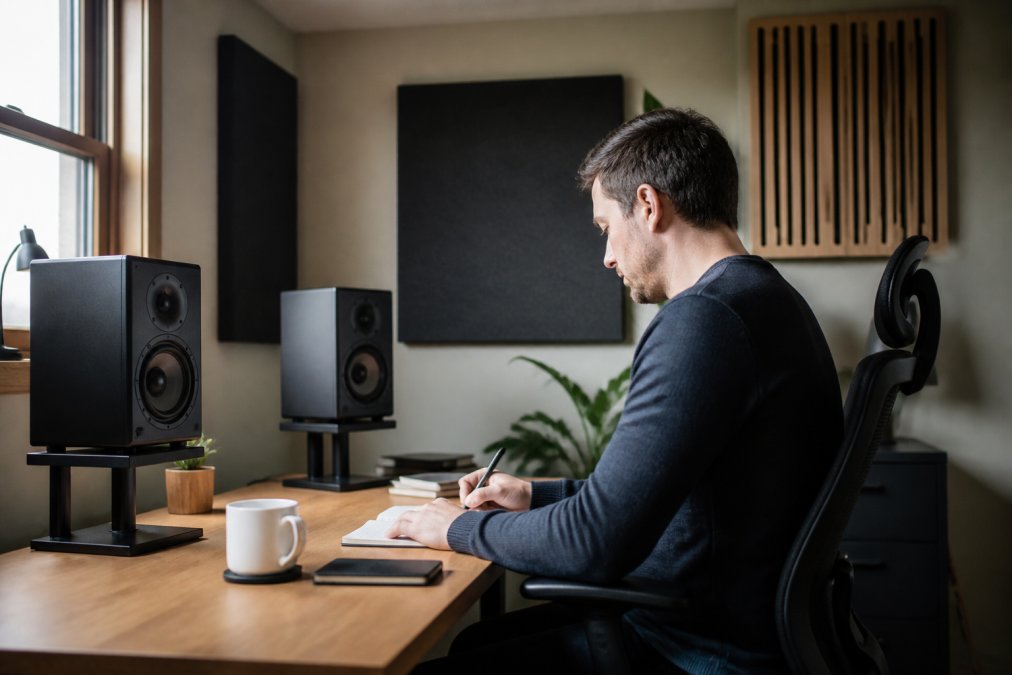
Position speakers symmetrically. The distance from your listening position to each speaker should be equal. Asymmetry degrades soundstage and imaging.
Angle speakers toward your listening position. Speakers should be aimed at your ears, not straight ahead. For near-field listening, speakers are often angled inward at roughly 30 degrees.
Elevate tweeters to ear level. When seated, your ears should be roughly aligned with the tweeter. Speaker stands or wall mounts are essential for achieving correct tweeter height.
Avoid placing speakers in corners. Corner placement excites room modes and creates bass bloom. Placing speakers along a wall, away from corners, typically delivers more balanced bass response.
Keep speakers away from large reflective surfaces. Glass doors, mirrors, and large windows create reflections that degrade soundstage.
Allow adequate space behind speakers. Speakers need air movement behind them, particularly if they're bass-reflex designs. Leave at least 6-12 inches of space behind speakers.
For high performance audio for small rooms, speaker placement is often the first optimization to make. It costs nothing and can deliver dramatic improvements in audio quality.
Common Mistakes When Setting Up Audio in Small Rooms
Understanding what not to do is as important as knowing what to do.
Placing subwoofers in corners is the most frequent error. Corner placement excites room modes maximally, creating boomy, uncontrolled bass. Test placement away from corners before settling on a position.
Ignoring room treatment entirely is another common mistake. A modest speaker in a treated room outperforms an expensive speaker in an untreated room. Acoustic treatment should be a priority, not an afterthought.
Using full-range floor speakers in small rooms creates unnecessary problems. Floorstanding speakers couple to the floor, exciting room modes aggressively. Bookshelf speakers are almost always the better choice.
Setting subwoofer crossover frequencies too high is a subtle but common mistake. A crossover frequency above 100 Hz means your subwoofer is handling frequencies where you can localize its position. Keep crossover frequencies at 80-100 Hz or lower.
Positioning listening position too close to walls creates bass buildup and reflections. Position your listening area at least 2-3 feet away from walls, particularly the wall behind you.
Failing to calibrate speaker levels creates imbalanced stereo imaging. Use a sound level meter to ensure both speakers are producing equal volume at your listening position.
Neglecting speaker cable quality can degrade high performance audio for small rooms. Use adequate gauge (typically 12 AWG or heavier for runs under 8 feet) and ensure good connections.
Treating the entire room instead of focusing on critical points wastes money and effort. Focus on first-reflection points and corners first. This delivers 80% of the benefit at 20% of the cost.
Building high performance audio for small rooms is absolutely achievable. The physics that govern small spaces are well understood, and solutions exist for every common problem. The key is prioritizing room optimization over equipment cost, understanding how speaker placement affects soundstage and imaging, and implementing acoustic treatment strategically.
At Electro Gift Shop, we believe that great audio doesn't require a dedicated listening room or a massive budget. Our curated selection of portable, high-quality audio gadgets, like the Mini Retro White Noise Bluetooth Speaker at $37.99, demonstrates that thoughtful design and genuine performance can coexist. Whether you're optimizing a home office, bedroom, or apartment, the principles in this guide will help you achieve audio quality that rivals systems costing far more. Shop Now and discover how high performance audio for small rooms can transform your daily listening experience.
Frequently Asked Questions
What is the best audio system for a small room?
The best system depends on your space and listening habits. For small rooms, near-field listening setups with compact desktop speakers or high-quality bookshelf speakers positioned close to your listening position deliver excellent results without overwhelming the space. All-in-one streaming systems work well for simplicity, while discrete component setups offer more control over sound. Pair your speakers with acoustic treatment to manage room modes and standing waves, which cause bass buildup in compact spaces. Test before buying when possible to ensure the system matches your room's acoustic characteristics.
How do I improve acoustics in a small room for better audio?
Start with strategic speaker placement away from corners and walls to reduce bass buildup. Add small room acoustic treatment using absorption panels at reflection points, typically the side walls and ceiling. For non-dedicated rooms, use portable acoustic panels or bass traps that don't require permanent installation. Consider digital signal processing (DSP) and room correction software to address frequency response issues. Seal gaps around doors and windows to reduce external noise. The combination of physical treatment and software correction delivers the most dramatic improvement in perceived audio quality.
What are the key specs I should look for in compact desktop speakers?
Focus on frequency response (ideally 50Hz-20kHz for full-range audio), sensitivity (measured in dB at 1 meter), and impedance compatibility. Check total harmonic distortion (THD) ratings, which should be under 1% at normal listening levels. For small rooms, prioritize speakers with good stereo separation and imaging, which create convincing soundstage even at close listening distances. Amplifier power matters less than efficiency in compact spaces. Look for speakers designed for near-field listening, which are optimized for listening distances of 3-6 feet.
Can I use a soundbar instead of discrete speakers in a small room?
Soundbars offer convenience and space-saving benefits, making them practical for small rooms. However, discrete component systems (separate amplifier, speakers, and source) typically deliver superior soundstage, imaging, and dynamic range. Soundbars excel for movies and casual listening but may lack the stereo separation and high-fidelity detail that music lovers prefer. If space is extremely limited and simplicity matters most, a quality soundbar works well. For serious listening, compact bookshelf speakers with a dedicated amplifier provide better performance at comparable prices.
Why do small rooms have so much bass buildup?
Small rooms create acoustic problems called room modes and standing waves, where bass frequencies reflect off walls and combine constructively at certain points, creating boomy, uneven bass response. This happens because room dimensions interact with low frequencies in ways that amplify some notes while canceling others. Bass reflex and sealed enclosure speaker designs both contribute to this effect. Solving it requires a combination of speaker placement (away from corners), acoustic treatment (bass traps), and sometimes digital room correction. Understanding these physics helps you position speakers and treatment more effectively.
Is a subwoofer necessary in a small room?
A subwoofer can improve bass response if your main speakers lack low-frequency extension, but it's not essential for all small-room setups. Compact desktop speakers and quality bookshelf speakers often handle bass adequately for music listening. Subwoofers help most when you want deep bass for movies or electronic music, or when your main speakers roll off below 60Hz. In very small rooms, a single subwoofer can create uneven bass due to room modes. If you add one, use DSP and room correction to integrate it smoothly with your mains and manage room resonances.
What's the difference between near-field listening and traditional stereo setup?
Near-field listening means sitting close to your speakers, typically 3-6 feet away, so direct sound dominates over room reflections. This minimizes the impact of poor room acoustics and standing waves, making it ideal for small rooms. Traditional stereo setups rely on larger listening distances and expect treated rooms to control reflections. Near-field setups use compact desktop speakers optimized for close listening, delivering excellent soundstage and imaging at short distances. This approach suits home offices, bedrooms, and small apartments where dedicated listening rooms aren't possible.
This article was written using GrandRanker