

High Quality Audio for Daily Commute: 2026 Guide
Table of Contents
- Why Commute Audio Deserves Better Than Phone Speakers
- Best Noise Cancelling Headphones for Commuting
- Portable DAC for Mobile Audio: When Your Phone Isn't Enough
- How to Choose Travel Headphones for Your Commute
- Wired vs Wireless: Which Wins for Daily Commute Audio?
- Offline Listening Optimization for Spotty Signal Routes
- Commute Audio Hygiene: Cleaning Gear You Wear Daily
- Hearing Protection for Commuters: Volume Limits That Matter
- Multi-Modal Commute Audio Setup: Train, Bike, Walk
- Frequently Asked Questions
Last Updated: September 17, 2026
Why Commute Audio Deserves Better Than Phone Speakers
The average commuter loses 45 minutes a day to engine drone, rail squeal, and platform announcements. That is nearly four hours a week of listening time squandered on a phone speaker that simply cannot compete with ambient noise. High quality audio for daily commute is not a luxury upgrade; it is the difference between arriving at work drained and arriving with a clear head.
This guide from Electro Gift Shop covers hardware decisions that can change how your commute sounds, from noise cancellation to portable amplification. Below, we explain how to build a setup that works on a packed train, a windy cycle path, and a noisy bus interchange, and we flag common mistakes that can make expensive gear sound cheap.
Best Noise Cancelling Headphones for Commuting
The best noise cancelling headphones for commuting are over-ear models with hybrid active noise cancellation and a transparency mode you can trigger without removing the headphones. Hybrid ANC uses microphones inside and outside the earcup to cancel low-frequency rumble, which is exactly the noise a train or bus produces.
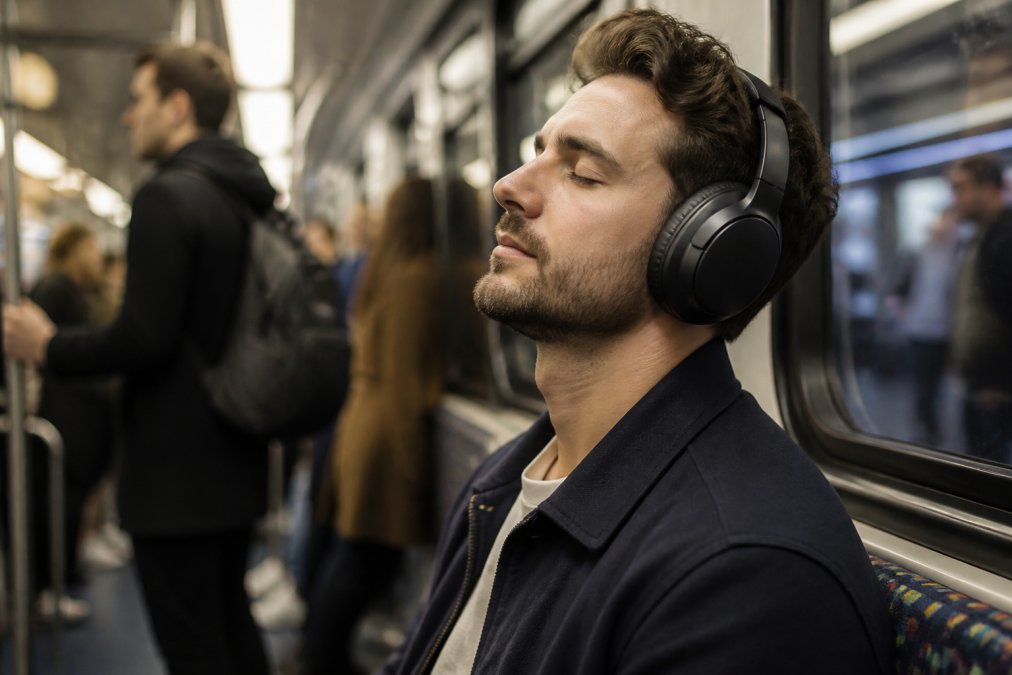
The practical difference between good and mediocre ANC shows up below 500 Hz. That is where engine hum, ventilation, and tyre roar live. Higher-frequency sounds, like a baby crying or a platform announcement, are harder to cancel and are better handled by a strong ear tip seal or a well-padded earcup.
How ANC Handles Train, Bus, and Plane Noise
Train interiors generate a steady low-frequency rumble that hybrid ANC handles well. Bus noise is more variable, with rattles and door hydraulics that sit higher in the frequency range, so isolation quality matters as much as the electronics. Plane cabins combine constant engine drone with a pressure sensation that no headphone can remove entirely.
A useful reference point is the CDC guidance on noise-induced hearing loss, which explains how sustained exposure to low-frequency noise affects hearing over time. That is the real argument for ANC: it lets you listen at lower volume because the background noise is already reduced.
Portable DAC for Mobile Audio: When Your Phone Isn't Enough
A portable DAC for mobile audio is worth buying when your headphones need more power than a phone's built-in amplifier can deliver, or when your phone has no headphone jack at all. Most modern phones output enough volume for efficient earbuds but struggle with high-impedance over-ear headphones.
The telltale sign you need one: you push the volume to maximum and the sound turns thin and flat rather than loud. A dedicated digital-to-analog converter restores dynamic range and gives you cleaner amplification. Look for a unit that supports your phone's connection standard and, ideally, lossless audio playback.
How to Choose Travel Headphones for Your Commute
How to choose travel headphones comes down to three variables: fit, battery life, and Bluetooth codec support. Get these right and the rest of the specification sheet matters far less than marketing suggests. The sections below explain the mechanisms behind each variable so you can read a spec sheet like a commuter rather than a shopper.

Fit, Battery, and Bluetooth Codecs Explained Simply
Ergonomic fit determines whether you can wear headphones for a full commute without pressure headaches. Over-ear models distribute weight across the skull; in-ear models rely on an ear tip seal that blocks ambient noise passively. Clamp force is the number that matters most on over-ears: too light and the seal breaks when you turn your head, too heavy and you feel it after 20 minutes. A common pattern is that commuters who wear glasses need a slightly lighter clamp or a deeper earcup, because the arm of the frame creates a leak that undermines both comfort and bass response.
Battery longevity should cover at least two full commutes plus a buffer. Charging speed matters more than raw capacity if you routinely forget to plug in overnight. A useful rule of thumb: a 10-minute quick charge should give you roughly 4-5 hours of playback on most current ANC models, which is enough to cover a forgotten charge on the way out the door. If your commute is longer than 90 minutes each way, prioritize total playtime over charge speed, because you will be running the battery down faster than any quick top-up can replace.
Bluetooth codecs govern how much audio data travels between your phone and headphones. Standard codecs compress more aggressively; higher-bitrate codecs preserve more detail but drain battery faster and require both devices to support them. The practical hierarchy most listeners encounter is SBC (the baseline, always available), AAC (better on Apple devices), and LDAC or aptX Adaptive (higher bitrate on Android and select players). The catch is that a high-bitrate codec only helps if the source file is high quality to begin with, streaming a 256 kbps file over LDAC does not create detail that was never there.
Isolation is the fourth variable that ties the others together. Passive isolation comes from the ear tip seal or earcup padding; active isolation comes from ANC. On a noisy train, the two work together: a good seal lets the ANC focus on low-frequency rumble rather than fighting higher-frequency noise it cannot cancel. This is why a well-fitting $80 earbud can sometimes sound quieter than a poorly fitting $300 over-ear on the same route.
| Priority | What to Check | Why It Matters |
|---|---|---|
| Fit | Clamp force, earcup padding, glasses compatibility | Prevents listening fatigue and seal leaks on long rides |
| Battery | Playtime, quick-charge rate, charge time | Avoids mid-commute shutdowns; quick charge covers forgetfulness |
| Codec | Device compatibility (SBC, AAC, LDAC, aptX) | Determines audio fidelity ceiling, but only if source quality matches |
| Isolation | Ear tip seal or ANC type | Cuts ambient noise at the source so you can listen at lower volume |
A final decision shortcut: if you commute mostly on one mode (train or car), prioritize ANC and battery. If you commute across modes (walk, train, bike), prioritize fit stability and a transparency mode you can trigger with one hand. The gear that wins on a single-mode commute is rarely the gear that wins on a multi-modal one.
Wired vs Wireless: Which Wins for Daily Commute Audio?
Wired wins on audio fidelity and latency; wireless wins on convenience and freedom of movement. For daily commute audio, the honest answer is that wireless has closed most of the gap, and the cable is now a specialist choice rather than a default.
Wired connections avoid Bluetooth compression entirely, which matters if you listen to lossless audio or watch video where latency causes lip-sync problems. Wireless models with multipoint connectivity let you switch between a laptop and phone without repairing, which is a genuine quality-of-life improvement on a mixed commute.
Offline Listening Optimization for Spotty Signal Routes
Offline playback is the single most reliable upgrade for anyone whose commute passes through tunnels, rural stretches, or underground sections. Streaming quality collapses the moment signal drops, and buffering gaps are more disruptive than a slightly lower bitrate. Most guides stop at "download your music", this section goes further, because offline listening for high quality audio for daily commute is a storage and format problem, not just a download button.
Why Streaming Fails on Commutes (and What to Do Instead)
Streaming services adapt bitrate to signal strength. On a strong connection you might get 256-320 kbps; in a tunnel, the service either buffers or drops to a much lower bitrate to keep playing. That drop is audible on detailed music and on spoken-word content where consonants smear. The fix is to download at the highest quality your service and storage allow, then force the app into offline mode for the duration of the commute so it never attempts to re-buffer.
Most major services let you set download quality separately from streaming quality. Set downloads to the highest tier (often labeled "Very High" or "Lossless"), and set streaming to a lower tier to save mobile data. This gives you full fidelity on the train and low data use everywhere else.
Mini Retro White Noise Bluetooth Speaker →
Storage Math: How Much Space Hi-Res Audio Actually Takes
Hi-res and lossless files are large. A useful planning estimate:
- A standard 3-4 minute song at 256 kbps takes roughly 5-8 MB.
- The same song at CD quality (16-bit/44.1 kHz lossless) takes roughly 30-40 MB.
- The same song at 24-bit/96 kHz hi-res takes roughly 80-120 MB.
That means a 10-hour commute playlist, roughly 150 songs, can consume about 1 GB at standard quality, 5-6 GB at CD quality, or 12-18 GB at hi-res. If your phone has 128 GB of storage and you also carry photos and apps, hi-res offline libraries fill up fast. A practical approach is to keep a rotating offline library of 20-30 albums at hi-res for focused listening, and a larger library at standard quality for background listening.
A Workflow for Tunnels, Trains, and Dead Zones
- Download before you leave. Set the app to download over Wi-Fi only, so you do not burn mobile data. Queue new albums the night before.
- Force offline mode. Most apps have an offline toggle. Turn it on when you enter the station so the app does not waste battery hunting for signal.
- Match codec to content. For critical listening on hi-res files, use a wired connection or a high-bitrate codec like LDAC or aptX Adaptive. For podcasts and audiobooks, standard codecs are fine and save battery.
- Keep a local backup. If your phone storage is tight, a small USB-C drive or a player with a microSD slot lets you carry a larger offline library without filling your phone.
Offline Listening for Audiobooks and Podcasts
Spoken-word content has different priorities. Audiobooks and podcasts are usually encoded at lower bitrates (64-128 kbps) because speech does not need the same frequency range as music. That means a 10-hour audiobook might take only 300-500 MB even at high quality. Download entire series before a long commute rather than individual episodes, and check whether your app supports variable speed playback offline, it is one of the most useful commute features and it works without a signal.
One more gap most guides miss: if your commute crosses a border or enters a region with different licensing, some streaming catalogs change or become unavailable. Offline downloads are not subject to those regional shifts once they are on your device, which makes them the most reliable way to keep a consistent listening library across a multi-modal or cross-border commute.
Commute Audio Hygiene: Cleaning Gear You Wear Daily
Commute audio hygiene is the maintenance routine most listeners skip, and it is the fastest way to shorten the life of gear you wear every day. Ear tips, earcup cushions, and headband fabric collect sweat, skin oils, and earwax, all of which degrade both sound and comfort.
Wipe earcups with a dry microfibre cloth after each use. Remove silicone ear tips weekly and wash them in warm soapy water, then let them air dry completely before refitting. For fabric-based gear, follow the manufacturer's cleaning instructions rather than improvising.
A practical option for commuters who want something soft against the skin is the Bluetooth Sleep Headband - Wireless Headphones, Built-In Speakers, Comfortable Fabric, 10-Hour Battery Life. The sweat-wicking fabric is designed for extended wear, and the built-in HD stereo speakers sit flat against the ear rather than pressing into it. At $8.99, it is an inexpensive way to test whether a fabric-based fit suits your commute before investing in pricier over-ear gear.
Hearing Protection for Commuters: Volume Limits That Matter
Hearing protection for commuters starts with a simple rule: keep volume below 60% of maximum and take a break every 60 minutes. Commuters who crank volume to overcome train noise are the group most at risk, because the noise floor pushes them higher without them noticing.
The World Health Organization guidance on safe listening recommends a weekly sound allowance rather than a simple volume cap, since duration and intensity combine. ANC helps here more than any single setting, because it lowers the noise floor so you can listen quietly.
Multi-Modal Commute Audio Setup: Train, Bike, Walk
Multi-modal commuting breaks most single-purpose audio setups. A train leg rewards isolation; a bike leg demands ambient awareness; a walking leg needs stability and quick controls. One pair of headphones rarely handles all three well.
For the bike leg, ambient awareness is non-negotiable. Transparency mode or open-ear designs let traffic noise through, and haptic controls let you change tracks without looking down. For the train leg, switch to full ANC. For walking, prioritize a secure ergonomic fit and compact design so the gear disappears into a pocket.
The Mini Retro White Noise Bluetooth Speaker fits the walking and waiting portions of a commute rather than the ride itself. Its 360-degree surround sound and Bluetooth 5.0 connection make it useful at a platform cafe or a desk, and the built-in nature sounds are a genuine option for blocking out open-plan office noise. It measures 5.6 x 6 x 2.64 inches, runs 4-6 hours on a 1500mAh battery, and recharges in 2-3 hours via USB. At $37.99, it covers the parts of the day your headphones do not.

| Commute Leg | Priority | Recommended Setup |
|---|---|---|
| Train or bus | Noise isolation | Over-ear ANC headphones |
| Bike | Ambient awareness | Transparency mode or open-ear |
| Walk | Stability and portability | Compact earbuds or fabric headband |
What most guides miss is that your commute is not one listening environment. Treating it as one is why so many people buy a single expensive pair and end up disappointed on two legs out of three.
Your commute is the most consistent listening window you have, and it deserves gear matched to each leg of the journey rather than one compromise purchase. Electro Gift Shop stocks portable, retro-styled audio gear built for exactly this kind of daily use, from the compact Mini Retro White Noise Bluetooth Speaker to the fabric Bluetooth Sleep Headband with its 10-hour battery and sweat-wicking design. Both are lightweight, easy to carry, and designed to offer quality sound. Shop now at Electro Gift Shop and make every commute sound better.
Frequently Asked Questions
How does active noise cancellation improve the commuting experience?
Active noise cancellation (ANC) uses microphones to sample ambient noise and generates inverse sound waves to cancel it out. On a train or bus, this cuts engine rumble and chatter so you hear music at lower volumes. Lower volume means less listening fatigue and better long-term hearing protection. ANC also improves perceived audio fidelity because your music isn't competing with background noise, letting details and dynamic range come through clearly.
Should I choose wired or wireless headphones for my daily commute?
Wireless earbuds and over-ear headphones win on convenience: no tangled cables, easy pairing, and multipoint connectivity lets you switch between phone and laptop. Wired still has advantages for commute audio: zero latency, no battery anxiety, and often better soundstage at the same price. If you use a portable DAC for mobile audio, wired is the only option. Many commuters carry both: wireless for the walk, wired for focused listening on longer train rides.
What are the best audio formats for high-quality mobile listening?
For most commuters, a good Bluetooth codec (like LDAC or aptX Adaptive) paired with a solid streaming tier delivers excellent results. If you want true hi-res audio, download lossless files locally and play them through a portable DAC. Offline playback also solves the problem of spotty signal in tunnels and underground sections. The format matters less than the chain: source file, codec, and ear tip seal together determine what you actually hear.
How can I improve my audio quality without upgrading my device?
Start with ear tip seal. A proper seal improves ambient noise isolation and bass response more than any software tweak. Next, check your streaming quality settings. Many apps default to lower bitrates; switching to the highest available tier is free. Then try a portable DAC for mobile audio if your phone's headphone output sounds thin. Finally, clean your ear tips and headband regularly. Wax buildup and fabric oils degrade sound and comfort over time.