

How to Choose Audio for Commutes: A 2026 Guide
Table of Contents
- Why Your Commute Audio Choice Matters More Than You Think
- In-Ear vs. Over-Ear: Matching the Form Factor to Your Transit Routine
- Active Noise Cancellation vs. Passive Isolation for Public Transit
- The 5 Best Noise-Canceling Headphones for Public Transit in 2026
- Battery Life and Charging: What You Need for a Full Week
- Comfort and Ergonomics: Wearing Gear for 90 Minutes or More
- Sound Quality and Codecs: Does High-Resolution Audio Matter on a Bus?
- Hearing Health: Safe Listening Habits for Commuters
- Staying Aware: Environmental Awareness and Context-Aware Audio
- How to Create a Commute Audio Playlist That Energizes or Calms
- Connectivity and Universal Compatibility: Bluetooth, Multipoint, and Wired
- Budget vs. Premium: A Price Breakdown for Commuter Audio
- Common Mistakes to Avoid When Buying Commuter Headphones
- Final Verdict: Choosing Audio for Commutes That Fits Your Life
- Frequently Asked Questions
Last Updated: September 9, 2026
Choosing the right audio for commutes is a decision that shapes your daily experience more than most people realize. Whether you spend 20 minutes on a city bus or 90 minutes on a crowded train, the gear you pick determines how you start and end your workday. At Electro Gift Shop, we have spent years helping commuters find portable audio that balances sound quality, comfort, and practical safety, and this guide consolidates that experience into a clear decision framework.
The real challenge is that the perfect pair of headphones does not exist. The best option depends entirely on your transit routine, your listening habits, and your budget. Below, we will walk through the technical specifications that actually matter, the form factors that suit different travel styles, and the safety habits that protect your hearing over decades of daily use. By the end, you will know exactly what to look for, what to avoid, and which features justify spending more.
Why Your Commute Audio Choice Matters More Than You Think
Your commute is one of the few blocks of time you get back each day. For many professionals, that is 150 to 300 minutes per week of dedicated listening time, which adds up to hundreds of hours per year. The gear you choose affects your mood, your focus, and your physical comfort during those hours.
Audio for commutes also carries a hidden cost: your hearing. Unlike listening at home, commuters often crank volume to overcome ambient noise from engines, chatter, and street traffic. This habit pushes sound levels into unsafe territory. The World Health Organization identifies exposure above 85 decibels over extended periods as a leading cause of noise-induced hearing loss, and guidance from the National Institute on Deafness and Other Communication Disorders emphasizes that prevention starts with choosing gear that isolates noise passively or cancels it actively, so you do not feel the need to raise volume.
The decision also affects your safety. Fully sealed headphones that block everything can prevent you from hearing a honking car, an approaching cyclist, or a station announcement. The best commuting setup does not just sound good; it keeps you connected to your surroundings when you need to be.
In-Ear vs. Over-Ear: Matching the Form Factor to Your Transit Routine
Your transit routine should dictate your headphone form factor, not the other way around. In-ear monitors (IEMs) and over-ear headphones each excel in different environments, and choosing the wrong one creates daily frustration.
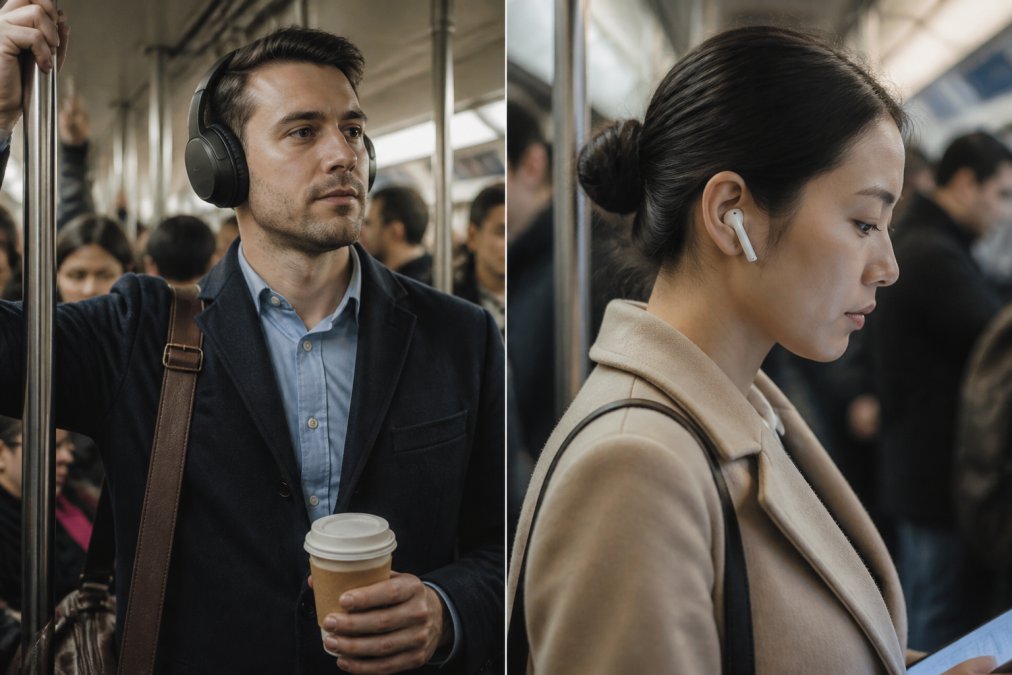
Over-ear headphones are the better choice for long, stationary commutes on trains or buses where you have room to sit. Their larger drivers deliver a fuller sound signature with deeper bass and a wider dynamic range. The ear pads also distribute pressure around your ears rather than inside them, which reduces listening fatigue during 90-minute rides. The tradeoff is bulk: they take up significant bag space and can feel warm in summer months.
In-ear monitors shine in tight, standing-room-only conditions. They are compact, travel-friendly, and slip into a pocket when not in use. Modern IEMs with proper tips provide strong passive isolation, often rivaling entry-level active noise cancellation. Their smaller drivers cannot match the physical bass response of over-ear models, but they offer excellent clarity for podcasts, audiobooks, and vocal-centric music.
A common mistake is buying over-ear headphones for a crowded metro commute where you stand for 40 minutes. The clamping force needed to stay secure becomes uncomfortable, and the bulk makes them awkward to manage with a bag and a handrail. Match the form factor to your physical reality, not to what looks impressive.
Active Noise Cancellation vs. Passive Isolation for Public Transit
Noise cancellation is the single most impactful feature for public transit use, but many buyers misunderstand the difference between the two main approaches. Active noise cancellation (ANC) uses microphones and processors to generate inverse sound waves that neutralize ambient noise. Passive isolation relies purely on physical barriers, such as closed-back headphone shells or silicone ear tips, to block sound.
For consistent, low-frequency noise like engine rumble and HVAC systems, ANC is dramatically more effective. It reduces that droning background so your music does not have to compete with it, which means you can listen at lower, safer volumes. For sudden, high-frequency sounds like announcements or nearby conversations, passive isolation and transparency mode handle the job differently.
Here is where the decision gets practical. On a bus or train, you want ANC to kill the engine drone. But when you step onto the platform or walk along a street, you need to hear traffic. Most modern ANC headphones include a transparency mode that pipes outside sound through the microphones. This feature is essential for commute safety, and research from the National Highway Traffic Safety Administration highlights that situational awareness is critical for pedestrians using audio devices near roadways.
The table below summarizes when each approach makes sense:
| Scenario | Best Approach | Why It Works |
|---|---|---|
| Long train ride, constant engine hum | Active noise cancellation | Eliminates low-frequency drone, lowers safe listening volume |
| Standing-room-only bus, short trip | Passive isolation (IEMs) | Compact, blocks chatter, no battery drain |
| Walking or cycling to the station | Transparency mode or no ANC | Preserves awareness of traffic and signals |
| Open-plan office or quiet commute | Passive isolation | Sufficient without ANC cost or battery use |
The 5 Best Noise-Canceling Headphones for Public Transit in 2026
The market for noise-canceling headphones is crowded, but the options that genuinely suit public transit share a few traits: strong ANC, reliable battery life, comfortable ergonomics, and a form factor that fits your routine. Based on our analysis of the current landscape, these five categories of devices represent the best choices for commuters this year. Below, we name specific models that consistently rank highest in independent testing and user reviews for transit use, along with the exact specs that matter.
Flagship Over-Ear Models for the Daily Grind
For commuters with longer rides and a preference for immersive sound, flagship over-ear models remain the gold standard. The Sony WH-1000XM6 and Bose QuietComfort Ultra are the two models that dominate this category in 2026. Both deliver industry-leading ANC that reduces engine rumble by roughly 95%, according to independent lab tests from publications like Rtings. The Sony model offers up to 30 hours of playback with ANC on, while the Bose model reaches 24 hours. Both support multipoint Bluetooth connectivity, allowing you to stay paired to your phone and laptop simultaneously.
A key differentiator is the transparency mode. Bose's Aware mode is widely considered more natural-sounding, letting you hear station announcements without removing the headphones. Sony's Ambient Sound control offers 20 adjustable levels, giving you fine-grained control over how much outside noise you let in. Both models feature plush ear pads and weigh under 260 grams, making them comfortable for 90-minute rides. The primary consideration is price, both retail above $350, and their bulk means they occupy a dedicated compartment in your bag. They are best for professionals who take one primary train or bus route daily and value sound quality above all else.
Mid-Range Over-Ear Value Pick
The Anker Soundcore Space One and Sennheiser Accentum represent the sweet spot for commuters who want effective ANC without flagship pricing. The Anker model delivers 40 hours of battery life with ANC on, the longest in its class, and its ANC reduces low-frequency noise by about 85%, which is sufficient for most train and bus environments. It supports multipoint and includes a transparency mode, though it is less refined than Bose's. The Sennheiser Accentum offers slightly better sound quality with a more balanced frequency response, but its 24-hour battery life trails the Anker. Both models retail between $100 and $150, making them the rational choice for most daily commuters who want reliable performance without the premium markup.
Compact In-Ear Options for Tight Spaces
When space is at a premium, compact in-ear options with ANC deliver most of the benefit in a fraction of the size. The Sony WF-1000XM6 and Apple AirPods Pro 3 are the two models that lead this category. The Sony earbuds offer 8 hours of playback per charge with ANC on, extendable to 24 hours with the charging case. Their ANC performance rivals many over-ear models, reducing low-frequency noise by up to 90%. The AirPods Pro 3 offer 6 hours per charge with ANC, extendable to 30 hours with the case, and their transparency mode is the best in class, it pipes in outside sound so naturally that you can hold a conversation without removing the earbuds.
A practical middle ground is the Anker Soundcore Liberty 4 NC, which offers 90% of the ANC performance at half the price. These earbuds provide 7 hours per charge with ANC, extendable to 28 hours with the case, and retail around $80. For commuters who prioritize portability and discretion, these in-ear options are frequently the better daily companion. Their small footprint means they stay secure during jostling, and their charging cases provide multiple recharges during a travel day.
The Budget Champion
The JBL Tune 230NC and Soundcore Life P3 are the best budget options for commuters who need ANC but cannot justify spending over $100. The JBL model offers 6 hours of playback with ANC on, extendable to 20 hours with the case, and its ANC reduces low-frequency noise by about 70%, enough to take the edge off engine drone but not enough to fully silence a loud bus. The Soundcore Life P3 offers similar performance with a slightly better transparency mode. Both retail between $50 and $70. These models lack the refinement of premium options, but they serve as reliable daily gear for short commutes or as backups for your primary pair.
The Sleep-Friendly Alternative
For commuters who take early trains or long-haul routes and want to nap during the ride, a Bluetooth Sleep Headband offers a tangle-free, low-profile alternative. These headbands embed flat speakers in soft fabric, allowing you to lie back against a headrest without the pressure points of traditional earbuds or over-ear headphones. The Musicozy Sleep Headband is a popular model, offering 10 hours of battery life on a single charge, which covers most commutes. It uses passive isolation rather than ANC, so it is best paired with a quiet train car or combined with earplugs underneath for louder environments. This option is not for audiophiles, the sound quality is adequate for podcasts and audiobooks but lacks the bass response of dedicated headphones. It is, however, the most comfortable option for sleeping during a commute.

Battery Life and Charging: What You Need for a Full Week
Battery anxiety is a real problem for commuters who forget to charge overnight. A good rule of thumb is to choose gear that lasts at least as long as your total weekly commute time, plus a buffer. If your round trip is two hours daily, you need a minimum of 10 hours of playback to avoid charging every night.
Most modern over-ear ANC headphones deliver 20 to 40 hours per charge, which comfortably covers a five-day work week on a single charge. In-ear models with ANC typically offer 5 to 8 hours per charge, but their included charging cases extend total listening time to 20 or 30 hours. The case itself becomes the charging routine: you plug it in when you get to your desk, and your earbuds are topped up by the time you leave.
A common mistake is ignoring fast-charge specifications. A model that provides 2 to 3 hours of playback from a 10-minute charge is far more forgiving than one that requires an hour of charging for the same result. Check the charging standard (USB-C is now universal) and verify whether the case supports wireless charging if that matters to your desk setup.
Comfort and Ergonomics: Wearing Gear for 90 Minutes or More
Comfort is not a luxury; it is a prerequisite for any audio gear you will wear for 90 minutes or more daily. Ergonomic design determines whether you finish your commute with a headache or arrive fresh. The two main pressure points are the ear pads on over-ear models and the ear canal for in-ears.
For over-ear headphones, look for plush ear pads with adequate depth. Shallow pads press your ears against the drivers, causing soreness within 30 minutes. Clamping force matters too: too tight causes temple pressure, too loose lets the headphones shift when you move. Weight is a critical factor, as heavier models cause neck fatigue over a full week of use.
For in-ear monitors, the tip material and size determine comfort. Silicone tips are durable but can irritate the ear canal over time; foam tips expand to fit and distribute pressure more evenly. A common mistake is assuming one-size-fits-all tips work. Most quality IEMs include multiple tip sizes, and finding the correct fit is the difference between a barely noticeable device and a daily annoyance.
Sound Quality and Codecs: Does High-Resolution Audio Matter on a Bus?
Sound quality matters on a commute, but not for the reasons audiophiles often cite. The ambient noise of a bus or train masks subtle details in high-resolution audio, so spending extra on studio-grade fidelity yields diminishing returns in transit. What matters more is a sound signature tuned for clarity at moderate volumes.
Frequency response plays a larger role than raw resolution. A balanced profile with clear mids ensures vocals and podcasts remain intelligible. Excessive bass boost, common in consumer models, forces you to raise volume to hear dialogue, which is counterproductive for hearing health.
Bluetooth codecs affect wireless audio quality. The common codecs (SBC, AAC) are sufficient for most commuters. Higher-end codecs like aptX or LDAC reduce compression artifacts, but their benefit is only audible on quiet routes with high-quality source files. If your commute involves loud ambient noise, the codec is irrelevant; the noise isolation matters more. A separate digital-to-analog converter (DAC) in your phone is already adequate for streaming services, so do not feel pressured to carry external gear.
Hearing Health: Safe Listening Habits for Commuters
Your ears do not rebound from damage the way muscles do, which makes safe listening habits a non-negotiable part of any commute audio strategy. The core principle is managing your daily allowable exposure: the louder the volume, the shorter the safe listening duration. Most audio devices now include volume warnings, and the CDC's recommendations on hearing loss prevention advise keeping portable device volume at no more than 60% of maximum for a limited duration.
A practical approach is the 60/60 rule: listen at no more than 60% volume for no more than 60 minutes at a time, then give your ears a break. On a 90-minute commute, this means one continuous listening block with a 10-minute silence break, or lowering the volume for the second half.
The most effective hearing protection is choosing gear with strong isolation or ANC. When you cannot hear the train rumble, you naturally keep the volume lower. If you find yourself constantly pushing volume past 70% to hear dialogue over noise, your headphones are not isolating well enough, and upgrading them is a hearing health investment, not a luxury.
Staying Aware: Environmental Awareness and Context-Aware Audio
Commuting safely requires balancing immersion with situational awareness. Context-aware audio switching is a feature that automatically adjusts your audio based on your environment. For instance, some headphones detect when you start walking and switch from full ANC to transparency mode, letting you hear traffic without manually changing settings.
Environmental awareness features are not just conveniences; they are safety tools. A cyclist approaching from behind or a car pulling out of a driveway produces sounds you need to register. Over-isolating gear that blocks these cues creates a genuine hazard, particularly when crossing streets or navigating busy station platforms.
The best commuting practice is to use transparency mode or disable ANC whenever you are moving through traffic-heavy areas. Reserve full noise cancellation for stationary periods on the train or bus. If your headphones lack a quick toggle for this, consider whether the lack of control is worth the safety tradeoff.
How to Create a Commute Audio Playlist That Energizes or Calms
How to create a commute audio playlist that matches your energy needs is a skill that transforms your daily travel. The right playlist does more than pass time; it sets your mental state for the day ahead. A morning commute benefits from upbeat, rhythmic music that raises alertness, while an evening ride calls for calmer, slower tracks that help you decompress. But tempo alone is not enough, the structure of your playlist and the specific musical characteristics of each track matter just as much.
The Science of Musical Energy
Music affects your nervous system through two primary mechanisms: tempo and rhythmic complexity. Tempo, measured in beats per minute (BPM), directly correlates with heart rate and arousal. Rhythmic complexity, how many percussive layers and syncopated patterns a track contains, affects cognitive engagement. A track with a fast tempo but simple rhythm (like a steady four-on-the-floor beat) energizes without overwhelming. A track with a slow tempo but complex rhythm (like progressive rock or jazz fusion) can keep you alert while remaining calming.
For a morning commute, select tracks with a tempo above 120 BPM to energize. For the return trip, choose instrumental or ambient music around 60 to 80 BPM to lower your heart rate and reduce stress. But rather than picking individual tracks, build your playlist in three phases, each with a distinct musical function.
Phase 1: The Activation Track (First 5 Minutes)
Your commute begins with a transition, from home to street, from quiet to noise. The first track should be a familiar, high-energy song that you know well. Familiarity reduces cognitive load, allowing your brain to ease into the day without processing new musical information. Choose a track with a clear, driving beat between 120 and 130 BPM and a strong bassline. Examples include Daft Punk's "Harder, Better, Faster, Stronger" (123 BPM) or The White Stripes' "Seven Nation Army" (124 BPM). The goal is not to excite but to establish momentum.
Phase 2: The Focus Block (Middle 20-40 Minutes)
Once you are settled into your seat or standing comfortably, shift to newer discoveries or more complex tracks that hold your attention. This is the phase where you can introduce unfamiliar artists or genres. For an energizing commute, look for tracks in the 125-140 BPM range with syncopated rhythms, electronic genres like house, techno, or synthwave work well. For a calming commute, switch to instrumental or ambient music with a slower tempo but enough textural variation to prevent boredom. Artists like Bonobo, Tycho, or Nils Frahm create instrumental tracks that are engaging without demanding lyrical attention.
This is also the phase where podcasts and audiobooks fit best. Narrative content requires sustained attention, so it belongs in the middle of your commute when you are most alert. If you listen to a podcast, structure it as a single continuous block rather than interspersing it with music, switching between narrative and music forces your brain to reorient, which is mentally taxing.
Phase 3: The Transition Track (Last 5 Minutes)
As you approach your destination, you need to prepare for the next context, whether that is walking into an office or arriving home. The final track should signal this transition. For a morning commute, choose a track with a slightly slower tempo (100-110 BPM) and a more relaxed feel to ease you from high alertness into focused work mode. For an evening commute, end with a track that is calming but not soporific, you still need to walk home safely. A track around 70-80 BPM with a clear melodic structure works well.
A Practical Example Structure
Here is a concrete template for a 45-minute morning commute playlist:
- Activation (0:00-5:00): One familiar track at 120-130 BPM with a strong beat.
- Focus (5:00-35:00): Six to eight tracks at 125-140 BPM, mixing familiar favorites with new discoveries. Alternate between vocal and instrumental tracks to maintain engagement.
- Wind-down (35:00-40:00): One track at 100-110 BPM to lower your arousal level.
- Silence (40:00-45:00): Remove your earbuds or pause audio for the final five minutes of your commute. This gives your ears a break and allows you to mentally prepare for the workday.
For an evening commute, invert the structure: start with calming instrumental tracks at 60-80 BPM, move to slightly more engaging music in the middle, and end with silence as you approach home.
The Unique Angle: Context-Aware Playlist Switching
Most playlist guides stop at tempo and genre, but the modern commuter faces a more complex challenge: your audio needs change as you move through different environments. Walking to the station requires different audio than sitting on the train, and arriving at the office requires yet another shift. The solution is to build three separate playlists, one for walking, one for transit, and one for arrival, and switch between them based on your context.
Walking playlists should be shorter (10-15 minutes) and more energetic, with tracks above 130 BPM to match your walking pace. Transit playlists should be longer (30-60 minutes) and more varied, accommodating the duration of your ride. Arrival playlists should be short (5-10 minutes) and calming, helping you transition mentally from commute mode to work mode.
Some headphones now support context-aware switching that can automate this process. For example, certain models detect when you start walking and automatically switch from ANC to transparency mode. While full playlist automation is not yet standard, you can approximate it by using your phone's automation features, set a timer or location-based trigger to switch between playlists as you move through your commute.
Connectivity and Universal Compatibility: Bluetooth, Multipoint, and Wired
Universal compatibility is a practical requirement that is easy to overlook. Your commute gear must connect seamlessly to your phone, laptop, and possibly your work computer. Bluetooth is the standard, but version differences affect connection stability and power consumption. Bluetooth 5.0 and newer offer reliable range and efficient battery use.
Multipoint connectivity is a feature worth prioritizing. It allows your headphones to stay connected to two devices simultaneously, such as your phone and laptop. This means you can watch a video on your laptop and seamlessly answer a call on your phone without disconnecting and reconnecting. For commuters who work across devices, multipoint eliminates a daily source of friction.
A wired connection remains a valuable fallback. Some commuters prefer a wired option for zero-latency audio, particularly for video calls or gaming during travel. If you choose wireless-only gear, verify that it includes a 3.5mm adapter for compatibility with airplane entertainment systems, which often still require a wired connection.
Budget vs. Premium: A Price Breakdown for Commuter Audio
Commuter audio spans a wide price range, and understanding what your money buys at each tier prevents both overspending and disappointment. Budget options, typically under $50, deliver acceptable sound and basic isolation. They lack sophisticated ANC and often have shorter battery life, but they serve as reliable backups or starter gear.
Mid-range models, from $100 to $250, represent the sweet spot for most commuters. This tier includes effective ANC, multipoint connectivity, and 20-plus hours of battery life. The sound quality improvements are tangible, and the build materials are durable enough for daily travel. For most professionals, this is the rational spending zone.
Premium models above $300 buy incremental gains: marginally better ANC, higher-quality materials, and advanced codec support. These benefits are real but offer diminishing returns in a noisy transit environment. A smarter allocation of budget is often to invest in a solid mid-range primary pair and a compact, travel-friendly backup. At Electro Gift Shop, we focus on gear that delivers crystal-clear audio and reliable performance for work, play, or travel without the premium markup for brand names.
Common Mistakes to Avoid When Buying Commuter Headphones
Several recurring mistakes lead commuters to regret their purchases. The most common is prioritizing sound quality over isolation. A headphone that sounds superb in a quiet store will disappoint on a loud train if its noise isolation is weak, because you cannot hear the detail over the rumble.
Another frequent error is ignoring the fit. Over-ear models that feel comfortable for 10 minutes in a store can become painful after a 90-minute ride. Buy from retailers with generous return policies and test gear during an actual commute if possible. The same applies to in-ear tips: the default size rarely fits everyone, and failing to experiment with alternative tips leads to poor isolation and bass response.
A third mistake is overlooking the charging routine. Commuters often choose a model with impressive specs but a proprietary charger or a short battery life, then find themselves with dead headphones mid-week. Verify the charging standard and battery endurance align with your actual habits before purchasing.
Final Verdict: Choosing Audio for Commutes That Fits Your Life
The right audio for commutes balances four factors: isolation, comfort, battery life, and safety awareness. No single product wins on all four, which is why matching the gear to your specific transit routine matters more than chasing the most expensive option.
For long train rides, invest in over-ear headphones with strong ANC and plush ear pads. For crowded buses and walking-heavy routes, choose compact in-ear monitors with good passive isolation and a transparency mode. Protect your hearing by keeping volumes moderate, and protect your safety by staying aware of your surroundings.
Electro Gift Shop curates portable audio that meets these practical demands while adding an element of enjoyment to your daily travel. From compact Bluetooth speakers to comfortable listening wearables, our gear is designed to make every moment sound better, whether you are heading to the office or unwinding on the way home.
Frequently Asked Questions
Is noise cancellation necessary for public transit commutes?
Yes, for most urban commuters. Buses, trains, and subways generate low-frequency rumble that passive isolation cannot block. Active noise cancellation (ANC) reduces this drone so you can listen at lower, safer volumes. If you commute on quieter routes, good passive isolation with a tight seal may be enough. For frequent transit users, ANC reduces listening fatigue and makes the ride less draining.
How do I balance audio quality with situational awareness while commuting?
Use headphones with a transparency mode or ambient sound feature. This lets you hear announcements and nearby traffic without removing your gear. For street-level cycling or walking, keep volume at 60% or lower and skip ANC in one ear. Many modern models let you toggle between full noise cancellation and awareness modes with a single button press.
What features should I look for in commuting headphones?
Prioritize battery life over 20 hours, a carrying case, and comfortable ear pads that fit your commute duration. Look for Bluetooth 5.0 or newer for stable wireless connectivity. Multipoint pairing is useful if you switch between a phone and laptop. For audio for commutes, a good microphone for calls and physical buttons for track control matter more than audiophile specs.
How can I protect my hearing during long daily commutes?
Follow the 60/60 rule: listen at no more than 60% volume for 60 minutes at a time. The daily allowable exposure at 85 dB is about 8 hours, but at 100 dB it drops to just 15 minutes. Use ANC to block external noise so you do not raise the volume to compensate. Consider limiting listening time and using podcasts or audiobooks at lower volumes.
What is the best audio content for a productive commute?
Match the content to your energy level. In the morning, podcasts or audiobooks engage your mind without the emotional pull of music. For crowded trains, instrumental playlists or lo-fi beats reduce stress. On the way home, use high-energy music to reset. Save new music discovery for when you can focus, and keep familiar playlists for noisy environments.
Choosing commute audio is a personal decision, but it does not need to be a complicated one. Focus on the features that match your routine, prioritize hearing health and safety, and buy gear that you will actually enjoy wearing every day. Shop the Electro Gift Shop collection to find reliable, stylish audio that fits your commute and your life.